
 Worksheets
Fronts and Weather
Total questions: 29
Worksheet time: 1hrs 12mins

This symbol is used for what type of front?
cold front
occluded front
stationary front
warm front
What happens at a cold front?
A warm air mass and cold air mass meet, but neither moves
Two cold air masses are on either side of a warm air mass
Cold, dense air pushes warm air upwards
Warm air catches up to cold air and slides over it
What type of weather might be expected during a cold front?
Light rain showers that last for a couple of days
Heavy thunderstorms or ice storms followed by cold temperatures
Light rain showers followed by warmer temperatures
Clear dry weather

This symbol is used for what type of front?
cold front
occluded front
stationary front
warm front
What happens at a warm front?
A warm air mass and cold air mass meet, but neither moves
Two cold air masses are on either side of a warm air mass
Cold, dense air pushes warm air upwards
Warm air catches up to cold air and slides over it
What type of weather might be expected during a warm front?
Light rain showers that last for a couple of days
Heavy thunderstorms or ice storms followed by cold temperatures
Light rain showers followed by warmer temperatures
Clear dry weather

This symbol is used for what type of front?
cold front
occluded front
stationary front
warm front
What happens at a stationary front?
A warm air mass and cold air mass meet, but neither moves
Two cold air masses are on either side of a warm air mass
Cold, dense air pushes warm air upwards
Warm air catches up to cold air and slides over it
What type of weather might be expected during a stationary front?
Light rain showers that last for a couple of days
Heavy thunderstorms or ice storms followed by cold temperatures
Light rain showers followed by warmer temperatures
Clear dry weather

This symbol is used for what type of front?
cold front
occluded front
stationary front
warm front
What happens at an occluded front?
A warm air mass and cold air mass meet, but neither moves
Two cold air masses are on either side of a warm air mass
Cold, dense air pushes warm air upwards
Warm air catches up to cold air and slides over it
In science, what is a front?
A front is a boundary where air of different temperature and humidity meet.
A front is an area that is cold and frosty.
A front is an area of smooth, flat land.
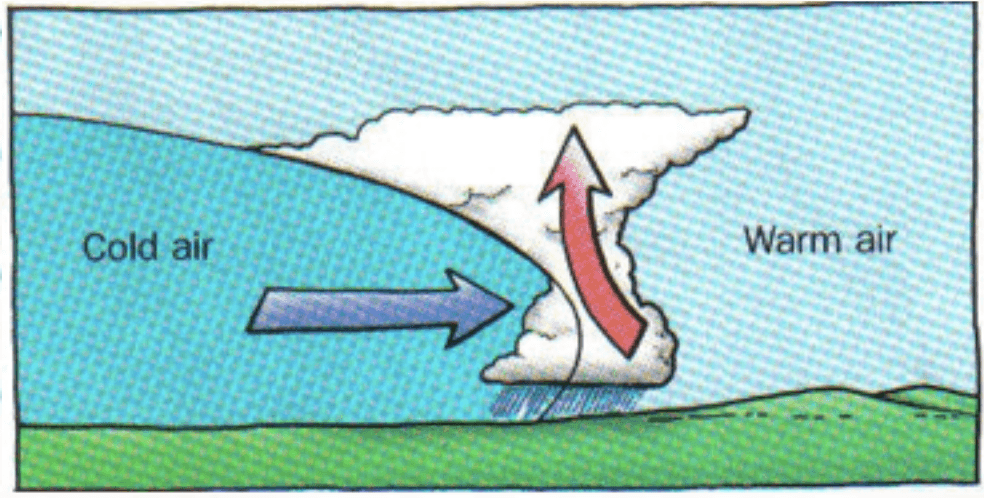
Name that front.
Cold Front
Warm Front
Stationary Front
Occluded Front
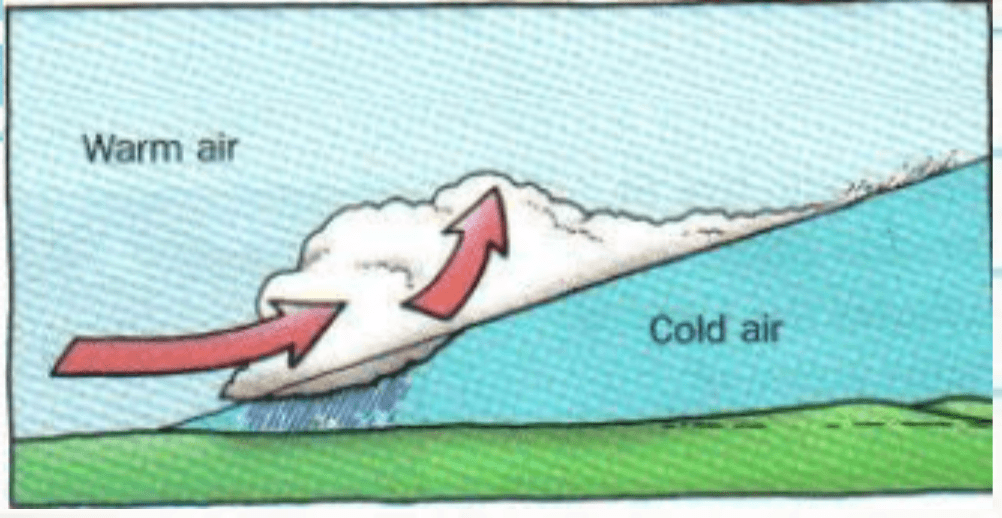
Name that front.
Cold Front
Warm Front
Stationary Front
Occluded Front
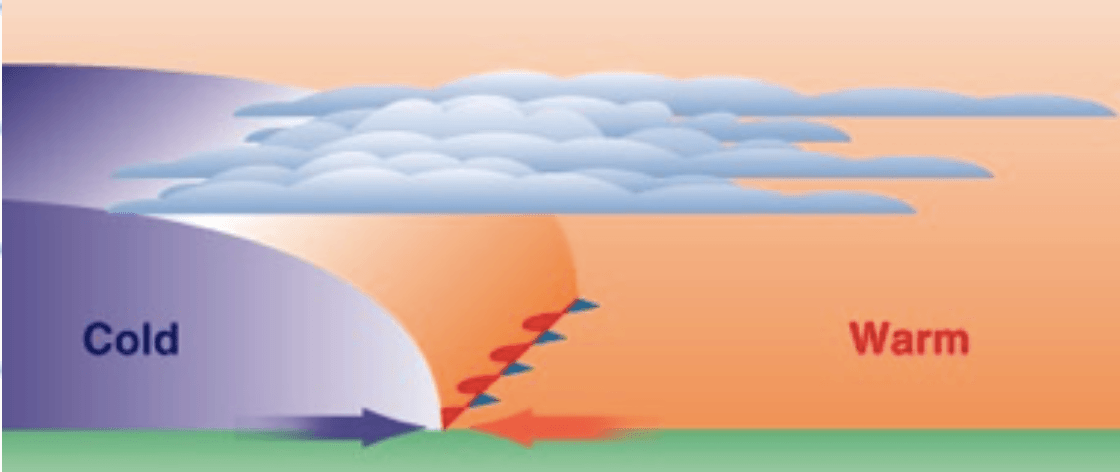
Name that front.
Cold Front
Warm Front
Stationary Front
Occluded Front
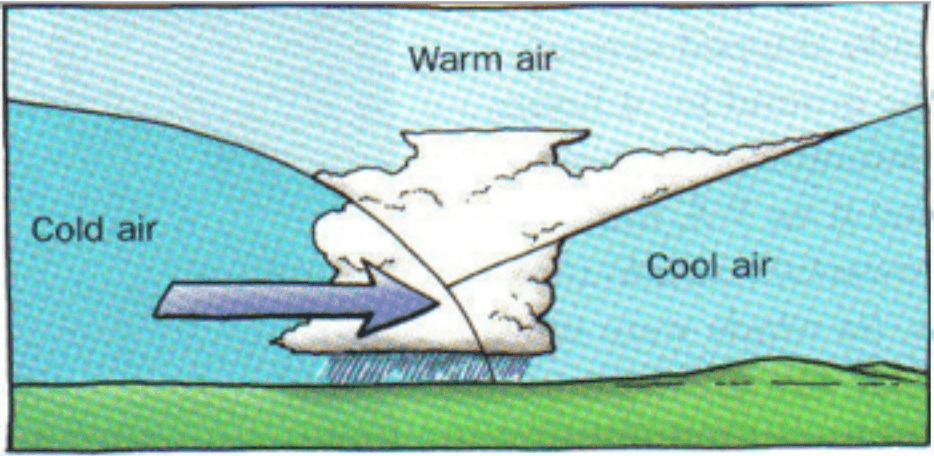
Name that front.
Cold Front
Warm Front
Stationary Front
Occluded Front
What type of weather will you see along a cold front?
Thunderstorms
Sunny skies
Gentle rain
No weather
Relative humidity is defined as:
The amount of water vapor present in air expressed as a percentage of the amount needed for saturation at the same temperature.
The total amount of water vapor in the air at any given time.
The temperature at which water vapor begins to condense into liquid.
The ratio of the air's actual water vapor content compared to its oxygen content.
The dewpoint is an important concept because it indicates:
The highest temperature reached during the day
The temperature at which air must be cooled to become saturated with water vapor
The exact time when precipitation will start
The percentage of humidity in the air
Which of the following factors does NOT affect relative humidity?
Temperature
Air pressure
The amount of water vapor in the air
The color of the sky
What happens when the relative humidity reaches 100%?
It starts to snow regardless of the temperature.
The air cannot hold any more water vapor, leading to condensation and possibly precipitation.
Relative humidity starts to decrease automatically.
It indicates the onset of a drought.
Why does relative humidity change throughout the day?
Because the amount of water vapor in the air changes.
Because the temperature changes, affecting the air's capacity to hold water vapor.
Because the air pressure changes.
Relative humidity does not change throughout the day.
What does it mean if the dewpoint and temperature are the same?
The relative humidity is 50%.
It is likely to rain within the next 24 hours.
The relative humidity is 100%.
The air is extremely dry.
How does the temperature affect the capacity of air to hold water vapor?
Higher temperatures decrease the air's capacity to hold water vapor.
Temperature changes do not affect the air's capacity to hold water vapor.
Lower temperatures increase the air's capacity to hold water vapor.
Higher temperatures increase the air's capacity to hold water vapor.
What is the primary cause of wind?
Differences in air pressure
Rotation of the Earth
Changes in temperature only
Gravitational pull from the moon



