
NEW
Font size
 Worksheets
FY25 SPS8 Remediation Quiz
Total questions: 8
Worksheet time: 4mins

What is the total distance traveled by the object from point K to point L?
10 m
15 m
20 m
25 m
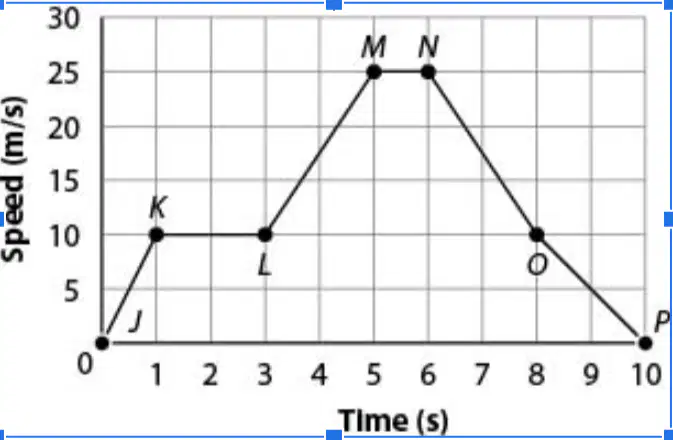
What is the acceleration of the object during the time interval t = 3 seconds to t = 5 seconds?
5.0 m/s²
7.5 m/s²
12.5 m/s²
17.5 m/s²
An object is moving along a straight line at a constant speed of 20 m/s. How far did the object travel during the first 4 seconds?
5 m
20 m
40 m
80 m
Which scenario best demonstrates an example of Newton's first law of motion?
A shopping cart accelerates when it is pushed.
A rocket lifts off from a launch pad.
A car passenger moves forward when a car suddenly stops.
A man pushes a canoe off the shore and into the water.
A girl weighing 400 Newtons is on a dock and exerts a force of 100 Newtons on a sailboat weighing 10,000 Newtons. How much force does the sailboat exert on the girl? (Note: the sailboat nor the girl moves)
25 N
100 N
400 N
10,000 N
Read the passage about Newton's laws. An eighth-grade science teacher wants to demonstrate Newton's laws. She moves the lab tables to the side of the classroom and sets up two rolling office chairs at the back of the room. She places a stack of books that weighs 85 pounds on one chair and another stack of books that weighs 130 pounds on the other chair. The teacher then asks a student to give each chair a push with an equal force. Which evidence and explanation best describe the relationship between acceleration and mass?
Evidence: The chair with the smaller mass experiences a larger acceleration than the chair with the larger mass. Explanation: The acceleration of an object is inversely related to its mass.
Evidence: The chair with the smaller mass experiences a larger acceleration than the chair with the larger mass. Explanation: The acceleration of an object is directly related to its mass.
Evidence: The chair with the smaller mass experiences a smaller acceleration than the chair with the larger mass. Explanation: The acceleration of an object is inversely related to its mass.
Evidence: The chair with the smaller mass experiences a smaller acceleration than the chair with the larger mass. Explanation: The acceleration of an object is directly related to its mass.
Which of the following objects has the greatest inertia?
A 10.0 kg object at rest
A 5.0 kg object moving at 5.0 m/s
A 20.0 kg object at rest
A 15 kg object moving at 1.0 m/s
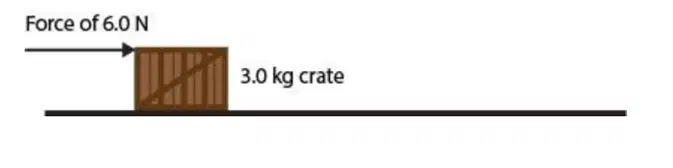
A force of 6.0 N is applied horizontally to a 3.0 kg crate initially at rest on a horizontal frictionless surface. After the crate is pushed for 1.5 seconds, it has a velocity of 3.0 m/s. Does this support Newton's second law of motion, that force equals mass times acceleration? Explain.
Yes, because the acceleration of the crate is 2.0 m/s².
Yes, because the mass and the velocity of the crate are equal.
No, because the acceleration of the crate is 2.0 m/s².
No, because the mass and the velocity of the crate are equal.

