
 Worksheets
Solubility and the Rate of Dissolving
Total questions: 20
Worksheet time: 24mins
Stirring the solution increases the rate of dissolution (rate of dissolving).
True
False
The smaller the particle size the faster the rate of dissolution (rate of dissolving).
True
False
Which will dissolve faster? Crushed table salt or a cube of table salt. Assume they have an equal mass.
crushed table salt
crystal of table salt
What combination would dissolve a solid solute the fastest?
high temperature, no stirring
no heat, no stirring
sugar cube, no heat
high temperature, stirring
Which of the following actions will NOT
increase the rate of dissolution
(dissolving) for solids?
Stirring the solution
Decreasing the temperature
Increasing the surface area of the
solute
Increasing the temperature
Select the 3 properties that affect the rate of dissolving materials
surface area
volume
temperature
texture
stirring
How does cold water affect the speed of dissolving?
Cold water slows down dissolving.
Cold water speeds up dissolving.
Cold water has no effect on dissolving.
Cold water has no effect on dissolving.
John has three cups of sugar particles. Cup 1 has large sugar particles, Cup 2 has medium-sized particles, and Cup 3 has small sugar particles. If John pours each cup in water, which cup of sugar particles will dissolve the fastest?
Cup 1 will dissolve the fastest.
Cup 2 will dissolve the fastest.
Cup 3 will dissolve the fastest.
They will dissolve at the same rate.
Jackson is making dinner and is trying to dissolve salt into a pot of water. The salt is dissolving slowly. What should Jackson do to speed up the rate of dissolving?
He should put larger salt particles in the water.
He should heat the water to a higher temperature.
He should completely stop stirring the pot of water.
He should slow down the speed he is stirring the pot.
What things can be dissolved?
salt
sand
black pepper powder
The sugar cubes are called the
solute
solvent
The water is called the
solvent
solute
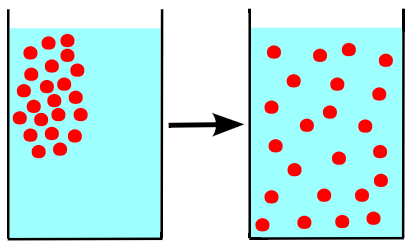
to spread out evenly in a liquid
Evaporation
Dissolve
Magnetic
Solute
change in state of matter from a liquid to a vapor or gas
Magnetic
Condensation
Concentration
Evaporation
material with very tiny holes that blocks solid or larger particles but allows gas, liquid, or small grains to pass through
Filter
Magnet
Tweezers
Beaker
able to be attracted to a magnet
Condensation
Evaporation
Substance
Magnetic
a change to matter in which no new kinds of matter are formed; ex: mixture
Chemical Change
Flammability
Physical change
Substance

