
NEW
Font size
S
M
L
XL
 Worksheets
Moon, Sun and Earth
Total questions: 20
Worksheet time: 13mins
Name
Class
Date
1.

A body that orbits a planet is a...
a)
Meteor
b)
Asteroid
c)
Satellite
d)
Comet
2.
Spinning of Earth on its axis.
a)
Rotation
b)
Revolution
3.
Movement of Earth around the sun.
a)
Rotation
b)
Revolution
4.
Earth has seasons because.....
a)
Its axis is tilted
b)
Revolves around Saturn
c)
The sun revolves around Earth
5.

A force is a ......
a)
Push
b)
Pull
c)
Push or a Pull
6.
What is a satelite?
a)
A body that orbits a planet
b)
an object that orbits a sun
c)
a piece of glass in a space shuttle in earth
7.
What is revolution?
a)
a day were the sun appears farthest north of the equator once each year and farthest south each year
b)
the movement of one object around another
8.
what is rotation?
a)
the spinning of earth on its axis
b)
the imaginary line that passes through earths center.
c)
the movement of one object around another
d)
when the sun goes around earth 4 times
9.
what causes day and night?
a)
rotation
b)
revolution
c)
solstice
d)
equinox
10.
Which of the following is a characteristic of both the Earth and the Moon?
a)
Atmosphere containing oxygen
b)
Rocky surface covered with landforms
c)
Flowing water in oceans and rivers
d)
Fossils and fossil fuels under the surface
11.
What characteristic do the Earth and Moon share that makes them different from the Sun?
a)
Spherical shape
b)
Rotate on an axis
c)
Rocky crust and surface
d)
Found in our Solar System
12.
Among the Earth, Sun, and Moon, what makes the Earth unique? Only the Earth –
a)
can generate energy
b)
lacks an atmosphere
c)
is made mostly of rock
d)
contains water in liquid form
13.
The Sun and the Earth share some similarities, including their –
a)
size
b)
shape
c)
temperature
d)
composition
14.

A student created a diagram to compare the characteristics of the Earth and the Moon.
Which of the following characteristics could be placed in the center part of the diagram?
Which of the following characteristics could be placed in the center part of the diagram?
a)
orbits another object
b)
strong gravitational pull
c)
rotates every 24 hours
d)
has an atmosphere
15.
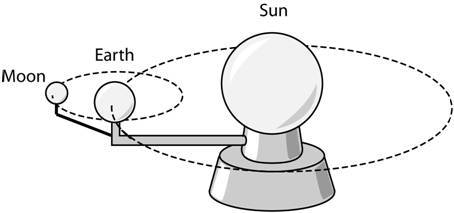
This model can be used to show some relationships between the Earth, Sun, and Moon.
The model shows all of the following EXCEPT –
The model shows all of the following EXCEPT –
a)
the relative sizes of the Moon and Earth
b)
the way the Moon revolves around the Earth
c)
the composition of the Moon, Earth, and Sun
d)
how the Moon and the Earth revolve around the Sun
16.
Of the Earth, Sun, and Moon, which ones orbit another object?
a)
the Sun and the Earth
b)
the Sun and the Moon
c)
the Moon and the Sun
d)
the Moon and the Earth
17.
The moon’s surface has many more craters than the Earth’s. What best explains the difference in the number of craters on the surface of the Moon and the Earth?
a)
The Moon rarely gets impacted by meteorites.
b)
The Earth’s atmosphere protects it from impacts.
c)
The Moon’s gravity attracts more meteorites than Earth's.
d)
The Earth rotates on its axis more quickly than the Moon.
18.
Which of the following lists the Earth, Sun, and Moon in order of size, from largest to smallest?
a)
Earth, Sun, and Moon
b)
Earth, Moon, and Sun
c)
Sun, Earth, and Moon
d)
Sun, Moon, and Earth
19.
Which location on Earth receives the most direct sunlight?
a)
The deserts
b)
The South Pole
c)
The Equator
d)
The Western Hemisphere
20.
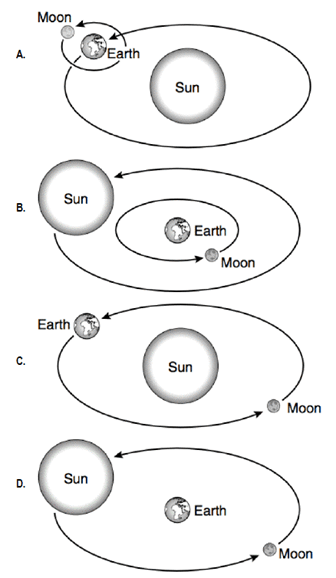
Which of these best shows that the Earth revolves around the sun as the moon revolves around the Earth?
a)
Picture A
b)
Picture B
c)
Picture C
d)
Picture D
Reset

