
NEW
Font size
S
M
L
XL
 Worksheets
Exponential and Logistic Growth
Total questions: 22
Worksheet time: 18mins
Name
Class
Date
1.
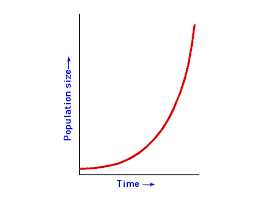
What type of growth is shown in the diagram?
a)
exponential growth
b)
logistic growth
c)
predator-prey cycle
d)
boom-bust curve
2.
Largest number of individuals of a population that the environment can support...
a)
carrying capacity
b)
population crash
c)
lag phase
d)
mutualism
3.
What do you call a period of rapid growth?
a)
exponential growth
b)
logistic growth
c)
emigration
d)
predator-prey cycle
4.

Which type of growth is best illustrated by this rabbit population?
a)
exponential
b)
logistic
c)
S-shaped
d)
predator-prey
5.
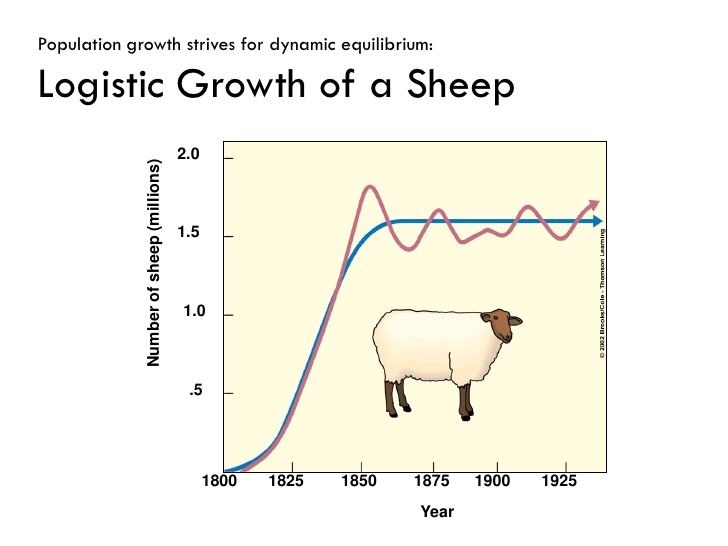
What is the carrying capacity for this sheep population?
a)
1.8 million
b)
1.25 million
c)
1.6 million
d)
1.o million
6.
Type of growth that occurs when disease and parasites are present...
a)
exponential
b)
J-shaped
c)
predator-prey
d)
logistic
7.

What is the carrying capacity of this population?
a)
100
b)
200
c)
300
d)
400
8.
Why has the population been able to grow so quickly in such a short period of time?
a)
Doctors have developed easier and safer ways to have babies
b)
People needed more help to work their farms so they had more children
c)
Because people stayed in one place and only moved when crowded out
d)
Because of medical care, clean water and better access to nutritious food
9.

If a disease destroying barley plants in a field swept through an ecosystem, what would happen to the barley eating bird population in the the field ?
a)
The bird population would stay the same
b)
The bird population would infinitely increase
c)
The bird population would decrease
10.

What point on the graph represents the carrying capacity?
a)
A
b)
B
c)
C
d)
D
11.

Will competition increase/decrease the carrying capacity of an ecosystem for the animal in competition?
a)
Decrease
b)
Increase
12.

When a population grows past the ecosystem's carrying capacity, what happens to the population?
a)
Continues to grow
b)
The population starts to die off to return to carrying capcity
c)
The population will go extinct due to lack of resources
d)
The population grows then finds a new carrying capacity
13.

The largest number of individuals in a species that an environment can support long term
a)
carrying capacity
b)
emigration
c)
immigration
d)
population density
14.

If the carrying capacity of a predator decreases, what will happen to the carrying capacity of the prey?
a)
Will Increase
b)
Will Decrease
c)
Will stay the same
d)
Will fluctuate
15.
Limiting factors are sometimes helpful because they can keep the population from getting to large.
a)
True
b)
False
16.
Which limiting factor would increase due to the number of individuals in a population?
a)
Unusual weather
b)
Natural disaster
c)
Disease
17.
The graph of logistic growth can be described as...
a)
S-shaped
b)
J-shaped
c)
U-shaped
18.
If the number of births in a population is the same as the number of deaths in a population, what will happen to the growth of the population?
a)
It will increase.
b)
It will decrease.
c)
It will stay the same.
d)
It will fluctuate.
19.
If the number of births is greater than the number of deaths in a population, what will happen to the growth of the population?
a)
It will increase.
b)
It will decrease.
c)
It will stay the same.
d)
It will fluctuate.
20.
What growth pattern describes a population whose growth rate slows or stops following a period of exponential growth?
a)
logistic growth
b)
population growth
c)
exponential growth
d)
predator-prey cycle
21.
What type of growth is shown in the diagram?
a)
exponential growth
b)
logistic growth
c)
predator-prey cycle
d)
boom-bust curve
22.

What is the approximate carrying capacity of Paramecium aurelia cultured alone?
a)
150
b)
400
c)
450
d)
500
Reset

