
NEW
Font size
S
M
L
XL
 Worksheets
Equipotential
Total questions: 8
Worksheet time: 16mins
Name
Class
Date
1.
A tiny sphere carrying a charge of 6.5 µC sits in an electric field, at a point where the electric potential is 240 V. What is the sphere’s potential energy?
a)
2.7 x 10⁻⁸ J
b)
6.5 x 10⁻⁶ J
c)
1.6 x 10⁻³ J
d)
240 J
2.
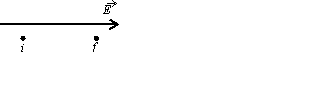
An electron moves from point i to point f, in the direction of a uniform electric field. During this motion:
a)
the work done by the field is positive and the potential energy of the electron-field system increases
b)
the work done by the field is negative and the potential energy of the electron-field system increases
c)
the work done by the field is positive and the potential energy of the electron-field system decreases
d)
the work done by the field is negative and the potential energy of the electron-field system decreases
3.
If 500 J of work are required to carry a 40-C charge from one point to another, the potential difference between these two points is:
a)
12.5 V
b)
20,000 V
c)
0.08 V
d)
depends on the path
4.
The potential difference between two points is 100 V. If a particle with a charge of 2 C is transported from one of these points to the other, the magnitude of the work done is:
a)
200 J
b)
100 J
c)
50 J
d)
2 J
5.
During a lightning discharge, 30 C of charge move through a potential difference of 1.0 ´ 108 V in 2.0 ´ 10–2 s. The energy released by this lightning bolt is:
a)
1.5 ´ 1011 J
b)
3.0 ´ 109 J
c)
6.0 ´ 107 J
d)
3.3 ´ 106 J
6.

An electron goes from one equipotential surface to another along one of the four paths shown below. Rank the paths according to the work done by the electric field, from least to greatest.
a)
1, 2, 3, 4
b)
4, 3, 2, 1
c)
1, then 3, then 4 and 2 tie
d)
4 and 2 tie, then 3, then 1
7.

A particle with mass m and charge –q is projected with speed v0 into the region between two parallel plates as shown. The potential difference between the two plates is V and their separation is d. The change in kinetic energy of the particle as it traverses this region is:
a)
–qV/d
b)
2qV/mv2
c)
qV
d)
1/2 mv2
8.
The Earth’s electric field creates a potential that increases 100 V for every meter of altitude. If an object of charge +4.5 mC and mass 68 g falls a distance of 1.0 m from rest under the influence of the Earth’s electric and gravitational fields, what is its final kinetic energy?
a)
0.22 J
b)
0.45 J
c)
0.67 J
d)
1.1 J
Reset

