
NEW
Font size
S
M
L
XL
 Worksheets
Amplify Unit
Total questions: 27
Worksheet time: 20mins
Name
Class
Date
1.
An organism that makes its own food through photosynthesis is called...
a)
Consumer
b)
Producer
c)
Heterotroph
d)
Decomposer
2.
Organisms that recycle nutrients and feed on dead/decaying plants and animals
a)
Producer
b)
Autotroph
c)
Decomposer
d)
Predator
3.
How much energy is passed from one trophic level to the next?
a)
10%
b)
50%
c)
90%
d)
100%
4.

Which organism in this food chain would have the most energy?
a)
Grass
b)
Grasshopper
c)
Frog
d)
Python
5.
What is photosynthesis?
a)
how fungi obtain energy
b)
The process in which green plants use oxygen to make carbon dioxide
c)
the process in which green plants use carbon dioxide to make oxygen
d)
the process of absorbing energy by touching things
6.
What is the source of all energy?
a)
producers
b)
sun
c)
consumers
d)
decomposers
7.

Which of the following is the best example of a decomposer?
a)
vulture
b)
bacteria
c)
algae
d)
rat
8.
Interconnected food chains are called
a)
food cycles
b)
energy pyramids
c)
trophic levels
d)
food webs
9.
A food chain shows how _____ moves through an ecosystem
a)
matter
b)
food
c)
energy
d)
atoms
10.

This diagram is an
a)
food chain
b)
food web
c)
energy pyramid
d)
energy cycle
11.

One problem with this diagram is
a)
there are no producers
b)
there are no cosumers
c)
energy is increasing as you go up
d)
energy is not changing as you go up
12.

If the plants in this diagram have 37,000 units of energy, how much do the grasshoppers have?
a)
37,000
b)
370
c)
3,700
d)
37
13.
An ecosystem can be described as
a)
the process in which plants convert light into energy
b)
organisms that eat only plants
c)
something that is made up of living and non-living things and their interactions
d)
organisms that make their own food
14.
Humans have no effect on ecosystems.
a)
True
b)
False
15.
What is an invasive species?
a)
A species that was born in a certain area
b)
A species that was brought to America by Mrs. Smyth
c)
A species that is not from an area and causes damage
d)
A species that feeds on Asian Carp
16.
What would happen if one organism in an ecosystem became extinct?
a)
The ecosystem would be stronger and better overall
b)
The ecosystem would not change at all
c)
All of the organisms in the ecosystem would find a new place to live
d)
The ecosystem would change, but most of the animals and plants would survive.
17.
What would most likely happen if an ecosystem no longer received sunlight?
a)
The number of herbivores would increase
b)
The number of plants would increase
c)
all organisms would adapt
d)
All living organisms would eventually die
18.
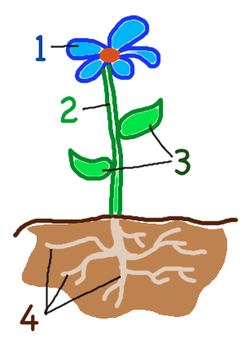
What part of the plant is #4?
a)
leaf
b)
flower
c)
stem
d)
root
19.
If a frog is the prey, what could be the predator?
a)
Grass
b)
Insect
c)
Snake
d)
Snail
20.
What are the 3 main things that plants need to grow?
a)
sunlight, water, soil
b)
sunlight, air, water
c)
sunlight, air, soil
d)
sunlight, soil, nutrients
21.

An organism that needs to eat other organisms to obtain energy is known as a:
a)
Autotroph
b)
Producer
c)
Consumer
d)
Mutualist
22.

Which organism recieves the least amount of energy from the producer?
a)
Owl
b)
Grasshopper
c)
Lilypad
d)
Mouse
23.

Which level will contain plants?
a)
A
b)
B
c)
C
d)
D
24.
Examples of how humans negatively affect local ecosystems are
a)
Building dams, deforestation (cutting down trees), adding point sources to nearby streams to allow for run-off, building roads and structures, and salting roads.
b)
Creating laws to prohibit fishing from local streams.
c)
Planting trees and other plants to attract native species.
d)
Removing non-native species from the environment.
25.
All members of one kind of organism that live in the same area
a)
population
b)
microorganism
c)
communit
d)
organism
26.
Which is an example of a food chain?
a)
grass, rabbit, snake, owl
b)
rabbit, grass, snake, owl
c)
grass, fox, mouse, owl
27.
True or False?
A food chain is several food webs that overlap.
A food chain is several food webs that overlap.
a)
True
b)
False
Reset

