
 Worksheets
Solar System
Total questions: 20
Worksheet time: 11mins
Name
Class
Date
1.
What holds the planets in their orbits around the sun?
a)
gravity
b)
speed
c)
string
d)
air currents
2.
What is in the center of the Heliocentric Model?
a)
Sun
b)
Comet
c)
Jupiter
d)
Earth
3.
In which type of model are the Sun, other planets, and the Moon in orbit around the Earth?
a)
heliocentric model
b)
tetrahedral model
c)
concentric model
d)
geocentric model
4.
An _______ is between the orbits of Mars and Jupiter.
a)
Oort Cloud
b)
Asteroid belt
c)
Kuiper belt
d)
Photosphere
5.
Venus, Mercury, Earth, and Mars are what type of planet?
a)
Gas Giants
b)
Ice Giants
c)
Terrestrial Planets
d)
Exterior Planets
6.
Which choice shows the correct order of the planets?
a)
Mars, Venus, Earth, Mercury, Jupiter, Saturn, Uranus, Neptune
b)
Earth, Venus, Mars, Mercury, Jupiter, Saturn, Uranus, Pluto
c)
Mercury, Venus, Earth, Mars, Jupiter, Saturn, Uranus, Neptune
d)
Saturn, Venus, Mars, Mercury, Jupiter, Neptune Mercury, Uranus
7.

What planet is it?
a)
Jupiter
b)
Saturn
c)
Uranus
d)
Venus
8.
Jupiter, Saturn, Uranus, and Neptune are what type of planets?
a)
Gas Giants
b)
Ice Giants
c)
Terrestrial Planets
d)
Exterior Planets
9.
What is responsible for smaller objects in space continuously circling/orbiting larger objects?
a)
light-year
b)
air
c)
wind
d)
gravity
10.
The four terrestrial planets all have
a)
Rocky surfaces
b)
Hot temperatures
c)
Deep atmospheres
d)
Large size
11.
The curved path in which a planet, satellite, or spacecraft moves in a circle around another object. The path one object takes around another.
a)
rotate
b)
orbit
c)
moon
d)
revolve
12.
Any object with mass has gravity.
a)
True
b)
Sometimes
c)
False
d)
Never
13.
Two factors effecting the magnitude of the force of gravity between 2 objects are...
a)
mass and distance
b)
mass and matter
c)
distance and weight
d)
weight and mass
14.
Almost Earth’s twin in size and mass, this planet has very thick atmosphere.
a)
Venus
b)
Mars
c)
Mercury
d)
Neptune
15.
This gas giant has a large storm in its atmosphere known as The Red Spot
a)
Jupiter
b)
Saturn
c)
Uranus
d)
Neptune
16.
Most likely due to a massive collision, this planet rotates from top to bottom.
a)
Saturn
b)
Venus
c)
Neptune
d)
Uranus
17.
Planets that are closer to the sun
a)
take more time to orbit
b)
take less time to orbit
18.
What is true of all planets in our Solar System?
a)
They are large bodies in space that orbit the Sun
b)
Planets do not move, only stars move
c)
Planets make their own light
d)
Planets are larger than stars
19.
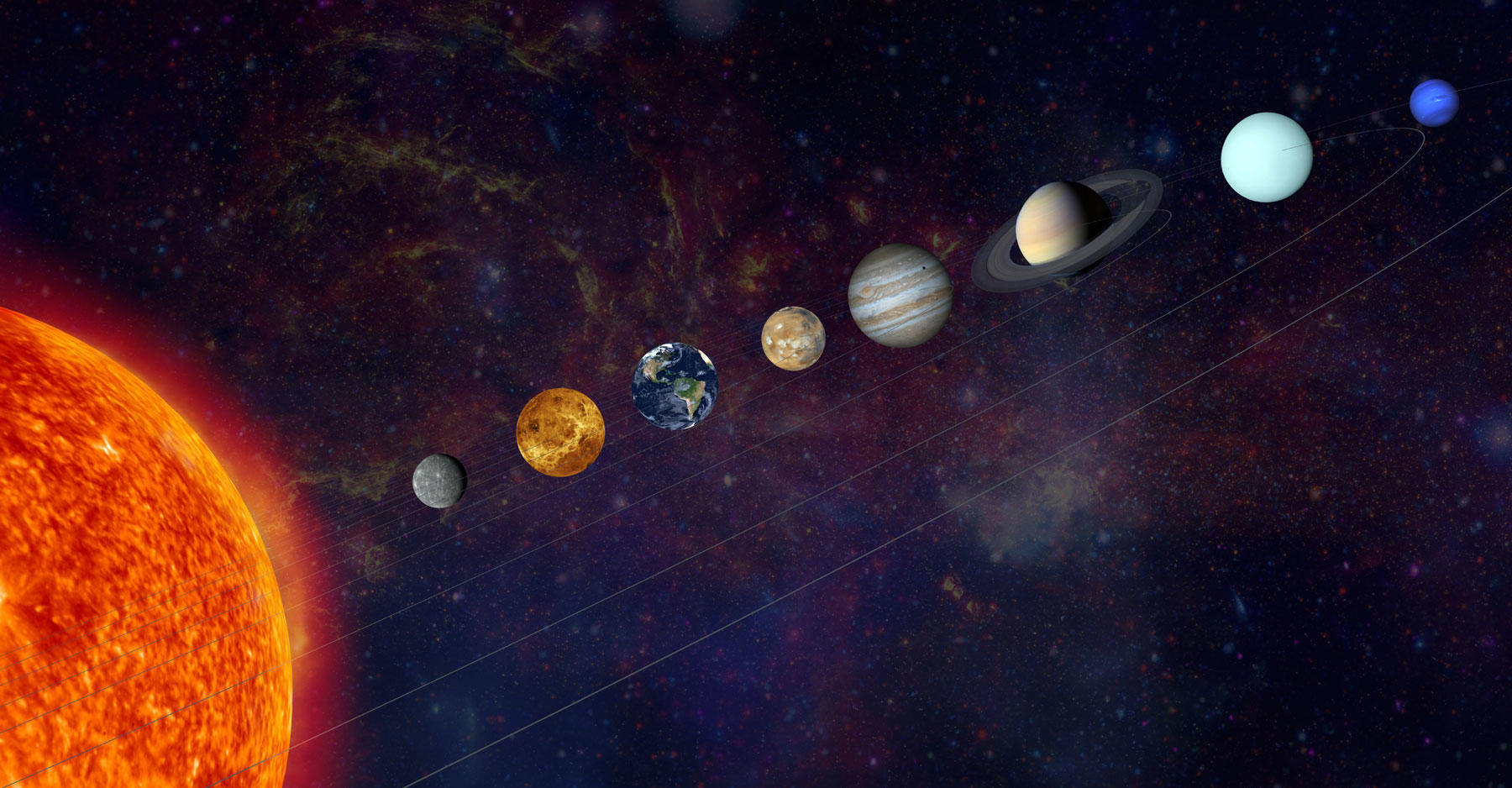
True or False
The planets are all equally distanced from each other.
The planets are all equally distanced from each other.
a)
True
b)
False
20.
Planets form by a process called...
a)
accretion
b)
dark matter interactions
c)
electromagnetic radiation
d)
sun-dropping
100 %

