
 Worksheets
AP Chem
Total questions: 21
Worksheet time: 23mins
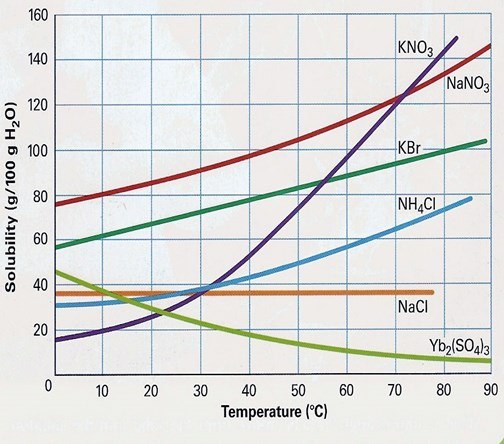
At 30'C, which substance has the lowest solubility?
KNO3
KBr
NaCl
Yb2(SO4)3
A homogeneous mixture is the same thing as...
a solution
a heterogeneous mixture
a compound
an element
Which of the following usually makes a substance dissolve faster in a solvent?
adding more solvent to the solution
increasing the particle size of the solute
lowering the temperature
decreasing the number of particles
If a material does NOT dissolve in a liquid, it is said to be___________________
soluble
insoluble
partly soluble
partly insoluble

Three 10 g samples of sugar are represented below.
Sample A dissolves in water more slowly than sample B.
Sample B dissolves more slowly than sample C.
Which of the following best explains why sample A dissolves more slowly than the other two?
It has the most volume.
It has the smallest surface area.
It has the largest number of sugar molecules.
It has the fewest bonds between sugar modules.
A technican prepared a solution by heating 100 mL of distilled water while adding KCl crystals until no more KCl would dissolve. She then capped the clear solution and set it aside on the lab counter. After several hours she noticed the solution had become cloudly and some solid had settled to the bottom of the flask. Which statement best describes what happened?
As the solution cooled, evaporation of water increased the KCl concentration beyond its solubility.
Water molecules, trapped with the KCl crystals, were released after heating.
At lower temperatures the solubility of KCl decreased and recrystallization occurred.
At increased temperatures the solubility of KCl increased and remained too high after cooling.
A student pours mineral salts into a bottle of cold water. Which of the following best explains why shaking the bottle will affect the dissolving rate of the salt?
Shaking exposes the salts to the solvent more quickly.
Shaking helps more water evaporate.
Shaking equalizes the water temperature.
Shaking causes more ions to precipitate out of solution.
Li2S
Soluble
Insoluble
(NH4)2CO3
Soluble
insoluble

When two liquids have very different polarity, they are _________________________ in each other.
miscible
immiscible

What statement best describes the solubility of this molecule?
it is completely insoluble in water because of the large nonpolar segment of the molecule
a small amount of it can dissolve in water because of the OH group at the end of the molecule.
it is highly soluble in water because water is the universal solvent.

