
 Worksheets
dilations of quadratic functions
Total questions: 80
Worksheet time: 5hrs 43mins


If the blue is f(x)=x2, then the red must be
Which of the following equations represents f(x)=x2 after being transformed by 3 to the right and down 10
f(x)= x + 13
f(x) = (x + 10)2 + 3
f(x) = (x - 3)2 - 10
f(x) = x - 13
Match the equation to its description
f(x)=(x−2)2+2
Right 2 and up 2
Right 2 and down 2
Left 2 and up 2
Left 2 and down 2
f(x)=(x+5)2−4
Describe this translation:
Right 5 and up 4
Left 5 and down 4
down 5 and right 4
up 5 and left 4
Given f(x) = (x-3)2 - 5. What transformations took place from the original function f(x)?
Right 3 and up 5
Right 3 and down 5
Which transformation transforms the graph of f(x) = x2 to the graph of g(x) = (x + 2)2+9
left 2 and down 9
right 2 and up five
left 2 and up 9
left 9 and up 2
Which of the following equations represents f(x)=x2 after being transformed by 4 to the left and up 7
f(x)= x + 4
f(x) = (x + 4)2 + 7
f(x) = (x + 7)2 - 4
f(x) = x - 7


What change does a Translation Cause?
a shift up, down, left, or right
a reflection
a compression
a stretch


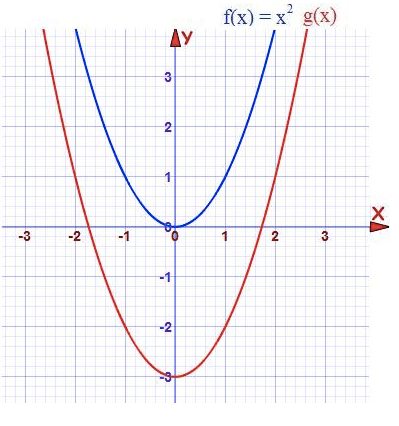
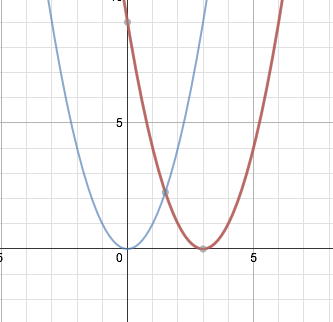
Which equation below is a quadratic function translated up 3 units?
y = x2 + 3
y = (x + 3)2
y = 3x2
y = -x2 - 3
Which of the following quadratics has a range of all real numbers less than or equal to 4?


*Hint: Domain is the set of all x-values included in the function.
Which graph best represents a function with a range of all real numbers greater than or equal to -6?


Which graph represents a function with a domain of all real numbers greater than or equal to -7 and less than 2?


Determine the domain and range of the function.
Domain: all real numbers.
Range: all real numbers less than or equal to 1.
Domain: all real numbers.
Range: all real numbers less than or equal to 2.
Domain: all real numbers less than or equal to 1.
Range: all real numbers.
Domain: all numbers between 1 and 3.
Range: all real numbers less than or equal to 1.

What is the vertex of the quadratic function shown?
(5, 5)
(-5, -5)
(2, 0)
(0, -2.5)
-x2 + 4x - 6
-3x2 + 12x - 7
Compare the function y = 5x2 to the parent function y = x2. How did the parabola change?
A vertical compression made the parabola wider.
A vertical stretch made the parabola narrower.
The parabola shifted horizontally
The parabola shifted vertically
Compare the function y = -9x2 to the parent function y = x2. How did the parabola change?
A vertical compression made the parabola wider.
A vertical stretch made the parabola narrower.
The parabola shifted horizontally
The parabola shifted vertically
Compare the function y = 3/4x2 to the parent function y = x2. How did the parabola change?
A vertical compression made the parabola wider.
A vertical stretch made the parabola narrower.
The parabola shifted horizontally
The parabola shifted vertically

Select the equation of the quadratic function (parabola):
y = x2 - 8
y = x2 + 8
y = ( x - 8 )2
y = ( x + 8 )2
f(x) = x2 to the graph of
g(x) = (x + 4)2?
If the function f(x) = x2 is changed so that a new function is created, g(x) = 5x2, how does g(x) compare to f(x)?
The graph of g(x) is wider than the graph of f(x)
The graph of g(x) is narrower than the graph of f(x)
The graph of g(x) is shifted 5 units up above f(x)
The graph of g(x) is shifted 5 units down below f(x)
If the function f(x) = x2 is changed so that a new function is created, r(x) = 1/3nf(x), how does r(x) compare to f(x)?
The graph of r(x) is wider than the graph of f(x)
The graph of r(x) is narrower than the graph of f(x)
The graph of r(x) is shifted 5 units up above f(x)
The graph of r(x) is shifted 5 units down below f(x)
Which of the following shows a vertical compression of the parent function f(x)=x2?
y = 2x2
y = 3/5x2
y = -4x2
y = -x2
Does the equation vertically stretch or compress?
f(x)= 2x2
*Always compare to the parent function (graph first)*
vertically stretch
vertically compress
horizontally shift 4 units left
horizontally shift 4 units right

f(x) = x2
then the red must be...
Describe the transformations from the original parent function f(x) = x2.
g(x) = 5x2 + 2
Vertical Compression of 5
Translated Down 2
Vertical Compression of 5
Translated Up 2
Vertical Stretch of 5
Translated Up 2
Vertical Shrink of 5
Translated Down 2

Write the equation of the quadratic function. (parabola)
y = x2 - 6
y = x2 + 6
y = ( x - 6 )2
y = ( x + 6 )2
How did we transform from f(x) =x2 to g(x) = 3x2
vertical shift down
vertical stretch
vertical compression

How did we transform from f(x) =x2 to g(x) = 3x2
vertical shift down
vertical stretch
vertical compression
Determine the vertex from the following equation: −(x+1)2−1
Vertex: (1,-1)
Vertex: (-1, 1)
Vertex: (-1, -1)
Vertex: (1, 1)
Determine the vertex from the following equation: 21(x+4)2+1
Vertex: (-4, 1)
Vertex: (-4, -1)
Vertex: (4, 1)
Vertex: (4, -1)
Determine the axis of symmetry of the following equation: −2(x+2)2+3
A. O. S: 3
A. O. S: -2
A. O. S: 2
A. O. S: 1
Determine the axis of symmetry of the following equation: (x−3)2+5
A. O. S: 1
A. O. S: -3
A. O. S: 3
A. O. S: 5
Determine if the parabola has a maximum or minimum, if it opens up (+) then it will have a minimum, if it opens down (-) then it will have a maximum. 3(x+3)2−2
Maximum
Minimum
Determine if the following equation has a maximum or minimum: −(x−2)2+7
Maximum
Minimum
What is a quadratic funtion in the form of f(x)=a(x−h)2+k called?
Factored Form
Standard Form
Vertex Form
What is the vertex of the equation
y=(x−3)2+5(-3, 5)
(3, 5)
(-3, -5)
(3, -5)
What is the vertex of the equation
y=(x+7)2+3(7, 3)
(7, -3)
(-7, 3)
(-7, -3)
What is the vertex of the equation
y=(x−4)2(-4, 0)
(4, 0)
(0, 4)
(0, -4)
What is the vertex of the equation
y=2(x+1)2−5(1, -5)
(-1, -5)
(-1, 5)
(1, 5)
What is the vertex of the equation
y=x2−1(0, -1)
(0, 1)
(1, 0)
(-1, 0)
What is the vertex of the equation
y=−2(x−1)2+5(-1, -5)
(-1, 5)
(1, 5)
(1, -5)
What direction does the following graph open?
f(x)=(x−4)2−5left
right
up
down

Does this parabola have a minimum or maximum and what is its value?
minimum: 2
maximum: 2
minimum: 5
maximum: 5
Given the equation: y = -(x - 4)2 - 3,
does this parabola have a maximum or minimum value?
Maximum
Minimum
What is the axis of symmetry for the equation: y = ½(x - 4)² - 4?
y = 4
y = - 4
x = 4
x = - 4
What is true for: y = -2(x - 1)² + 5
Opens up with a minimum
Opens down with a maximum
Opens left
Opens right

What are the x- intercepts (roots, solutions)?
x= 0 and x= -4
x= 0 and x= 4
y= 0
x= 2
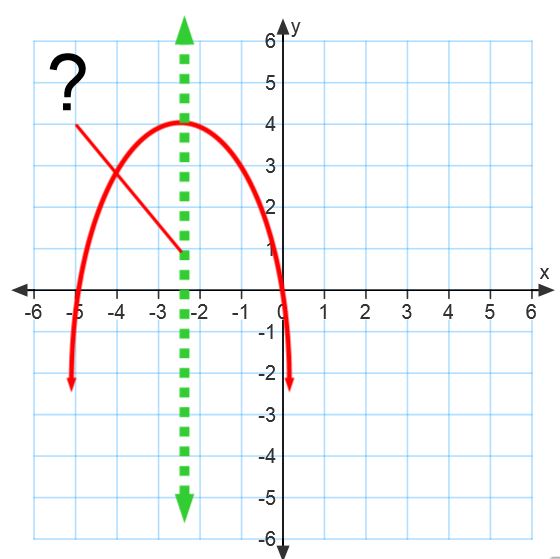
y = 3(x + 5)2 - 4,
what is the vertex of the parabola?
What is the vertex of the following parabola?
y=3(x+5)2−4
(5, -4)
(-5, -4)
(-15, -4)
(15, -4)
What is the vertex for the parabola?
f(x)=4(x−2)2+3
(-2, 3)
(2, -3)
(4, 3)
(2, 3)
A parabola has a vertex at (-3,2).
Where is the axis of symmetry?
y = -2
x = 3
x = -3
y = 2
What is true for: y = -2(x - 1)² + 5
Opens up with a minimum
Opens down with a maximum
Opens left
Opens right
f(x) = -(x + 3)2 - 5
If the blue graph is f(x) = x2
then the red must be...
g(x) = x2 - 5
g(x) = x2 + 5
g(x) = (x - 5)2
g(x) = (x + 5)2
What does the quadratic function that has a vertex of (3,4) look like?
y = a(x+3)2 + 4
y = a(x-3)2 + 4
y = -a(x+3) - 4
y = a(x-3)2 - 4

