
 Worksheets
Earth Science Regents Meteorology
Total questions: 34
Worksheet time: 35mins
Name
Class
Date
1.
Air pressure is usually highest when the air is
a)
cool and humid
b)
cool and dry
c)
warm and humid
d)
warm and dry
2.
What is the relative humidity when the dry-bulb temperature is 16°C and the wet-bulb temperature is 14°C?
a)
90%
b)
80%
c)
14%
d)
13%
3.
Which list correctly matches each instrument with the weather variable it measures?
a)
wind vane—wind speed
thermometer—temperature
precipitation gauge—relative humidity
thermometer—temperature
precipitation gauge—relative humidity
b)
wind vane—wind direction
thermometer—dewpoint
psychrometer—air pressure
thermometer—dewpoint
psychrometer—air pressure
c)
barometer—relative humidity
anemometer—cloud cover
precipitation gauge—probability of precipitation
anemometer—cloud cover
precipitation gauge—probability of precipitation
d)
barometer—air pressure
anemometer—wind speed
psychrometer—relative humidity
anemometer—wind speed
psychrometer—relative humidity
4.
Which weather change is most likely indicated by rapidly falling air pressure?
a)
Humidity is decreasing.
b)
Temperature is decreasing.
c)
Skies are clearing.
d)
A storm is approaching.
5.
Weather-station measurements indicate that the Dewpoint temperature and air temperature are getting farther apart and that air pressure is rising. Which type of weather is most likely arriving at the station?
a)
a snowstorm
b)
a warm front
c)
cool, dry air
d)
maritime tropical air
6.
Earth’s surface winds generally blow from regions of higher
a)
air temperature toward regions of lower air temperature
b)
air pressure toward regions of lower air pressure
c)
latitudes toward regions of lower latitudes
d)
elevations toward regions of lower elevations
7.
A low-pressure system in the Northern Hemisphere has a surface air-circulation pattern that is
a)
clockwise and away from the center
b)
clockwise and toward the center
c)
counterclockwise and away from the center
d)
counterclockwise and toward the center
8.
The weather characteristics of air masses result primarily from their
a)
geographic origin
b)
size and shape
c)
rate of movement
d)
direction of movement
9.
Which type of air mass most likely has high humidity and high temperature?
a)
cP
b)
cT
c)
mT
d)
mP
10.
An air mass entering Alaska from the northern Pacific Ocean would most likely be labeled on a weather map as
a)
cP
b)
cT
c)
mP
d)
mT
11.
The dewpoint is 15°C. What is the wet-bulb temperature on a sling psychrometer if the dry-bulb temperature is 18°C?
a)
16°C
b)
2°C
c)
3°C
d)
20°C
12.
In which direction do the surface winds blow around a high-pressure system in the Northern Hemisphere?
a)
clockwise and inward
b)
clockwise and outward
c)
counterclockwise and inward
d)
counterclockwise and outward
13.

What type of storm front if this?
a)
Warm Front
b)
Cold Front
c)
Stationary Front
d)
Occluded Front
14.

What type of storm front is this?
a)
Warm Front
b)
Cold Front
c)
Occluded Front
d)
Stationary Front
15.

What type of storm front is this?
a)
Warm Front
b)
Cold Front
c)
Occluded Front
d)
Stationary Front
16.
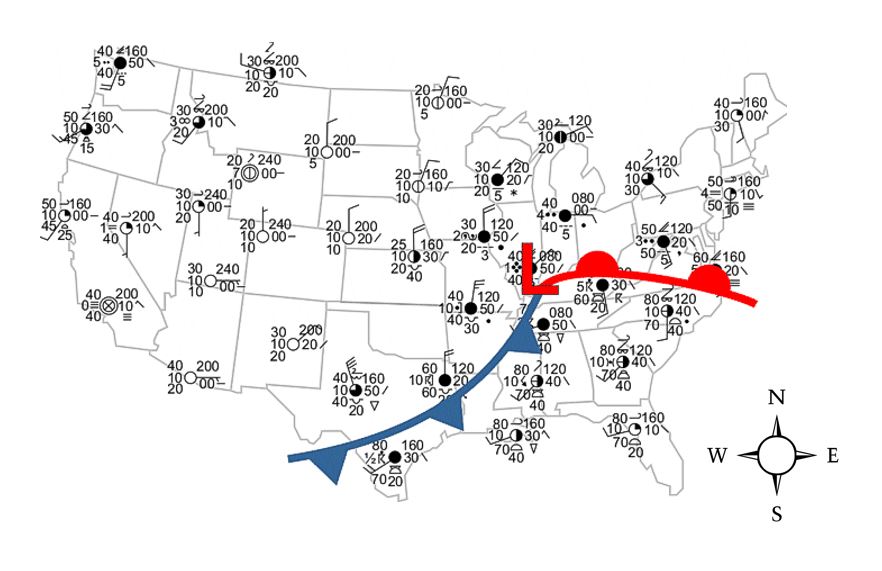
What direction is the cold front moving on the map?
a)
Southwest
b)
Northwest
c)
Southeast
d)
Northeast
17.
What direction is the warm front moving on the map?
a)
North
b)
South
c)
East
d)
West
18.
When two different air masses collide...
a)
A front forms
b)
They casually become one
c)
A new planet evolves
d)
Dinosaurs become extinct
19.
Where does it rain relative to the warm front?
a)
On top of the front
b)
Behind the front
c)
Ahead of the front
20.
Where does rain occur relative to a cold front?
a)
on the front
b)
behind the front
c)
ahead of the front
21.
Jet stream winds over the United States generally move from
a)
east to west
b)
north to south
c)
west to east
d)
south to north
22.
An air mass classified as mP usually forms over which type of Earth surface?
a)
warm land
b)
warm ocean
c)
cool land
d)
cool ocean
23.

Which front will most likely pass over location A during the next two hours?
a)
warm
b)
stationary
c)
occluded
d)
cold
24.
Compared to land surface temperature changes, water surface temperature changes occur
a)
more slowly because water has a lower specific heat
b)
more slowly because water has a higher specific heat
c)
faster because water has a lower specific heat
d)
faster because water has a higher specific heat
25.
Wet areas caused by rising air and converging surface winds are located at which two latitudes?
a)
0° and 30° N
b)
0° and 60° S
c)
30° N and 30° S
d)
90° N and 90°S
26.
An air pressure of 993.0 mb is equal to how many inches of mercury?
a)
29.30 hg
b)
29.32 hg
c)
29.49 hg
d)
29.20 hg
27.
As warm, moist air moves into a region, barometric pressure readings in the region will generally
a)
decrease
b)
increase
c)
remain the same
28.
In which planetary wind belt do most storms move toward the southeast?
a)
30° N to 60° N
b)
0° to 30° N
c)
0° to 30° S
d)
30° S to 60° S
29.
Which group of substances is arranged in order of decreasing specific heat values?
a)
iron, granite, basalt
b)
copper, lead, iron
c)
dry air, water vapor, ice
d)
liquid water, ice, water vapor
30.
During the day at the beach, a cool breeze blows
a)
from the land to the sea because there is a high pressure over the ocean
b)
from the land to the sea because low pressure over the ocean
c)
from the sea to the land because high pressure over the ocean
d)
from the sea to the land because low pressure over the ocean
31.

According to the data shown in the table, which day had the highest relative humidity?
a)
1
b)
2
c)
3
d)
4
32.
What is the dewpoint when the dry bulb temperature is 20°C and the relative humidity is 17%?
a)
–5°C
b)
11°C
c)
–2°C
d)
15°C
33.
A psychrometer is used to determine which weather variables?
a)
wind speed and wind direction
b)
percentage of cloud cover and cloud height
c)
air pressure and air temperature
d)
relative humidity and dewpoint
34.
The greatest chance of precipitation will occur if the air temperature and dew point are
a)
close together
b)
far apart
c)
the same
100 %

