
NEW
Font size
 Worksheets
Open Scied
Total questions: 22
Worksheet time: 2hrs 50mins

Balloon 1 and Balloon 2 are filled with the same amount of air. The air in Balloon 2 is cooled so that it is at a lower temperature than the air in Balloon 1. The air in which of these balloons has more thermal energy?
The air in Balloon 1 has more thermal energy.
The air in Balloon 2 has more thermal energy.
The air in Balloon 1 and the air in Balloon 2 have the same amount of thermal energy.
Neither the air in Balloon 1 nor the air in Balloon 2 has any thermal energy.

You have two different rubber balls. These balls are made of the exact same material and have the same temperature. But the balls have different masses as shown in the diagram.
Which ball has the least total thermal energy, Ball A or Ball B?
Ball A
Ball B
Both Ball A & Ball B have an equal amount of thermal energy.

When the bolts are added to the water, thermal energy will be transferred from the
water to the bolts.
water to the water.
bolts to the water.
bolts to the bolts.

Which beaker will have the greatest change in temperature?
Beaker A
Beaker B
Beaker C
All beakers will have the same amount of change in temperature.

On the cold day, the smell reached the student with the stopwatch slower than on the warm day. What does this data provide evidence of?
On a cold day, the molecules of gas in the room are lighter and move faster.
On a cold day, more energy is transferred to the gas in the container.
On a cold day, the molecules of gas in the room have less kinetic energy on average.
On a cold day, less energy was needed to move the gas across the room.

Which bucket of water will have the greatest change in temperature?
Bucket A
Bucket B
Bucket C

Two identical plastic cups contain the same amount of water at two different temperatures, as shown above. Both cups are placed in a room at 50 °C.
At the time the cups were placed in the room, in which cup do the water molecules have lower average kinetic energy?
Cup 1
Cup 2
The kinetic energy is the same.
There is not enough information to tell.
Two identical plastic cups contain the same amount of water at two different temperatures, as shown above. Both cups are placed in a room at 50 °C.
The temperature of the water in Cup 1 will __________________ over time.
increase
decrease
stay the same
Two identical plastic cups contain the same amount of water at two different temperatures, as shown above. Both cups are placed in a room at 50 °C.
Because the temperature of the water in Cup 1 is ______ than the temperature in the room, thermal energy is transferred from the ______ to the ______.
colder, room, cup
colder, cup, room
warmer, room, cup
warmer, cup, room

A hot pan was taken from the oven and placed on a table. The rate of thermal energy transfer between the pan and its surroundings depends on which of the following?
The temperature of the pan.
The temperature of the pan, the mass of the pan, and the temperature of the surroundings.
The mass of the pan.
The temperature of the surroundings.

Bowling Pin 1 and Bowling Pin 2 are shown to the right.
They are both made up of the same types of molecules. They are both made up of the same number of molecules.
Bowling Pin 2 has more thermal energy than Bowling Pin 1.
Is the average speed of the molecules of Bowling Pin 1 more, less, or the same as the average speed of the molecules of Bowling Pin 2?
The average speed of the molecules of Bowling Pin 2 is more than the average speed of the molecules of Bowling Pin 1.
The average speed of the molecules of Bowling Pin 2 is less than the average speed of the molecules of Bowling Pin 1.
The average speed of the molecules of Bowling Pin 2 is the same as the average speed of the molecules of Bowling Pin 1.
More information is needed to say anything about the average speed of the molecules.
A cook uses a metal bucket to make ice cream. After making ice cream, he places the cold bucket on the warmer counter. After some time, the metal bucket, the counter, and the air in the room will be at the same temperature. Why?
Because thermal energy will be transferred from the counter to the metal bucket and from the air to the metal bucket.
Because coldness will be transferred from the metal bucket to the counter and from the metal bucket to the air.
Because thermal energy will be transferred from the metal bucket to the counter and from the metal bucket to the air, and coldness will be transferred from the metal bucket to the counter and from the metal bucket to the air.
Because thermal energy will be transferred from the metal bucket to the air, but thermal energy will not be transferred from the metal bucket to the counter.

In the morning, a student puts a warm can of soda in a cooler filled with ice.
What happened to the total amount of energy in the cooler containing the can of soda and the ice?
The total amount of energy increased because the energy that the can of soda transferred to the ice is greater than the energy that the ice lost.
The total amount of energy decreased because the can of soda has less energy than it started with, and the amount of energy the ice has did not change.
The total amount of energy stayed the same because the amount of energy that the can of soda lost is equal to the amount of energy that the ice gained.
The total amount of energy stayed the same because being warmer or colder does not affect the amount of energy objects have.

Heat always travels from...
Warm to cool
Cool to warm
Warm to warm
Cool to cool
When camping, we want to make soup and hot cocoa, but don’t like to carry all the heavy cooking pots needed to make hot water. Our new Wilderness Survival kit claims we can make hot water without a stove or pot! The kit provides a plastic bag to hold water, and matches to make a fire. The instructions say, “Build a fire. Find rocks. Put rocks in the fire until they get hot. Add hot rocks to the bag of water until the water is hot.” To prepare for our trip, we created a laboratory model of the hot water system. Our goal was to test it out in the lab to see how it could work best in the wilderness. Figure 1 shows the laboratory model, consisting of a plastic bag, partially filled with water, and the added hot rock.
Initial rock temperature = 200C
Initial water temperature = 20C
In which model, does the arrow represent the flow of thermal energy in the system.


If thermal energy is increasing, what is happening to the kinetic energy.
Kinetic energy would be decreasing
Kinetic energy would stay the same
Kinetic energy would be increasing
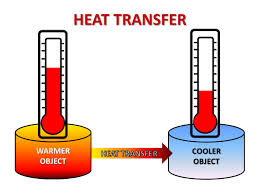
Energy transferred between two objects with varying temperatures, always transferring from warmest to coldest until the two objects have equal temperatures.
Heat
Thermal Energy
Energy Transfer
Temperature

You are asked to conducted an experiment to see if changing the amount (mass) of rock in the system would affect the heating of the water (Figure 2).
You used two rocks of different masses and heated them both in an oven until they reached 200C. We used equal amounts of 20C water in each container.
Figure 2 shows the change in water temperature Before and After a given amount of time.
Which statement best describes why the change in water temperature is different for Rock A and Rock B in Figure 2.
Rock B has more mass so it has more thermal energy than Rock A for the same temperature. The more thermal energy Rock B has, the more it will transfer to the water, so the water temperature increases more due to Rock B having greater mass.
Rock A has more mass so it has more thermal energy than Rock B for the same temperature. The more thermal energy Rock A has, the more it will transfer to the water, so the water temperature increases more due to Rock A having greater mass.
Rock B has less mass so it has more thermal energy than Rock A for the same temperature. The more thermal energy Rock B has, the more it will transfer to the water, so the water temperature increases more due to Rock B having a less mass.
Rock A has less mass so it has less thermal energy than Rock B for the same temperature. The less thermal energy Rock A has, the more it will transfer to the water, so the water temperature increases less due to Rock A having less mass.

When camping, we like to have hot cocoa made with milk. We conducted a second experiment to compare using milk in the plastic bag, instead of water. We used two rocks of the same mass at a temperature of 200C, and added the hot rocks to two separate plastic bags, each containing equal amounts of milk or water (Figure 3).
We found that the final temperature of the milk was different from the final temperature of the water, even though all the other experiment conditions were the same.
Use your knowledge of thermal energy transfer which statement describes why the final temperature of the milk was different from the final temperature of the water.
The amount of thermal energy transfer and the relationship of thermal energy to temperature depends on the materials.
Since milk is the same as water, the thermal energy transfer and the temperature would not be different.
The amount of thermal energy transfer and the relationship of thermal energy to temperature does NOT depends on the materials.
Since milk is different from water, the thermal energy transfer and the temperature could be different.
The amount of thermal energy transfer and the relationship of thermal energy to temperature depends on the materials.
Since milk is different from water, the thermal energy transfer and the temperature could be different.

