
 Worksheets
Invertebrates Bob Jones
Total questions: 59
Worksheet time: 57mins
Name
Class
Date
1.
What is an invertebrate?
a)
An animal with a backbone
b)
a mammal
c)
An animal without a backbone
d)
birds
2.

This picture is an example of which group of invertebrates?
a)
Segmented worms
b)
Fish
c)
Sponges
d)
Arthropods
3.

Is the picture a vertebrate or invertebrate?
a)
Vertebrate
b)
Invertebrate
4.

The organism in the picture is a(n)
a)
echinoderm
b)
mollusk
c)
arthropod
d)
cnidarian
5.
Arthropods have an outer covering called a(n)_________
a)
endoskeleton
b)
bones
c)
exoskeleton
d)
armor
6.
Which of the following is an example of a crustacean?
a)
squid
b)
crab
c)
earth worm
d)
bumble bee
7.

I have a soft-body, a hard shell, and live on land and water. What am I?
a)
Mollusk
b)
Arthropod
c)
Echinoderm
d)
Cnidarian
8.
Between 90-95% of all animals on earth can be classified as _____.
a)
invertebrates
b)
vertebrates
c)
reptiles
d)
mammals
9.
What type of symmetry do Arthropods have?
a)
Radial
b)
Bilateral
c)
Asymmetrical
10.
Lobster, shrimp, and crabs are examples of what group of Arthropods?
a)
Chilopoda
b)
Diplopoda
c)
Crustaceans
d)
Arachnida
11.
All arthropods have segmented bodies, jointed appendages, and ________________.
a)
tails
b)
lungs
c)
wings
d)
an exoskelton
12.
The removing and replacing of old exoskeleton is called
a)
metamorphosis
b)
replacement
c)
molting
d)
exoing
13.
The stages of incomplete metamorphosis are
a)
egg, larva, pupa, adult
b)
egg, larva, nymph, adult
c)
egg, nymph, adult
d)
egg, larva, adult
14.
The stages of complete metamorphosis are
a)
egg, larva, pupa, adult
b)
egg, larva, nymph, adult
c)
egg, nymph, adult
d)
egg, larva, adult
15.
What is molting?
a)
The process in which arthropods reproduce
b)
The process in which arthropods shed their outer covering and grow a larger one.
c)
The process in which larval forms develop into adult forms
d)
The process in which arthropods breathe
16.

What am I?
a)
Mollusk
b)
Annelid
c)
Arthropod
d)
Cnidarian
17.

What am I?
a)
Arthropod
b)
Cnidarian
c)
Mollusk
d)
Porifera
18.

I am spiny, have a water vascular system with tube feet, radial symmetry, and am called a brittle star.
a)
Mullosk
b)
Arthropod
c)
Echinoderm
d)
Cnidarian
19.

I have a round body divided into segments and my digestive tract has two openings.
a)
Echinoderm
b)
Cnidarian
c)
Annelid
d)
Mollusk
20.
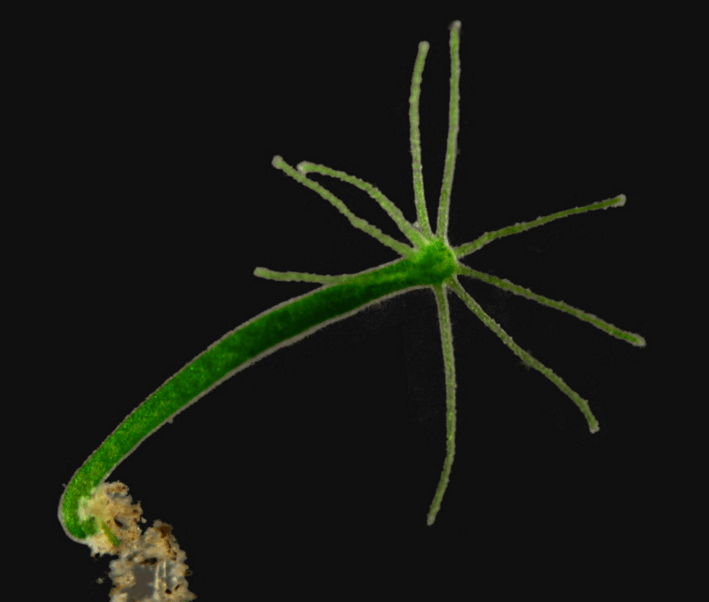
I have a digestive cavity with one opening, and have tentacles. I am a hydra.
a)
Echinoderm
b)
Cnidarian
c)
Arthropod
d)
Mollusk
21.

I have three pairs of legs and a body divided into three sections. As a butterfly, I have wings.
a)
Echinoderm
b)
Annelid
c)
Arthropod
d)
Mollusk
22.
Which of the following is an example of a crustacean?
a)
squid
b)
crab
c)
earth worm
d)
bumble bee
23.

The organism shown is an example of a(n)
a)
mollusk
b)
cnidarian
c)
sponge
d)
echinoderm
24.
What are some characteristics of sponges?
a)
Have some tissues
b)
Have stinging cells, and Take food into a body central cavity.
c)
Adults are stationary
Take food into their bodies for energy.
Take food into their bodies for energy.
d)
Jellyfish
Sea anemone
Jellyfish
Sea anemone
25.

Which animal is responsible for the first complete digestive system?
a)
Roundworms
b)
Octupus
c)
Thirteen line ground squirrel
d)
Hydra
26.
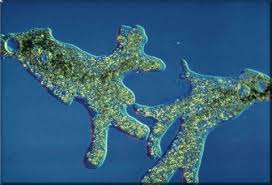
Which animal belongs to the Kingdom Animalia?
a)
Sponge
b)
Amoeba
c)
Paramecium
d)
Euglena
27.

Which is not a main class within the phylum of mollusca?
a)
crustacean
b)
cephalopod
c)
gastropod
d)
bivalve
28.

Which of the following is a cephalopod?
a)
snail
b)
slug
c)
oyster
d)
octopus
29.
Which phylum is mainly asymmetrical?
a)
cnidaria
b)
porifera (sponges)
c)
echinodermata
d)
arthropoda
30.
Which of the following organisms has a different type of symmetry?
a)
arthropods
b)
echinoderms
c)
worms
d)
mollusks
31.
Most animals have this type of symmetry?
a)
radial
b)
asymmetrical
c)
bilateral
d)
trilateral
32.
These two phyla have mainly radial symmetry.
a)
echinodermata and annelida
b)
annelida and arthropoda
c)
arthropoda and cnidaria
d)
cnidaria and echonodermata
33.
These three phyla have bilateral symmetry.
a)
arthropoda, cnidaria, sponges
b)
arthropoda, echinodermata, worms
c)
arthropoda, worms, mollusca
d)
arthropoda, mollusca, sponges
34.
These organisms all have nematocysts (stinging cells).
a)
cnidaria
b)
mollusca
c)
arthropoda
d)
porifera
35.

This form of cnidaria is known as a _______.
a)
polyp
b)
medusa
c)
polyanna
d)
medical
36.

This form of cnidaria is known as a __________.
a)
medusa
b)
polyp
c)
pollyanna
d)
poptop
37.

This belongs in the _______ phylum.
a)
annelida
b)
echinodermata
c)
arthropoda
d)
cnidaria
38.

This belongs to the ________ phylum.
a)
porifera
b)
echinodermata
c)
mollusca
d)
cnidaria
39.

These belong to __________ phylum.
a)
porifera (sponge)
b)
cnidaria
c)
echinodermata
d)
mollusca
40.

These belong to __________ phylum.
a)
cnidaria
b)
arthropoda
c)
annelida
d)
echinodermata
41.

These are ___________.
a)
bivalves
b)
univalves
c)
cephalopods
d)
gastropods
42.

All organisms in the class insecta have _______ legs.
a)
no
b)
6
c)
8
d)
10
43.

All organisms in the class arachnida have _______ legs.
a)
4
b)
6
c)
8
d)
10
44.

These all belong to the phylum _________.
a)
porifera
b)
annelida
c)
arthropoda
d)
cnidaria
45.
Dragonflies, stink bugs, and lady bugs are __________.
a)
insects
b)
arthropods
c)
animals
d)
all of these
46.
Most animals ________.
a)
are invertebrates
b)
are arthropods
c)
have jointed legs
d)
all of these
47.
Echinoderms have the ability to regenerate body parts.
a)
False
b)
True
48.
What filters food and eliminates waste from the water it lives in?
a)
sponge
b)
segmented worm
c)
arthropod
d)
mollusk
49.
Sponges use pores to
a)
move from place to place.
b)
filter food from the water.
c)
defend themselves.
50.
what type of habitat does a sponge live in
a)
ocean
b)
soil
c)
trees
d)
ground
51.
Are there more vertebrates or invertebrates living on Earth?
a)
vertebrates
b)
invertebrates
52.
Which is more complex
a)
Cnidarian
b)
Sponge
c)
Worm
53.
Most complex worm
a)
Phylum Platyhelminthes
b)
Phylum Nematoda
c)
Phylum Annelida
54.
What do parasitic worms do?
a)
Survive on their own
b)
Live off the resources of a hosts
55.
Which type of worm has the most complex digestive system?
a)
Annelids (Segmented worms)
b)
Nematodes (Roundworms)
c)
Platyhelminthes (Flatworms)
56.
Which class of Mollusks have the most advanced nervous system?
a)
Gastropods
b)
Bivalves
c)
Cephalopods
57.
What type of circulatory system do Arthropods have?
a)
closed
b)
open
58.
The tough layer on the outside of arthropod's bodies that provide protection and support
a)
nauplius
b)
exoskeleton
c)
skeleton
d)
shell
59.
Why do arthropods have to shed their exoskeletons?
a)
it wears out
b)
they don't shed
c)
it limits the size they can grow
d)
to go from water to land environments
100 %

