wayground logo

Free Printable Worksheets

NEW

Font size

S
M
L
XL
Worksheets

Fundamentals of Light

Total questions: 27

Worksheet time: 17mins

Name
Class
Date
1.

If the frequency of a wave decreases, the wave’s

a)

displacement decreases

b)

speed increases

c)

period decreases

d)

wavelength increases

2.
Allows little to no light through.
a)
Transparent
b)
Translucent
c)
Opal
d)
Opaque
3.
What happens when light hits an object you can see?
a)
The light turns corners.
b)
The light curves around the object.
c)
The object reflects the light.
d)
The light and the object do not form a shadow.
4.
Through what kind of matter does light move fastest?
a)
liquids
b)
air
c)
matter that is lighter in color
d)
matter that is in larger objects 
5.
What happens to blue light when it hits a shirt that appears blue?
a)
The light is reflected.
b)
The light is absorbed.
c)
The light is refracted.
d)
The light is blocked.
6.
What is a property of a transparent object?
a)
Almost all of the light rays that reach it are scattered.
b)
Almost all of the light rays that reach it are absorbed.
c)
Almost all of the light rays that reach it are reflected.
d)
Almost all of the light rays that reach it pass through it.
7.
Which is translucent?
a)
tissue paper
b)
air
c)
wood
d)
clear plastic
8.
Which is transparent?
a)
a wooden fence
b)
clean water
c)
aluminum foil
d)
a purple balloon
9.
If you wanted a gift to be a surprise, what kind of container would you put it in?
a)
transparent
b)
thick
c)
opaque
d)
translucent
10.
The moon is a source of light.
a)
True
b)
False
11.
How does light travel?
a)
in a wavy path
b)
in a straight path
c)
in a zig zag path
12.

What is the speed of light in air?

a)

300000000 miles/sec

b)

300000 km/sec

c)

300000 m/sec

d)

300000 miles/sec

13.
A light year is...
a)
The speed light travels
b)
How long it takes light to get to you from the sun
c)
The distance light can travel in a year
d)
How many years it takes light to be emitted
14.
What color has the shortest wavelength, or the highest frequency?
a)
yellow
b)
blue
c)
red
d)
violet
15.
The full spectrum of light energy is called the__________
a)
broad spectrum
b)
electromagnetic spectrum
c)
helium spectrum 
d)
natural light spectrum
16.

What is the earth's primary source of light energy?

a)

moon

b)

sun

c)

waves

d)

fire

17.
Light is a KIND of ENERGY.
a)
True
b)
False
18.
Which are the two type of light sources?
a)
Artificial and Natural
b)
Natural and Invented
c)
Artificial and Not Artificial
d)
All of them
19.
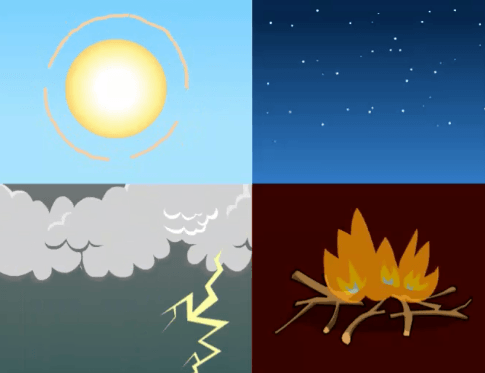
Which of these are examples of NATURAL sources of light?
a)
Sun 
b)
Stars
c)
Lightning
d)
ALL of them
20.
Things make shadows because they ______ light.
a)
BLOCK
b)
PASS
21.
Primary colors of light can combine to make
a)
black light
b)
white light
c)
primary pigments
d)
ultraviolet light
22.

Illuminance is measured in__________

a)

lumens

b)

candela

c)

lumen per square metre

d)

newton

23.

luminous intensity increases with _________ in distance between source of light and surface on which it falls.

a)

increase

b)

decrease

24.

wavelength range for visible light is_________

a)

200 nm - 400 nm

b)

0 nm - 400 nm

c)

1000 nm - 1500 nm

d)

400 nm - 700 nm

25.

complementary color for yellow is__________

a)

blue

b)

red

c)

green

d)

cyan

26.

According to Malu's law, the relationship between intensities of light is given as_______

a)

I2=I1sinθI_2=I_1\sin\theta  

b)

I2=I1sin2θI_2=I_1\sin^2\theta  

c)

I2=I1cos2θI_2=I_1\cos^2\theta  

d)

I2=I1cosθI_2=I_1\cos\theta  

27.

When light is blueshifted, the observed frequency _________

a)

is lower

b)

is higher

c)

remains the same

d)

none of the above