
 Worksheets
Ozone Pollution
Total questions: 20
Worksheet time: 12mins
Where is the ozone layer of the Earth?
At ground level
The stratosphere
Within the crust
In space
Which one of these is the molecular formula for ozone?
The ozone layer is important because it blocks out much of the sun's (a) rays.
Ozone is created primarily by (a) . When high-energy (b) rays strike an
(c) molecule (O2), they split the molecule into two single atoms. A freed atom then combines with another molecule to form a molecule of ozone ( (d) ).
Which of these is an ozone-depleting chemical?
A single atom of chlorine, acting as a catalyst, can destroy about ________ molecules of ozone.
2
100
1,000
How do scientists use data from satellites to calculate the ozone in the atmosphere?
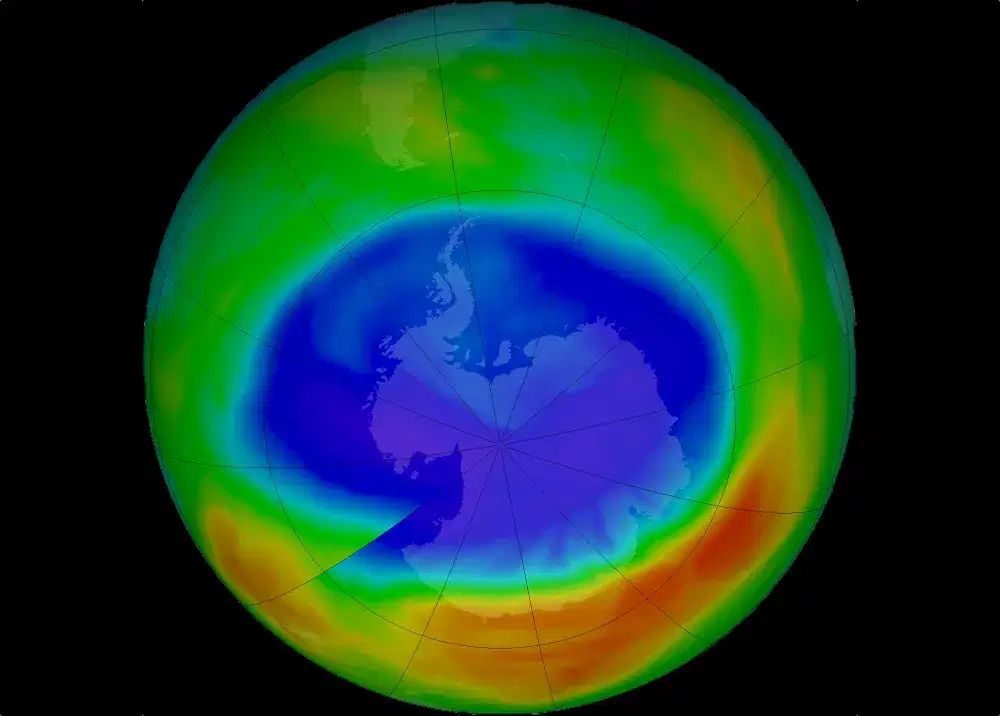
What does this image show over Antarctica?
Low UV radiation
Thinning of the ozone layer
Thinning ice sheets
Ocean currents
What atmospheric conditions contributed to the formation of the ozone hole over Antarctica?
High CO2 concentrations
High humidity
Extremely cold temperatures
Warm temperatures
What was the treaty that required countries to phase out the use of ozone-depleting chemicals?
Geneva Convention
Paris Climate Agreement
Without the Montreal Protocol, UV levels across the world would probably be around
1 - relatively low.
5 - mid-level.
10 - very high.
15 - beyond extreme.
Why are ozone-depleting chemicals still in the atmosphere today?
They stay in the atmosphere for 50-100 years
They break down quickly
Their production continues to this day
There are decreased emissions due to regulations
When is the ozone layer estimated to be fully recovered?
2030-2040
2070-2080
2050-2060
2100-2200
VOCs and nitrogen oxides combine in the presence of ________ to form photochemical smog.
carbon dioxide
human activity
trees
VOC stands for
Very Old Cantaloupe
Voracious Organic Crepes
Violent Original Conundrums
VOCs are emitted by various sources including
vehicles, paints, and plants
clouds and stars
Nitrogen oxides are released by
Motor vehicles
Smog is mostly composed of
PANs and ground-level ozone
How does smog affect people?
Smog causes respiratory issues and eye irritation
What's a "temperature inversion"?
A term used to describe why winters are cold and summers are warm
A type of pollution that causes cars to explode
A warm layer of air traps pollution around a city
A process that causes the Earth's core to overheat

