Wayground logo

Free Printable Worksheets

Font size

S
M
L
XL
Worksheets

Fossil Record Genius Challenge Generation

Total questions: 23

Worksheet time: 19mins

Name
Class
Date
1.
Which of the following could form a fossil?
a)
Bone
b)
Shell
c)
Seeds
d)
All of the above
2.
Most fossils form when organisms that die become buried in sediments
a)
True
b)
False
3.
Which of the following is true about molds and casts
a)
A mold forms when hard parts of an organism buried by sediments are gradually dissolved
b)
A mold that becomes filled in with hardened materials forms a cast
c)
A cast is a copy of the shape of an organism
d)
All of the above
4.
The formation of any fossil is a common event
a)
True
b)
False
5.
By determining the age of fossils, scientists can reconstruct the history of life on Earth
a)
True
b)
False
6.
In what way can scientists determine the ages of fossils?
a)
relative dating
b)
radioactive dating
c)
law of superposition
d)
All of the above
7.
In layers of sedimentary rock, the _________ layer is usually at the bottom. Each higher layer is _________ than the layers below it.
a)
oldest, younger
b)
youngest, older
c)
youngest, younger
d)
oldest, older
8.
Relative dating can only help scientists determine whether one fossil is older than another.
a)
True
b)
False
9.
Scientists use unstable elements that decay, called _________ elements, to determine the actual age of a fossil.
a)
radioactive
b)
cation
c)
anion
d)
petrified 
10.
What is the half-life of a radioactive element?
a)
How old it is when it is middle aged
b)
The time it takes for half of the atoms to decay
c)
The time it takes for half of the atom to form
d)
How old it is when the Earth is middle aged
11.
The millions of fossils that scientists have collected are called
a)
The Geologic Time Scale
b)
The Origin of Species
c)
The Fossil Record
d)
A really neat fossil collection
12.
What is a mass extinction?
a)
the extinction of all of Earth's species at ones time
b)
the extinction of many types of organisms at the same time
c)
the end of days
d)
the creation of many species at one time
13.
How do fossils provide evidence that evolution has happened on Earth?
a)
Fossils show how the sizes of certain animals has changed drastically over millions of years
b)
Fossils show that some species have gone extinct
c)
Fossils show how life forms present today are different than those from the past
d)
Different sedimentary rock layers provide evidence for how the environment has changed over time
14.
Which statement best describes a relationship between these organisms?
a)
Organism A was probably more primitive than Organisms B and C
b)
Organism A was probably more complex than organism B and C
c)
All of these organisms probably lived at the same time
15.

How many layers is fossil 'A' found in?

a)

1

b)

2

c)

3

d)

4

16.

Which fossils are found in layer 5.

a)

A, B

b)

A, C

c)

C only

d)

C, D

17.

How many of each fossil is found in layer 5?

a)

2 of fossil C and 3 of fossil D

b)

1 of fossil B and 3 of fossil D

c)

2 of fossil B and 2 of fossil D

d)

3 of fossil C and 2 of fossil D

18.

What are the oldest fossils and why?

a)

B, C- because they are closest to the top

b)

A, B- because they are closest to the bottom

c)

They are all the same age- because they are all found on layer 2

d)

A, B- because they are found closest to the top

19.

When did fossil A become extinct?

a)

Layer 1

b)

Layer 2

c)

Layer 3

d)

Layer 4

20.

The evolution of the horse is the most complete fossil record we have of a single organism. Using the picture, what can you conclude happened to the horse over time?

a)

The horse grew larger and lost its toes

b)

The horse shrank and lost its toes

c)

The horse grew larger and gained toes

d)

The horse shrank and gained toes

21.
According to the law of superposition, which layer is the youngest?
a)
A
b)
B
c)
C
22.

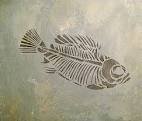
If scientists found this fossil, what could they infer?

a)

what fish are like today

b)

that this fish lacked oxygen

c)

that water once covered the area where this fossil was found

23.

Diagram 1 shows the fossilized remains of the lower portion of a camel's leg. Each subsequent diagram shows the same portion of a camel's leg, but the diagrams are from progressively later time periods. Diagram 4 shows the most recent fossil. What do these diagrams indicate?

a)

that fossils can show how a species changes over time.

b)

that modern camels have more toes than earlier species of camels.

c)

that all living organisms have increased in size over time.

d)

that fossils show how species stay the same over time.