
 Worksheets
Growth and Survival
Total questions: 29
Worksheet time: 18mins
Name
Class
Date
1.
A herd of zebras would be considered a
a)
community
b)
species
c)
ecosystem
d)
population
2.
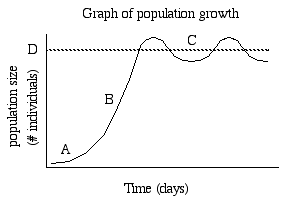
Which point on the graph represents carrying capacity?
a)
A
b)
B
c)
C
d)
D
3.
Which of the following encompases all the others?
a)
ecosystem
b)
community
c)
population
d)
individual
4.

Refer to the diagram of the survivorship curve.
Which curve best describes an organism that invests a lot of energy in parenting?
Which curve best describes an organism that invests a lot of energy in parenting?
a)
A
b)
B
c)
C
d)
this is not a survivorship curve
5.
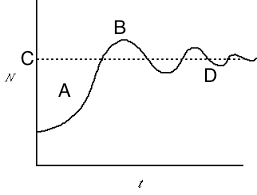
Which letter shows the the exponential growth of a population?
a)
A
b)
B
c)
C
d)
D
6.
A species described as r-strategist would definitely NOT have which of the following characteristics?
a)
clumped population pattern
b)
much parenting
c)
many offspring
d)
random population pattern
7.
The maximum population size for a species based on the environmental factors is called
a)
ecological footprint
b)
carrying capacity
c)
population growth
d)
environmental capacity
8.
There are 200 bears in an area. 10 emigrate, 15 immigrate, 10 are born and 20 die. How many are left?
a)
195
b)
205
c)
200
d)
260
9.
Refer to a population of 500 that experiences 55 births and 5 deaths during a one year period.
If the population maintains the current growth pattern, a plot of its growth would resemble which of the following?
If the population maintains the current growth pattern, a plot of its growth would resemble which of the following?
a)
exponential growth
b)
fluctuating growth
c)
K-selected growth
d)
logistic growth
10.
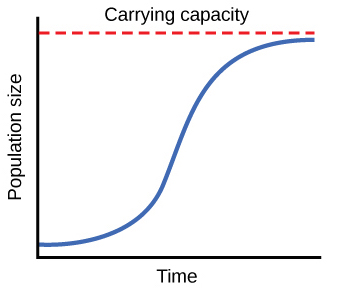
__________ growth shows growth of a population under environmental constraints (carrying capacity-K) that sets a maximum population size
a)
logistic
b)
exponential
c)
niche
d)
uniform
11.
________ grow slowly over time, cares for its young over a long period of time and is usually near the carrying capacity of its ecosystem.
a)
K-strategists
b)
R-strategists
c)
Uniform strategists
d)
environmentalists
12.
These types of organisms which multiply rapidly in numbers
a)
R-strategists
b)
K-strategists
c)
predators
d)
mutualists
13.

What effect will an invasive species have on the carrying capacity of an ecosystem?
a)
The carrying capacity will increase
b)
The carrying capacity for everyone will decrease
c)
The carrying capacity will only decrease for those in competition for same resource
d)
The carrying capacity for all animals will stay the same
14.
J-Shaped curves
a)
show a decline after an increase
b)
display populations that have reached carrying capacity
c)
represent exponential growth
d)
does not depend on the numbe rof resources
15.
All of the following are density-dependent factors that limit animal populations EXCEPT.
a)
weather
b)
predation
c)
food competition
d)
birthrate
16.
The build up of nutrients in a lake is a process called ________________.
a)
eutrophication
b)
volcanic eruption
c)
algae buildup
d)
pond death
17.

What type of survivorship was shown in 17th century England (dark blue and pink lines)?
a)
Type I
b)
Type II
c)
Type III
18.

What type of survivorship is shown in Great Britain in 1999 (teal and blue lines)?
a)
Type I
b)
Type II
c)
Type III
19.

What is the appoximate carrying capacity for this population?
a)
1.5
b)
1.75
c)
1.5 million
d)
1.25 million
20.

Is the pictured graph growth, decay, or linear or none?
a)
Exponential Growth
b)
Exponential Decay
c)
Linear
d)
None
21.
A certain plant needs moisture, carbon dioxide, oxygen, light, and minerals to survive. This scenario shows that this particular living organism depends on .
a)
Biotic and Abiotc Factors
b)
Biotic Factors
c)
Abiotic Factors
d)
None of the Above
22.

density-independent limiting factor
a)
disease
b)
parasitism
c)
fire
d)
competition
23.

Which type of growth is best illustrated by this rabbit population?
a)
exponential
b)
logistic
c)
S-shaped
d)
predator-prey
24.
Carrying capacity is represented by which letter?
a)
r
b)
L
c)
K
d)
c
25.

Which survivorship curve represents a species where most of the individuals live through their lives and die of old age?
a)
Type 1
b)
Type 2
c)
Type 3
26.
Which of the following is TRUE of predator/prey relationships?
a)
The amount of prey does not affect the number of predators.
b)
Herbivores are limited by the number of prey in an ecosystem.
c)
Humans are not considered predators.
d)
The number of predators is determined by available prey.
27.

Predator population lags behind prey population because:
a)
Increase in predators leads to decrease in prey
b)
Increase in predators leads to increase in prey
c)
Increase in predators leads to decrease in producers
28.
Which of the following can contribute to density-dependent regulation of populations?
a)
the removal of toxic waste by decomposers
b)
intraspecific competition for nutrients
c)
earthquakes
d)
floods
29.
Which of the following is a density-independent factor limiting human population growth?
a)
social pressure for birth control
b)
earthquakes
c)
plagues
d)
famines
100 %

