
 Worksheets
Category 2 Science
Total questions: 26
Worksheet time: 2hrs 6mins
Name
Class
Date
1.
Which testable question could be used to investigate the effects of force on an object?
a)
Why do toy cars move?
b)
Which type of battery lasts the longest?
c)
Where can magnets be purchased?
d)
Do balls roll faster on rough or smooth surfaces?
2.
The force of friction is caused by:
a)
surfaces rubbing against one another
b)
objects heating or cooling
c)
rough surfaces
d)
smooth surfaces
3.
What would take the most force?
a)
Rolling a rock down a hill
b)
Pushing a rock on ice
c)
Pushing a rock on a gravel road
d)
Pulling a rock on wheels
4.
Some students paint the inside of several boxes. They paint each box a different color. They observe that the inside of the box painted white looks brighter than the others. What is the most likely reason this box looks brighter?
a)
More light is reflected off white paint
b)
More is refracted by white paint
c)
More light passes through white paint
d)
More light is absorbed by white paint
5.

Which property of light makes it possible to produce hand shadows?
a)
Light travels in straight lines.
b)
Light is a form of energy.
c)
Light can be refracted.
d)
Light can be separated into different colors.
6.

Arissa looks into a mirror and sees an image of an object. Which diagram shows an X where the object is most likely located?
a)
F
b)
G
c)
G
d)
J
7.

A group of students built the circuit shown below. The light bulb does not glow. Which statement explains this observation?
a)
The bell uses most of the energy from the battery.
b)
The light bulb is not part of a complete circuit.
c)
The battery is not charged.
d)
The circuit does not have a switch.
8.

Most cars have lights, power locks, radios, and other equipment that use electricity. Electric circuits power this equipment. Each circuit has a fuse that completes it. Which of these describes one thing that could happen if the wire in a car fuse burns out?
a)
The car’s lights will burn brighter.
b)
The car’s radio will not work.
c)
The car’s turn signal will blink too slowly.
d)
The car’s power windows will open faster.
9.

What kind of energy?
a)
Thermal
b)
Electrical
c)
Mechanical
d)
Radiant
10.

What kind of energy does this device use?
a)
Chemical
b)
Electrical
c)
Thermal
d)
Chemical
11.
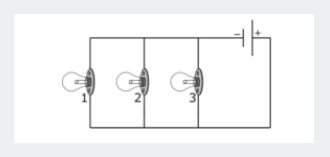
If bulb 1 burns out, what will occur?
a)
bulbs 2 and 3 will go out
b)
bulbs 2 and 3 receive more volts
c)
bulbs 2 and 3 will stay lit
d)
nothing will happen
12.

This instrument can be used to see if materials conduct electricity. Which of these groups contains items that could all conduct electricity to complete the circuit?
a)
rubber ball, plastic comb, nail
b)
paper clip, penny, screw
c)
cork, dollar bill, tweezers
d)
pencil, eraser, spoon
13.

The pictures shows what a student observed when he looked through a hand lens at a penny.
What happens to light passing through a hand lens that makes the image of the penny appear larger? The light is-
What happens to light passing through a hand lens that makes the image of the penny appear larger? The light is-
a)
absorbed
b)
reflected
c)
refracted
d)
stopped
14.

Jackie placed a pencil in a cup of water. The pencil appears broken because light-
a)
always travels in a straight line
b)
bends when it passes through water
c)
makes the water in the glass evaporate
d)
reflects the pencil on the water's surface
15.
Which of the following materials would reflect the most light?
a)
a flat sheet of aluminum foil
b)
a dark brown carpet square
c)
a smooth, black-topped table
d)
a piece of red construction paper
16.
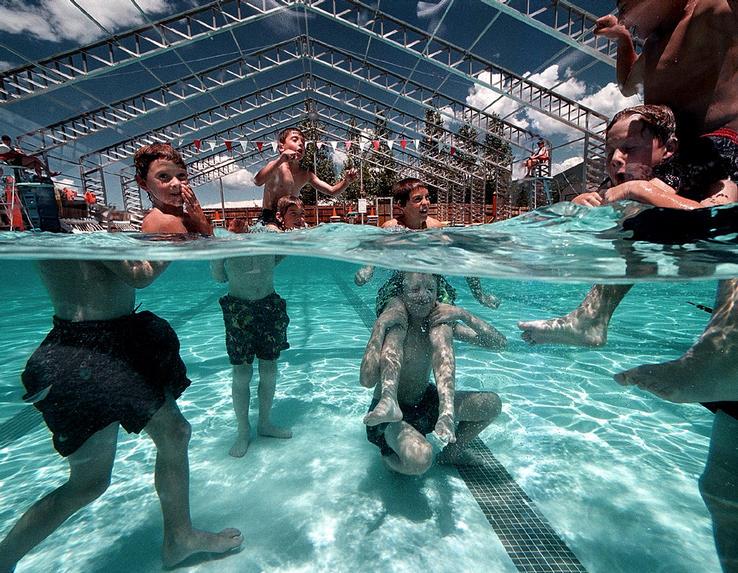
Why does the lower part of the child appear so much different in size from the upper part?
a)
The light rays that travel through water and then into air are refracted.
b)
The light rays that travel through water and then into air are enlarged.
c)
The light rays that travel through air and then into water are reflected.
d)
The light rays that travel through air and then into water are reduced.
17.

a)
Reflection
b)
Refraction
18.

a)
Refraction
b)
Reflection
19.

a)
Reflection
b)
Refraction
20.

a)
Reflection
b)
Refraction
21.

If the forces are the same in Scenario A and Scenario C, which ball would move the fastest?
a)
both balls would move at the same speed
b)
there is no way to determine which ball would move the fastest
c)
the ball in Scenario C
d)
the ball in Scenario A
22.
When conducting an experiment, in order to get reliable results, it is important to:
a)
Disregard results that do not match your hypothesis
b)
Test many different variables at the same time
c)
Test all forces at the same time
d)
Repeat the investigation several times
23.

Sebastian and JP wrap a copper wire around an iron nail and connect the ends of the wire to the battery. The nail attracts other small nails and paper clips as they stick together. What force is being observed?
a)
The students are observing the force of gravity.
b)
The students are observing the force of friction.
c)
The students are observing the force of magnetism.
d)
The students are observing the force of electricity.
24.

What is true about the image of the children on the swings?
a)
Both students are working even though only one is moving
b)
Student 1 is working because the swing is moving
c)
Earth's gravity is preventing Student 2 from moving
d)
Neither Student is working
25.

If you pull the cord, what direction will the box move?
a)
Up
b)
Down
c)
Left
d)
Right
26.

Which of these is NOT an example of a bicycle using mechanical energy?
a)
The pedals, gears, and chain turn the wheels.
b)
The wheels turn when the bicycle moves.
c)
The front wheel guides the bicycle when it moves.
d)
The reflector allows the bicycle to be seen at night.
100 %

