wayground logo

Free Printable Worksheets

NEW

Font size

S
M
L
XL
Worksheets

Work Power and Energy Variables

Total questions: 24

Worksheet time: 43mins

Name
Class
Date
1.

What is the equation for Kinetic Energy

a)

Ek=1/2 (mv2)

b)

Ek=Fd

c)

Ek=1/2 (kx2)

d)

Ek=mgh

2.

A joule is a unit of

a)

power

b)

heat

c)

energy

d)

current

3.

A 10 kg box is pulled a distance of 3m by a force of 30 N.

The work done is

a)

9 J

b)

30 J

c)

90 J

d)

900 J

4.

A girl weighs 400 N. She runs up a flight of stairs of height 5 m in 4 seconds. Her power is:

a)

320 W

b)

400 W

c)

500 W

d)

2 000 W

5.

Which of the following statements are true about work?

a)

Work is a form of energy.

b)

A Watt is the standard metric unit of work.

c)

Work is a time-based quantity; it is dependent upon how fast a force displaces an object.

d)

None of these.

6.

Which of the following statements are true about power?

a)

If person A and person B do the same job but person B does it faster, then person A does more work but person B has more power.

b)

Powerful people or powerful machines are simply people or machines which always do a lot of work.

c)

Power refers to how fast work is done upon an object.

d)

None of these

7.

Which of the following statements are true about kinetic energy?

a)

None of these

b)

Kinetic energy is the form of mechanical energy which depends upon the position of an object.

c)

If an object is at rest, then it does not have any kinetic energy.

d)

If an object is on the ground, then it does not have any kinetic energy.

8.

Which of the following statements are true about potential energy?

a)

Both gravitational and elastic potential energy are dependent upon the speed of an object.

b)

Moving objects cannot have potential energy.

c)

None of these

d)

Potential energy is the energy stored in an object due to its position.

9.

At which point is potential energy greatest?

a)

W

b)

X

c)

Y

d)

Z

10.
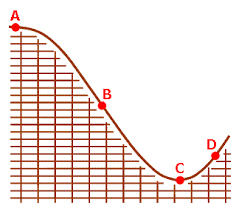
At which point(s) on the roller coaster is the kinetic energy at its maximum?
a)
A
b)
B
c)
C
d)
D
11.
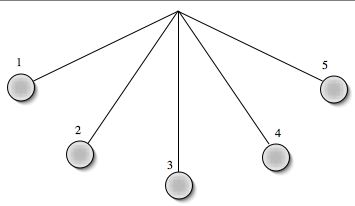
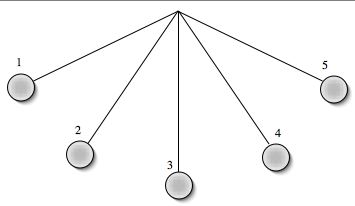
When a pendulum swings, at which point is potential energy at its greatest?
a)
1
b)
2
c)
3
d)
4
12.
When a pendulum swings, at which point is kinetic energy highest?
a)
1
b)
2
c)
3
d)
4
13.

What type of energy is stored in food and fuel?

a)

Chemical

b)

Thermal

c)

Potential

d)

Calories

14.
Energy of motion is which type of energy?
a)
Potential
b)
Kinetic
c)
Sound
d)
Gravitational
15.
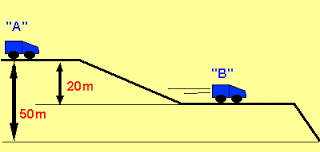
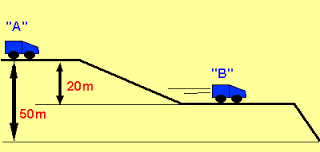
In diagram 2, if the mass of the car is 600 kg, what is the change in potential energy from point A to point B?
a)
411,600 J
b)
294,000
c)
176,400 J
d)
117,600 J
16.
In diagram 2, if the 600 kg cart is initially at rest, what is its velocity at point B?
a)
19.8 m/s
b)
15.0 m/s
c)
10.3 m/s
d)
3.8 m/s
17.
A cheetah can run briefly with a speed of 31m/s.  Suppose a cheetah with a mass of 47 kg runs at this speed.  What is the cheetah’s kinetic energy?
a)
22583.5 J
b)
728.5 J
c)
1457 J
d)
0.75 J
18.
When a 65 kg skydiver jumps from a plane, her speed steadily increases until air resistance provides a force that balances the force due to free fall.  How fast is the skydiver falling if her kinetic energy at the moment is 704000J?
a)
21661.53 m/s
b)
147.17 m/s
c)
22880.0 km/s
d)
10830.76 m/s
19.
A bike rider approaches a hill at a speed of 5.5 m/s. The combined mass of the bike and rider is 87kg. Find the initial kinetic energy of the system. 
The rider coasts up the hill. Ignoring friction, at what height will the bike come to rest?
a)
1316J, 1.5m
b)
2316J, 2.5m
c)
1457J, 3.5m
d)
none of the above
20.
What does the Law of Conservation of Energy state?
a)
Energy cannot be created or destroyed
b)
Nothing can exchange energy
c)
Energy will increase over time.
d)
Energy will decrease over time.
21.
A bead is moving with a speed of 20 m/s at position A on the track shown in the figure. This track is friction-free, and there is no appreciable air resistance. What is the speed of the bead at point C?
a)
0 m/s
b)
34 m/s
c)
69 m/s
d)
20 m/s
22.
A 60-kg skier pushes off the top of a frictionless hill with an initial speed of 4.0 m/s.  How fast will she be moving after dropping 10 m in elevation? Air resistance is negligible.
a)
0.20 km/s
b)
15 m/s
c)
10 m/s
d)
0.15 km/s
23.
A heavy sled and a light sled, both moving horizontally with the same kinetic energy, suddenly slide onto a rough patch of snow and eventually come to a stop. The coefficient of kinetic friction between the sleds and the rough snow is the same for both of them. Which of the following statements about these sleds are correct? 
a)
The light sled will slide farther on the rough snow than the heavy sled.
b)
The heavy sled will slide farther on the rough snow than the light sled.
c)
Both sleds will slide the same distance on the rough snow before stopping.
d)
All the statements are correct
24.

A 3 kg object moving at 5 m/s has a force applied causing it to come to a stop over a distance of 8 meters. How much work was done on the object and what was the force on the object?

a)

Work = 40 Joules

Force = 100 N

b)

Work = 75 Joules

Force = 9.4 N

c)

Work = 37.5 Joules

Force = 4.7 N

d)

No work was done and no force was applied to the object