
NEW
Font size
 Worksheets
Acid Base Titrations
Total questions: 20
Worksheet time: 19mins

A standard solution is a solution with accurately known concentration.
True
False
What is the main purpose of acid-base titrations?
To test if reactants react.
To calculate the concentration of unknown acid or base.
To test quality of reactants.
What is an equivalence point?
It is the point when enough analyte has been added.
It is the point when the amount of added titrant is equal to the amount of analyte in the solution.
It is the point when the volume of titrant is equivalent the volume of analyte.
It is the point when the concentration of titrant added is equivalent to the volume of analyte.
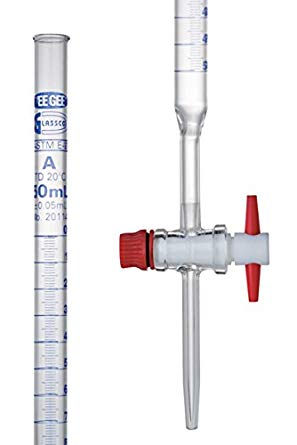
What is this piece of apparatus called
Pipette
Burette
Janette
Cuvette
1) 0.9 M NaOH is load into a buret - initial reading is 2.6 mL
2) 100 mL of unknown monoprotic acid is placed under the buret.
3) 2 drops of phenolphthalein is added to the acid.
4) The base is slowly added to the acid until it turns pink. - final reading from the buret is 23.6 mL.
WHAT IS THE MOLARITY OF THE ACID?
0.9 M
0.0189 M
0.189 M
21 M
What is the role of an indicator in a reaction?
To help reactants react successfully.
To bind to the analyte to form a products.
To show when the reaction has reached or past the equivalence point.
To provide a surface for the reaction to occur.
What is an equivalence point?
It is the point when enough analyte has been added.
It is the point when the amount of added titrant is equal to the amount of analyte in the solution.
It is the point when the volume of titrant is equivalent the volume of analyte.
It is the point when the concentration of titrant added is equivalent to the volume of analyte.


20ml of 0.1M of acids are used below, which acid require a diff vol to neutralize 0.1M NaOH?
Nitric acid
Sulfuric acid
Hydrochloric acid


