
 Worksheets
Plate Tectonics Earthquakes Volcanoes
Total questions: 38
Worksheet time: 3hrs 10mins
Non-explosive, gently sloping volcano made of flat layers of basaltic lava
Cinder cone
Shield
Composite
Transform
Theory that Earth's lithosphere is divided into plates & the plates move around on the asthenosphere
Seafloor spreading
Plate tectonics
Continental drift
Earthquakes
Boundary between two plates moving toward each other
Transform fault boundary
Divergent boundary
Convergent boundary
Strike-slip fault
Shaking of the ground caused by sudden movement of large blocks of rocks along a fault
Earthquake
Volcano
Tsunami
Surface waves
In an earthquake, the point underground where the rocks first begin to move
Epicenter
Normal fault
Focus
Reverse fault
These waves move along Earth's surface & cause the most damage
P waves
S waves
L waves
D waves
The point on Earth's surface directly above the focus of an earthquake
Juan de fuca plate
Focus
Seismic wave
Epicenter
Small, steep-sided volcanoes made of loosely packed layers of tephra, very explosive eruptions
Cinder cone volcano
Shield volcano
Composite volcano
Mauna Loa volcano
Boundary between 2 plates that are sliding horizontally past one another
Transform fault boundary
Convergent boundary
Divergent boundary
Reverse fault
In these faults, blocks of rock move sideways on either side of the fault plane (no vertical motion)
Reverse faults
Convergent boundary
Normal faults
Strike-slip faults
Volcanoes having alternate layers of lava & ash, have repeated explosive & non-explosive eruptions
Composite volcano
Shield volcano
Mid-ocean ridge
Cinder cone volcano
In these faults, the block of rock above the fault plane (the hanging wall) slides down relative to the other block (the foot wall)
Normal fault
Reverse fault
Backwards fault
Strike-slip fault
Along these faults, the block of rock above the fault plane (hanging wall) moves up relative to the other block (foot wall)
Reverse fault
Normal fault
Upside down fault
Strike-slip fault
The 1st seismic waves to arrive at any particular location after an earthquake, also called P-waves
Surface waves
Primary waves
Secondary waves
Love waves
Boundary between 2 plates that are moving apart
Convergent boundary
Transform fault boundary
Sideways boundary
Divergent boundary
An upward fold in the rock makes an arch called a(n)
anticline
syncline
folded mountain
fault block

What is the liquid layer, #19, called? Diagram not to scale.
mantle
lithosphere
inner core
outer core
This layer is 67% of Earth's mass, and is the layer between the crust and the core
Mantle
Asthenosphere
Oceanic Crust
Mesosphere
Why were magnetic patterns, found on the ocean floor, so puzzling?
They showed alternating bands of normal and reversed polarity.
No rocks were magnetic.
They did not show alternating bands of normal and reversed polarity.
All rocks were magnetic.


Where are the Rocky Mountains?
Asia
North America
Africa
Europe

What is the following Latin American physical feature? (labeled by red triangles)
Himalayan Mountains
Rocky Mountains
Alp Mountains
Andes Mountains
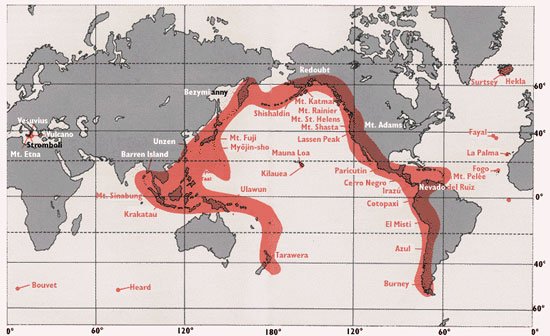
In a hot spot scenario, which of the following will move with time ?
the hot spot
the plate
neither move
both move

A____________________ is an eruption of jets of heated water and steam into the air.
hot spring
geyser
gorge
volcano

The Grand Prismatic ____________ in Yellowstone National Park is filled with hot mineral water, as indicated by the beautiful colours. (It really does look like this!)
geyser
hot spring
fumarole
volcano
What do we use to measure earthquakes?
Richter and Mercalli scales
ruler and digital scale
books and a wave machine
Magnitude and longitude
What is intensity?
the measure of impact and damage the earthquake had
the measurement of energy released from the earthquake
the measurement of waves from an earthquake
On the Richter scale what does the ground movement increase by when the scale goes up from 5 to 6?
factor of 1
factor of 10
factor of 100
factor of 30
Tsunamis are caused by
underwater disturbances such as earthquakes, landslides, and volcanoes.
wind and the gravitational pull of the moon.

Where are the P-waves located on this seismogram?
A
B
C
D


