
 Worksheets
High School Physical Science Milestone Review
Total questions: 23
Worksheet time: 12mins
Name
Class
Date
1.
Law of conservation states that matter CANNOT be _________ or _________
a)
created or destroyed
b)
invented or deconstructed
c)
transformed or transferred
d)
in or out
2.

A rock at the edge of a cliff.
a)
Potential
b)
Kinetic
3.

At which point is potential energy greatest
a)
W
b)
X
c)
Y
d)
Z
4.

What type of heat transfer is A?
a)
convection
b)
radiation
c)
conduction
d)
heat
5.
What type of heat transfer is B?
a)
convection
b)
radiation
c)
conduction
d)
heat
6.
What type of heat transfer is C?
a)
convection
b)
radiation
c)
conduction
d)
heat
7.
A wave with a large wavelength will have a ______ frequency and _____ energy
a)
high, low
b)
high, high
c)
low, high
d)
low, low
8.

The blue section of the wave is measuring _________________.
a)
wavelength
b)
crest
c)
trough
d)
amplitude
9.
How are electromagnetic waves different from other waves?
a)
They have very short wavelengths
b)
They transmit energy instead of matter
c)
They can travel through a vacuum
d)
They can change direction by reflection
10.
Which of the following lists components of the electromagnetic spectrum in order from the lowest frequency to the highest frequency?
a)
microwaves, infrared, gamma rays, xrays
b)
infrared, xrays, gamma rays, microwaves
c)
radio waves, visible spectrum, xrays, gamma rays
d)
gamma rays, xrays, visible spectrum, radio waves
11.
T/F? The greater the energy of an electromagnetic wave, the higher its frequency and the shorter its wavelength.
a)
True
b)
False
12.

Which has the most energy?
a)
Radio waves
b)
Gamma waves
c)
Visible Light
d)
When the masses of objects decrease, the distance between objects Microwaves
13.
When the frequency of a wave increases, what happens to the wavelength?
a)
The wavelength is not directly affected by the frequency of a wave.
b)
The wavelength increases.
c)
The wavelength decreases.
d)
More specific information is needed to form a conclusion about the wavelength.
14.
An object that blocks all of the light from passing through is...
a)
transparent
b)
clear
c)
opaque
d)
translucent
15.
This type of object lets some light through.
a)
transparent
b)
translucent
c)
co-parent
d)
opaque
16.
This type of object lets all light through.
a)
transparent
b)
translucent
c)
co-parent
d)
opaque
17.
True or False: Sound travels better through solids than through liquids
a)
True
b)
False
18.
Light waves travel at different speeds through different media. Which list shows the correct order of increasing speed of light waves in media, from slowest to fastest?
a)
solids → liquids → gases → vacuum
b)
vacuum → gases → liquids → solids
c)
gases → liquids → solids → vacuum
d)
liquids → solids → gases → vacuum
19.
Movers slide a box down the ramp of a truck.
What helps slow the box as it slides to the bottom of the ramp?
What helps slow the box as it slides to the bottom of the ramp?
a)
friction
b)
gravity
c)
inertia
d)
magnetism
20.
"The amount of chemical energy in a flashlight's battery is equal to the radiant energy transferred to the environment." Is this statement correct?
a)
Yes, flashlights are 100% efficient at transferring the chemical energy of the battery into radiant energy.
b)
No, all energy transformations are inefficient. Some of the chemical energy will be lost as thermal energy.
c)
No, the Law of Conservation of Energy does not apply to this situation because thesystem is not closed
d)
Yes, the Law of Conservation of Energy states that the total energy in a system can never be created or destroyed.
21.
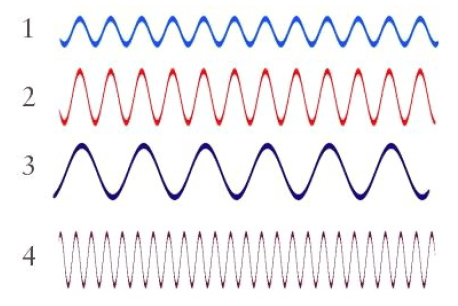
Which wave in the diagram has the greatest frequency?
a)
1
b)
2
c)
3
d)
4
22.
T/F? all energy transformations are inefficient.
a)
True
b)
False
23.

High frequency waves have _________ wavelengths.
a)
varying
b)
long
c)
the same
d)
short
100 %

