
 Worksheets
Chapter 6 Chemical Bonds
Total questions: 25
Worksheet time: 50mins
Name
Class
Date
1.
An ionic bond forms when atoms ___________ electrons.
a)
gain
b)
share
c)
increase
d)
transfer
2.
Which type of bond has an equal sharing of electrons?
a)
Polar Covalent
b)
Non Polar Covalent
c)
Ionic
d)
Metallic
3.
Which type of bond has an unequal sharing of electrons?
a)
Polar Covalent
b)
Non Polar Covalent
c)
Ionic
d)
Metallic
4.
Which type of bond has a transfer of an electron from on atom to another?
a)
Polar Covalent
b)
Non Polar Covalent
c)
Ionic
d)
Metallic
5.
Chemical bonds form when atoms
a)
combined nuclei
b)
give up neutrons
c)
gain protons
d)
share or transfer electrons
6.
Covalent compounds
a)
Share electrons
b)
transfer electrons
c)
contain a sea of electrons
d)
conduct electricity
7.
What is the number of valence electrons for Oxygen?
a)
8
b)
6
c)
2
d)
1
8.

How many valence electrons in this structure?
a)
6
b)
5
c)
4
d)
7
9.
A bond that forms when electrons are transferred is called a/an
a)
ionic bond
b)
covalent bond
c)
hydrogen bond
10.
When electrons are shared unequally a/an ___________ bond is formed
a)
ionic
b)
hydrogen
c)
polar covalent
11.
The chemical bond formed when two atoms share electrons is called a(an) IONIC bond.
a)
True
b)
False
12.
Are the atoms more stable when they are bonded together or when they are apart?
a)
Bonded Together
b)
Apart
13.
Predict the bond that will form between Be and F.
a)
Ionic
b)
Covalent
14.
Predict the bond that will form between Se and Cl.
a)
Ionic
b)
Covalent
15.
Predict the bond that will form between Sr and S.
a)
Ionic
b)
Covalent
16.
Which group includes non-reactive gasses that have a full outer electron shell?
a)
Alkai Metals
b)
Alkaline Metals
c)
Halogens
d)
Noble Gases
17.
Which of the following is an Alkaline Earth Metal?
a)
Calcium (Ca)
b)
Lithium (Li)
c)
Phosphorus (P)
d)
Copper (Cu)
18.
Statement that when the elements are arranged by increasing atomic number, there is a periodic repetition of their chemical and physical properties.
a)
octet rule
b)
periodic law
c)
transition elements
d)
noble gases
19.
Groups 1 and 2, 13 through 18
a)
halogens
b)
alkali metals
c)
representative elements
d)
transition elements
20.
Groups 3 through 12
a)
halogens
b)
alkali metals
c)
representative elements
d)
transition elements
21.
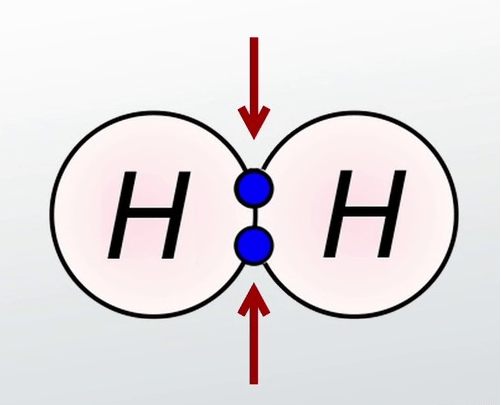
What type of bond is shown in this image?
a)
Ionic
b)
Polar Covalent
c)
Nonpolar Covalent
d)
Van der Waals Force
22.
The electronegativity difference in the bonds of CH4 (methane) is:
a)
0.4
b)
5.9
c)
-0.4
d)
1.7
23.
The electronegativity difference in the bonds of CCl4 (carbon tetrachloride) is:
a)
0.4
b)
0.5
c)
9.5
d)
5.5
24.
If Bromine bonds with Hydrogen, a ____________ bond forms.
a)
polar covalent
b)
nonpolar covalent
c)
metallic
d)
ionic
25.
If Boron bonds with Hydrogen, a ____________ bond forms.
a)
polar covalent
b)
nonpolar covalent
c)
metallic
d)
ionic
100 %

