
NEW
Font size
S
M
L
XL
 Worksheets
Layers of the Earth
Total questions: 25
Worksheet time: 44mins
Name
Class
Date
1.
This layer contains most of Earth's mass.
a)
Inner Core
b)
Mantle
c)
Outer Core
d)
Crust
2.
The partially melted portion of the mantle below the lithosphere
a)
mantle
b)
core
c)
crust
d)
asthenosphere
3.
The rigid outermost layer of Earth that includes the uppermost mantle and crust.
a)
asthenosphere
b)
lithosphere
c)
core
d)
mantle
4.
The thick middle layer in the solid part of the Earth.
a)
asthenosphere
b)
lithosphere
c)
mantle
d)
core
5.
Which layer of Earth do we live on?
a)
outer core
b)
inner core
c)
crust
d)
mantle
6.
Some students use an apple to represent the Earth. What is the best reason to use an apple for this comparison?
a)
The skin of the apple is very thin, and the crust of the Earth is very thin.
b)
The flesh of an apple is made of the same material all the way through, and the interior of the Earth is the same all the way through.
c)
The seeds of the apple are very light in comparison to the rest of the apple, and the core of the Earth is also made of very light matter.
d)
The stem of the apple comes from the core and the North Pole comes from the Earth’s core.
7.
What is the outer core composed of?
a)
Basalt
b)
Granite
c)
Solid Metals
d)
Molten (liquid) Metals
8.
What layer of the Earth is the hottest?
a)
Core
b)
Crust
c)
Mantle
9.
Earth's plates are...
a)
constantly moving and changing the face of the earth
b)
Never moves
c)
Moves seldom and very fast
d)
Moves when it feels like it
10.

Scientists think that convection currents that move the plates flow in Earth's
a)
Continental crust
b)
Oceanic crust
c)
Asthenosphere
d)
Lithosphere
11.
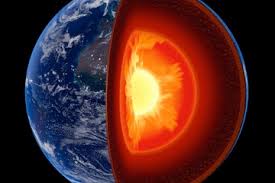
As you travel from the inner core to the crust, how would temperature, pressure and density of the material change?
a)
The would all increase
b)
The would all decrease.
c)
They would stay the same.
d)
Temperature would decrease, but pressure and density would increase.
12.
The oceanic floor is made of?
a)
Granite
b)
Basalt
c)
Cookies
d)
Water
13.
The continental floor is made up of?
a)
Flowers and grass
b)
Basalt
c)
Granite
d)
Crust
14.
Which layer of Earth has the GREATEST density?
a)
crust
b)
mantle
c)
outer core
d)
inner core
15.
Heat transfer within a fluid takes place by...
a)
convection currents
b)
radiation
c)
conduction
d)
density
16.
What are the two types of crust
a)
continental and oceanic
b)
ocean and upper
c)
lower and upper
d)
pizza and subway
17.
What are the two types of crust
a)
continental and oceanic
b)
ocean and upper
c)
lower and upper
d)
pizza and subway
18.
This layer of Earth is the thickest part
a)
crust
b)
outer core
c)
mantle
d)
inner core
19.
Where is the Earth's crust the thickest?
a)
Oceans
b)
Equator
c)
Mountains
d)
North and South Poles
20.
What layer of the Earth is liquid?
a)
upper mantle
b)
lower mantle
c)
outer core
d)
inner core
21.
What is a tectonic plate?
a)
A piece of the Moon
b)
A piece of the Earth's crust
c)
A piece of the mantle
d)
The center of the Eart
22.

What can tectonic plates crashing into each other cause?
a)
Hurricanes
b)
Rain
c)
Floods
d)
Earthquakes
23.

What can we learn from fossils?
a)
How earthquakes are created
b)
How erosion created changed mountains
c)
How the moon was created
d)
How Earth's environment has changed over time
24.

What might you conclude if a fish fossil was found on top of a mountain in Georgia?
a)
An ocean once covered that area of Georgia
b)
The fish evolved wings and could fly
c)
An earthquake caused the fish to migrate to the mountaintop
d)
A forest once covered the area of Georgia
25.
What observation can we make about Earth’s lithosphere AND asthenosphere?
a)
The asthenosphere floats on top of the lithosphere.
b)
The crust and the core make up the lithosphere.
c)
The crust and mantle make up the asthenosphere.
d)
The lithosphere floats on top of the asthenosphere
Reset

