
NEW
Font size
S
M
L
XL
 Worksheets
Electrolytic Cells
Total questions: 25
Worksheet time: 13mins
Name
Class
Date
1.

What happens at the positive electrode in a voltaic cell and in an electrolytic cell?
a)
A
b)
B
c)
C
d)
D
2.

What are produced at positive/negative electrodes during electrolysis of molten NaCI?
a)
A
b)
B
c)
C
d)
D
3.

Which factors affect amount of metal formed during electrolysis?
a)
I and II
b)
I and III
c)
II and III
d)
I, II and III
4.

What occurs during electrolysis of a molten salt?
a)
Electricity is produced by a spontaneous redox reaction
b)
Electricity cause a non-spontaneous redox reaction to occur
c)
Electrons flow through the molten salt
d)
Electrons are removed from both ions of the molten salt
5.

Object is electroplated with copper using copper(II) sulfate. Which statement is correct?
a)
Positive electrode increases in mass
b)
Concentration of Cu2+ ions in solution decreases
c)
Reduction occurs at positive electrode
d)
Reaction at negative electrode is Cu2+ + 2e– → Cu
6.
The ease of discharge of metal ions decreases down the electrochemical series.
a)
True
b)
False
7.
What is the name of the positive electrode in an electrolytic cell?
a)
cathode
b)
anode
8.
What is the name of the negative electrode in an electrolytic cell ?
a)
cathode
b)
anode
9.
The electrode connected to the positive terminal of a battery is __________.
a)
cathode
b)
anode
10.
Anion loses electrons at the
a)
cathode
b)
anode
11.
Reduction occurs at the
a)
anode
b)
cathode
12.
What kind of Electrical Current does Electroysis require?
a)
Direct
b)
Indirect
c)
Anternative
d)
A alternating
13.
What is electrolysis?
a)
breaking down of a compound using a current
b)
making a compound using a current
14.
Explain why the electrolyte has to be a liquid.
a)
So the ions can move
b)
So the electrons can move
c)
So that it doesn't get too hot
d)
So the fish are ok
15.
What happens at the positive electrode?
a)
Positive non-metal ions are attracted
b)
Positive metal ions are attracted
c)
Negative non-metal ions are attracted
d)
Negative metal ions are attracted
16.
When NaCl solution is electrolysed what has forms at the anode?
a)
Hydrogen
b)
Oxygen
c)
Chlorine
d)
Sodium
17.
Complete the half equation Al3+ -->
a)
Al3+ - 3e- --> Al
b)
Al2+ + 3e- --> Al
c)
Al3+ + 3e- --> Al
d)
Al3+ --> Al + 3e-
18.
What is the name given to the solution that is being electrolysed?
a)
Salt solution
b)
Electric solution
c)
Mineral solution
d)
Electrolyte
19.
Describe oxidation in terms of electrons
a)
oxidation is gain of electrons
b)
oxidation is loss of electrons
20.
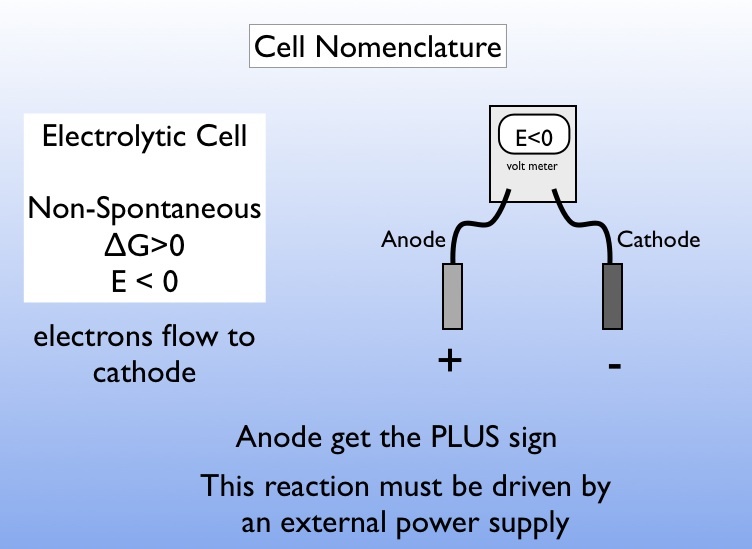
What is an electrolytic cell?
a)
a cell that converts chemical energy into electrical energy
b)
a cell that converts electrical energy into electrical energy
c)
a cell that converts electrical energy into chemical energy
d)
A cell that converts kinetic energy into potential energy.
21.

What does electrolysis mean?
a)
electric splitting
b)
electric combining
c)
proton splitting
d)
proton combining
22.
7. How do you test for Hydrogen gas?
a)
a) Lime water goes milky/cloudy
b)
b) Relights a glowing splint
c)
c) Lighted splint gives a squeaky pop.
d)
d) Bleaches damp indicator paper.
23.
6. How do you test for Oxygen gas?
a)
a) Lime water goes milky/cloudy
b)
b) Relights a glowing splint
c)
c) Lighted splint gives a squeaky pop.
d)
d) Bleaches damp indicator paper.
24.
What would molten potassium bromide break down into?
a)
Potassium and bromide
b)
Potassium and bromine
c)
Just potassium
d)
Just bromine
e)
Just bromide
25.
When NaCl solution is electrolysed what has forms at the anode?
a)
Hydrogen
b)
Oxygen
c)
Chlorine
d)
Sodium
Reset

