wayground logo

Free Printable Worksheets

Font size

S
M
L
XL
Worksheets

Water Distribution, Water Cycle, Ocean Floor, Heat Transfer

Total questions: 143

Worksheet time: 6hrs 14mins

Name
Class
Date
1.
The water that falls from the sky can be _______ or collected, and stored in rivers, lakes, and oceans.
a)
accumulated
b)
runoff
c)
ground water
d)
transpiration
2.
Water from rain or snow that flows over the surface of the land into streams, rivers, and lakes is called...
a)
accumulation
b)
runoff
c)
ground water
d)
surface water
3.
The process by which plants release water through the pores in their leaves is called...
a)
accumulation
b)
dormancy 
c)
photosynthesis 
d)
transpiration
4.
The transformation of water vapor back into liquid water by cooling is called...
a)
condensation
b)
evaporation
5.
If a rain drop lands in the ocean, it will eventually _______, and return to the clouds.
a)
condense
b)
evaporate
6.
After liquid water turns into water vapor, it goes into the air where it becomes a...
a)
glacier
b)
cloud
c)
surface water
d)
ground water
7.
Water vapor is the _______ form of water.
a)
solid
b)
liquid
c)
gaseous
8.
The higher water vapor rises in the atmosphere the _______ it gets.
a)
warmer
b)
colder
9.
Any form of water that falls from clouds and reaches Earth's surface as rain, snow, sleet, or hail is called...
a)
surface water
b)
precipitation 
c)
ground water
d)
runoff
10.
All of the water we see in lakes, rivers, and oceans is called...
a)
runoff
b)
surface water
c)
ground water
11.
What collects in cracks and spaces in the rocks and sediments beneath Earth's surface?
a)
runoff
b)
surface water
c)
ground water
d)
water vapor
12.
What can carry pollutants from the soil into rivers and streams?
a)
runoff water
b)
sunlight and heat
c)
water vapor
13.
What can cause surface water to evaporate forming water vapor?
a)
runoff water
b)
wind and heat
c)
pollutants 
d)
clouds
14.
The energy that drives the water cycle comes from the...
a)
Sun
b)
Moon
c)
Clouds
15.
When precipitation hits the ground, it can flow over the surface of the Earth, or...
a)
be absorbed into the ground
b)
immediately turn into a cloud
16.
Evaporation occurs when the sun heats up water in rivers, lakes, or the ocean, and turns it into...
a)
snow
b)
water vapor
c)
rain
d)
sleet
17.
The continuous movement of water from Earth's surface to the atmosphere and back again.
a)
water cycle
b)
weather
c)
rock cycle
18.
The mass of air surrounding the Earth.
a)
atmosphere
b)
clouds
c)
water cycle
d)
weather
19.
The water cycle plays a key role in _______ around the world.
a)
weather
b)
climate
20.
How much of Earth's freshwater is available for use?
a)
97%
b)
3%
c)
2%
d)
1%
21.
What is the energy source for the water cycle?
a)
the sun
b)
the earth
c)
water
d)
the moon
22.
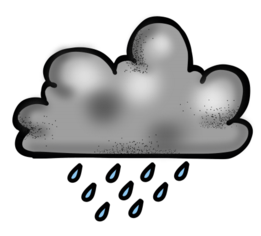
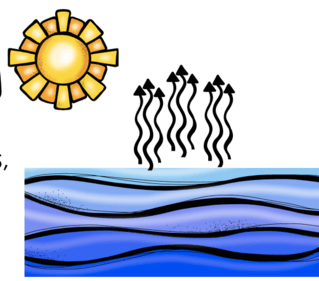
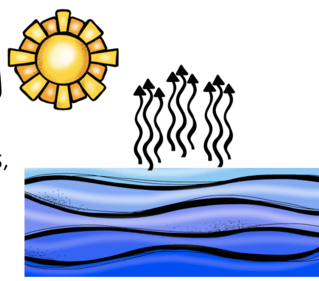
What part of the water cycle does this picture show?
a)
condensation
b)
precipitation
c)
evaporation
23.
What part of the water cycle does this picture show?
a)
condensation
b)
precipitation
c)
evaporation
24.
When water condenses, the water vapor in the air gets ___________ and changes back into liquid.
a)
cold
b)
hot
c)
warm
d)
solid
25.
Which is the opposite of condensation?
a)
runoff
b)
evaporation
c)
precipitation
d)
transpiration
26.
Which best explains why runoff is important?
a)
It returns water to other locations on Earth
b)
It increases the chance of flooding
c)
It makes evaporation occur faster
d)
It increases condensation
27.
What is it called when plants give off water vapor as a waste product?
a)
condensation
b)
evaporation
c)
sublimation
d)
transpiration
28.
When water _________, dew forms.
a)
Melts
b)
Evaporates
c)
Condenses
d)
Precipitates
29.
How much of our planet is estimated to be covered with water?
a)
68%
b)
50%
c)
97%
d)
75%
30.
How much of our planet's water is saltwater?
a)
75%
b)
1%
c)
99%
d)
97%
31.
Which of these is an example of precipitation?
a)
snow
b)
air
c)
clouds
d)
vapor
32.
Which is the opposite of condensation?
a)
runoff
b)
evaporation
c)
precipitation
d)
transpiration
33.
What is the water cycle?
a)
the 3 forms of water
b)
the movement of water on, above, or below the surface of the Earth
c)
when water melts
d)
when clouds form
34.
During which stage do clouds form?
a)
condensation
b)
evaporation
c)
precipitation
35.
Which stages does liquid water from the ocean turn into water vapor?
a)
condensation
b)
evaporation
c)
precipitation
d)
run off
36.
Which stage does ground water try to return to the ocean or soak into the ground?
a)
condensation
b)
evaporation
c)
precipitation
d)
run off
37.
What is A?
a)
Evaporation
b)
Condensation
c)
Precipitation
d)
Runoff
38.
What is B?
a)
Evaporation
b)
Condensation
c)
Precipitation
d)
Runoff
39.
What is C?
a)
Evaporation
b)
Condensation
c)
Precipitation
d)
Runoff
40.
What is D?
a)
Evaporation
b)
Condensation
c)
Precipitation
d)
Runoff
41.

When changing from a liquid to a gas, the water molecules are ____________________________.

a)

freezing and moving away from each other.

b)

evaporating and moving away from each other

c)

condensing and moving closer to each other

d)

evaporating and moving closer to each other

42.

When changing from a liquid to a solid, the water molecules are ____________________________.

a)

freezing and moving away from each other.

b)

evaporating and moving away from each other

c)

condensing and moving closer to each other

d)

freezing and moving closer to each other

43.

When changing from a solid to a liquid, the water molecules are ____________________________.

a)

melting and moving away from each other.

b)

evaporating and moving away from each other

c)

melting and moving closer to each other

d)

freezing and moving closer to each other

44.

When changing from a gas to a liquid, the water molecules are ____________________________.

a)

condensing and moving away from each other.

b)

evaporating and moving away from each other

c)

condensing and moving closer to each other

d)

freezing and moving closer to each other

45.

Water in its gas form is called ____________________,

a)

water vapor

b)

precipitation

c)

ice

d)

air

46.

Living things can be a part of the water cycle.

a)

True

b)

False

47.

This provides the power to keep the water cycle running.

a)

The Sun

b)

The Earth

c)

The wind

d)

living things

48.
What part of the water cycle does this picture show?
a)
condensation
b)
precipitation
c)
evaporation
49.
Which is the opposite of condensation?
a)
runoff
b)
evaporation
c)
precipitation
d)
transpiration
50.
Which best explains why runoff is important?
a)
It returns water to other locations on Earth
b)
It increases the chance of flooding
c)
It makes evaporation occur faster
d)
It increases condensation
51.
Snow, sleet, hail, and rain are all examples of  ________________. 
a)
evaporation
b)
condensation
c)
accumulation
d)
precipitation
52.
What follows evaporation during the water cycle? How does this occur?
a)
Water evaporates into water vapor
b)
Water vapor condenses and forms a  cloud
c)
Water precipitates to the ground
d)
Water runs down into the hydrosphere
53.
Precipitation happens when clouds of water droplets are too ______________.
a)
cold
b)
light
c)
heavy
d)
hot
54.
Evaporation happens when the sun ___________ water and turns it into vapor.
a)
cools
b)
heats up
c)
freezes
d)
lights up
55.

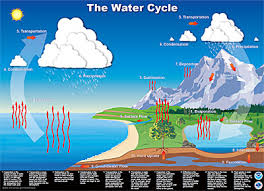
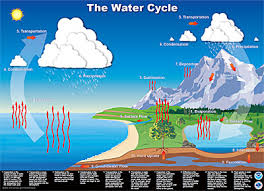
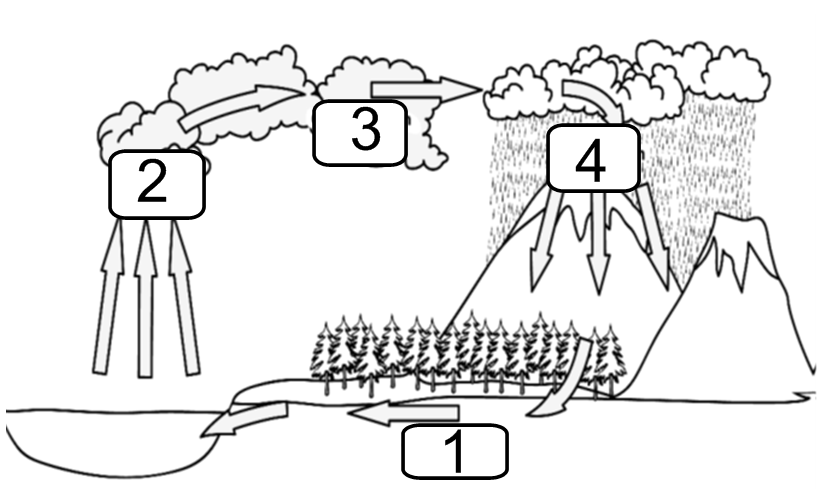
Which stage does the arrow below #2 show in the diagram?

a)

condensation

b)

evaporation

c)

precipitation

d)

run off

56.
Which stage does the #3 show in the diagram?
a)
condensation
b)
evaporation
c)
precipitation
d)
run off
57.
What is a man-made hole drilled below water table?
a)
natural spring
b)
lake
c)
wetlands
d)
well
58.
What is a layer of rock or sediment that holds water?
a)
glacier
b)
well
c)
aquifer
d)
natural spring
59.

What is precipitation?

a)

Sweat from our bodies on hot days

b)

Warm rain but not cold snow or sleet

c)

Gas that we use in furnaces or ovens

d)

Any form of water that falls from the sky

60.

What is another name or synonym for the water cycle?

a)

Geologic cycle

b)

Hydrologic cycle

c)

Geosphere

d)

Carbon cycle

61.

What is the energy source that drives the water cycle?

a)

The moon T

b)

The heat from our home in the winter all around the world

c)

The sun

d)

he heat generated solely from the core of the earth

62.

The _________ exerts a major influence on weather and climate by absorbing energy from the sun, releasing it over time, and globally redistributing it through ocean currents.

a)

Sun

b)

Ocean

c)

Continents

d)

Desert

63.

What are formed when water vapor condenses?

a)

Clouds

b)

Mountains

c)

Transpiration

d)

Valleys

64.

The act of turning from a gas into a liquid. ________________________

a)

Condensation

b)

Evaporation

c)

Transpiration

d)

Precipitation

65.

The movement caused within a fluid by the tendency of hotter and therefore less dense material to rise, and colder, denser material to sink under the influence of gravity, which consequently results in transfer of heat. ____________________

a)

Evaporation

b)

Convection

c)

Precipitation

d)

Transpiration

66.

The mixture of gases that surround the earth. ____________________

a)

Landforms

b)

Sun

c)

Atmosphere

d)

Weathering

67.

The process of eroding or being eroded by wind, water, or other natural agents. _______________________

a)

Runoff

b)

Sun

c)

Landforms

d)

weathering

68.

The act of turning from a liquid into a gas. ___________________

a)

Transpiration

b)

Condensation

c)

Evaporation

d)

Precipitation

69.

The major source of energy and the driving energy source of the water cycle. __________________

a)

moon

b)

ocaen

c)

Sun

d)

atmosphere

70.

A natural feature of the earth's surface. _____________________

a)

landforms

b)

sun

c)

erosion

d)

weathering

71.

The draining away of water from the surface of an area of land.

a)

weathering

b)

transpiration

c)

run-off

d)

precipitation

72.

The fall of water, ice, or snow deposited on the surface of the Earth from the atmosphere. __________

a)

Condensation

b)

Evaporation

c)

Precipitation

d)

Transpiration

73.

Wear away or change the appearance or texture of (something) by long exposure to the air. ________________

a)

Density

b)

Convection

c)

Atmosphere

d)

Erosion

74.
What part of the water cycle does this picture show?
a)
condensation
b)
precipitation
c)
evaporation
d)
transpiration
75.
Which of these is an example of precipitation?
a)
snow
b)
air
c)
clouds
d)
vapor
76.
Evaporation happens when the sun ___________ water and turns it into vapor.
a)
cools
b)
heats up
c)
freezes
d)
lights up
77.
What is the water cycle?
a)
the 3 forms of water
b)
the movement of water on, above, or below the surface of the Earth
c)
when water melts
d)
when clouds form
78.
What is water that flows in rivers and streams into the oceans and lakes?
a)
evaporating
b)
condensing
c)
precipitating
d)
runoff
79.
Where is most water found on Earth?
a)
glaciers
b)
lakes
c)
rivers
d)
oceans
80.
What source of energy evaporates the most water from Earth’s surface?
a)
volcanoes
b)
the sun
c)
lightning
d)
wind
81.
Which best explains why runoff is important?
a)
It returns water to other locations on Earth
b)
It increases the chance of flooding
c)
It makes evaporation occur faster
d)
It increases condensation
82.
What is it called when WATER is FORMED from an LIQUID to a WATER VAPOR Oor an [GAS]?
a)
EVAPORATION
b)
PRECIPITATION
c)
TRANSPIRATION
83.
What is precipitation?
a)
The part of the water cycle when the sun heats up water, turning it from a liquid into water vapor or steam. It rises from the ground into the air.
b)
The part of the water cycle when the water vapor in the air gets cold. The water turns back into a liquid and forms clouds.
c)
The part of the water cycle when clouds get heavy and can no longer hold the liquid water. This causes the water to fall from the sky to the earth as rain, snow, sleet, or hail.
84.
What is condensation?
a)
The part of the water cycle when the sun heats up water, turning it from a liquid into water vapor or steam. It rises from the ground into the air.
b)
The part of the water cycle when the water vapor in the air gets cold. The water turns back into a liquid and forms clouds.
c)
The part of the water cycle when clouds get heavy and can no longer hold the liquid water. This causes the water to fall from the sky to the earth as rain, snow, sleet, or hail.
85.
What is evaporation?
a)
The part of the water cycle when the sun heats up water, turning it from a liquid into water vapor or steam. It rises from the ground into the air.
b)
The part of the water cycle when the water vapor in the air gets cold. The water turns back into a liquid and forms clouds.
c)
The part of the water cycle when clouds get heavy and can no longer hold the liquid water. This causes the water to fall from the sky to the earth as rain, snow, sleet, or hail.
86.
What is water that flows in rivers and streams into the oceans and lakes?
a)
evaporating
b)
condensing
c)
precipitating
d)
runoff
87.
On which kind of day would you expect the most evaporation from the surface of a pond?
a)
cold, rainy
b)
cold, sunny
c)
warm, rainy
d)
warm, sunny
88.
Which of the following causes all of the water on the planet to change its state (solid, liquid, gas) and move through the water cycle?
a)
amount of plant matter
b)
location of ice caps
c)
size of ocean
d)
temperature
89.
What is water vapor?
a)
Water on the land (geosphere)
b)
Water in the air (atmosphere)
c)
Water in plants
d)
Water in the water (hydrosphere)
90.
What is      D?
a)
Evaporation
b)
Condensation
c)
Precipitation
d)
Runoff
91.
What percentage of Earth’s water is freshwater?
a)
75%
b)
3%
c)
1%
d)
97%
92.
What is water vapor doing when it changes to water?
a)
evaporating
b)
condensing
c)
precipitating
d)
runoff
93.
Which of these is not an example of precipitation?
a)
rain
b)
clouds
c)
sleet
d)
snow
94.
The water cycle is the movement of__________
a)
sun
b)
water
c)
precipitation
d)
movement
95.
When liquid water changes into gas called water vapor this called
a)
condensation
b)
evaporation
c)
precipatation
d)
runoff
96.
Water begins to evaporate when you add _______ to it.
a)
cold
b)
ice
c)
water cycle
d)
heat
97.
Which kind of water would you expect the most evaporation from on the surface of a pond?
a)
cold and rainy
b)
hot and rainy
c)
warm  and rainy
d)
warm and sunny
98.
When water vapor gas begins to change back into a liquid this is called.
a)
evaporation
b)
condensation
c)
water  cycle
d)
precipatation
99.
Where do we see condensation happening in the water cycle?
a)
ocean water
b)
clouds
c)
run off
d)
ground water/ soil
100.
The ______________is the beginning source of energy for the water cycle.
a)
sun
b)
wind
c)
geothermal
d)
volcano
101.
What happens to water after it falls from clouds as rain?
a)
forms a puddle
b)
soaks into the ground
c)
All of the above
d)
runs off mountains and hills in bodies of water
102.
Where does the water cycle begin?
a)
precipitation, condensation, evaporation, and runoff
b)
precipitation, condensation, evaportation, and runoff
c)
evaporation, condensation, precipitation, and runoff
d)
runoff, precipitation, condensation, and evaporation
103.
Where is most water found on the Earth? 
a)
In Glaciers
b)
In Lakes
c)
In Rivers
d)
In the Ocean
104.
What source of energy evaporates the most water from Earth's surface? 
a)
Volcanoes
b)
Sun
c)
Lightening
d)
Wind
105.
What is water doing when it changes to water? 
a)
Evaporating
b)
Condensing
c)
Precipitating
106.
What controls whether water is a gas, liquid, or solid ice? 
a)
the shape or size of the cup
b)
where it has been stored
c)
if it is being used for irrigation
d)
what its temperature is 
107.
Many Utah towns use water from wells for drinking.  How does water get into wells? 
a)
it has to be poured into them from water tanks
b)
rain sinks down through the soil into them 
c)
it is pumped by large engines into the well
d)
it evaporates from inside the Earth
108.
On which kind of day would you expect the most evaporation from the surface of a pond? 
a)
cold, rainy
b)
cold, sunny
c)
warm, rainy
d)
warm, sunny
109.
Which type of rainfall would be most helpful to farmers? 
a)
rainfall that evaporates quickly
b)
rainfall that runs off the land quickly
c)
rainfall that soaks into the soil slowly 
d)
very little rainfall
110.
River, streams and oceans are all points of _____________ in the water cycle.
a)
collection 
b)
precipitation
c)
condensation
d)
evaporation
111.
Predict what might happen to a river when heavy rains soak the soil near it.  The river will 
a)
sink
b)
rise
c)
freeze
d)
not change
112.
What part of the water cycle does this picture show?
a)
condensation
b)
precipitation
c)
evaporation
113.
Which of these is an example of precipitation?
a)
snow
b)
air
c)
clouds
d)
vapor
114.
Which is the opposite of condensation?
a)
runoff
b)
evaporation
c)
precipitation
d)
transpiration
115.
Which best explains why runoff is important?
a)
It returns water to other locations on Earth
b)
It increases the chance of flooding
c)
It makes evaporation occur faster
d)
It increases condensation
116.
Which stage does the #2 show in the diagram?
a)
condensation
b)
evaporation
c)
precipitation
d)
run off
117.
The ________ is the driving force of the earth's surface.
a)
sun
b)
moon 
c)
stars
118.
The water cycle has no start or end
a)
true
b)
false
119.
This is a picture of
a)
snow
b)
rain
c)
fog
d)
hail
120.
Water freezes inside a cloud before it falls
a)
Rain
b)
Sleet
c)
Hail
d)
Snow
121.
What is the water cycle?
a)
the 3 forms of water
b)
the movement of water on, above, or below the surface of the Earth
c)
when water melts
d)
when clouds form
122.
Which of these is an example of precipitation?
a)
snow
b)
air
c)
clouds
d)
vapor
123.
Which best explains why runoff is important?
a)
It returns water to other locations on Earth
b)
It increases the chance of flooding
c)
It makes evaporation occur faster
d)
It increases condensation
124.
Snow, sleet, hail, and rain are all examples of  ________________. 
a)
evaporation
b)
condensation
c)
accumulation
d)
precipitation
125.
What does groundwater do?
a)
It sends water to our buildings, houses, and water transplant places
b)
Goes to the sky
c)
Goes to the sun
d)
Provides rivers
126.
After the rain falls down onto Earth's surface, what most likely happens?
What is it called?
a)
1. The remains of the water is soaked into the ground.
2.Groundwater
b)
1. Groundwater
2. The remains of the water is soaked into the ground.
c)
1. Groundwater
2. Transpiration happens to the plants.
d)
1. The liquid turns into a gas or water vapor
2. Evaporation
127.
When water _________, dew forms.
a)
Melts
b)
Evaporates
c)
Condenses
d)
Precipitates
128.
When the water vapor in the air changes back to liquid, what does it form?
a)
rain,hail,sleet, or snow
b)
water
c)
condensation 
d)
snow and water
129.
What could happen when a drop of water falls back to earth?
a)
it goes underground then into oceans,lakes, or rivers
b)
it goes into your mouth
c)
it goes underground
d)
it goes to the beach
130.
Does warm water evaporate quicker than cold water?
a)
Yes
b)
No
131.
Is humidity the amount of water in the air?
a)
Yes
b)
No
132.
What causes water vapor to move?
a)
wind 
b)
snow
c)
water
d)
lava
133.
What percentage of Earth’s water is freshwater?
a)
75%
b)
3%
c)
1%
d)
97%
134.
Why are clouds a key element of the water cycle?
a)
increase amount of water on the planet
b)
protect land from sunlight
c)
lower temperature of the air
d)
transport water from one part of the planet to another
135.
What source of energy evaporates the most water from Earth’s surface?
a)
volcanoes
b)
the sun
c)
lightning
d)
wind
136.
What is water vapor doing when it changes to water?
a)
evaporating
b)
condensing
c)
precipitating
d)
runoff
137.
What is the process of water droplets or ice crystals falling from the sky?
a)
evaporating
b)
condensing
c)
precipitating
d)
runoff
138.
What is water that flows in rivers and streams into the oceans and lakes?
a)
evaporating
b)
condensing
c)
precipitating
d)
runoff
139.
Where does condensation occur in the water cycle?
a)
clouds forming
b)
ocean water changing to water vapor
c)
water flowing down a river
d)
underground water soaking into soil
140.
How can water vapor in the air return to Earth?
a)
evaporates and blown by the wind
b)
evaporates and forms clouds
c)
condenses then precipitates
d)
sticks to any warm surface 
141.
On which kind of day would you expect the most evaporation from the surface of a pond?
a)
cold, rainy
b)
cold, sunny
c)
warm, rainy
d)
warm, sunny
142.
How do clouds change the influence of the sun on the water cycle?
a)
produce precipitation, resulting in more fresh water
b)
shield water sources from the sun, reducing evaporation
c)
enhance the heat of the sun on the earth
d)
focus the sun's light
143.
Which of the following causes all of the water on the planet to change its state (solid, liquid, gas) and move through the water cycle?
a)
amount of plant matter
b)
location of ice caps
c)
size of ocean
d)
temperature