
 Worksheets
Force Arrow Strength and Direction
Total questions: 28
Worksheet time: 2hrs 12mins
If an object is moving to the right, this force is pushing or pulling to the left:
friction
applied
normal
tension
The force that keeps objects on top of surfaces instead of letting them sink into the surface is known as:
normal
abnormal
static
inertia
The force exerted by ropes and chains is called
tension
normal
elastic
mechanical
In a force diagram, or free-body diagram, the size/length of the arrow tells you this about the force:
relative strength
relative distance
relative direction
In a force diagram, or free-body diagram, the pointy-end of the arrow tells you this about the force:
relative strength
relative distance
relative direction
When determining the NET force on an object you should (TWO correct answers)
subtract forces in opposite directions
add forces in the same direction
divide by velocity
multiply by acceleration
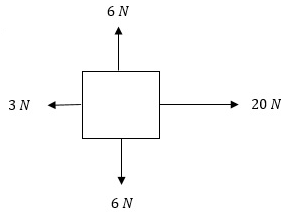
What is the NET FORCE of this diagram?
17 N, right
17 N, left
23 N, right
12 N, up
The best way to label a push or a pull on a diagram is to use


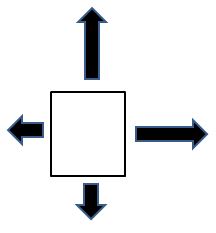
This object would be moving (pick all that are correct):
up
down
left
right
The down-arrow in this diagram is most-likely:
gravity
normal
a push or pull
friction
The up-arrow in this diagram is most-likely:
gravity
normal
a push or pull
friction
If this object were moving right, the left-arrow in this diagram is most-likely:
gravity
normal
a push or pull
friction

Which of the following best describes the object in this diagram.
A box sitting on the floor.
A hockey puck gliding to the right.
An athlete running to the right.
A skateboarding gliding to the left.
Which diagram best shows person pushing a couch (accelerating) across the floor?


This diagram can be used to indicate which of the following? (TWO correct answers)
a object at rest
an object moving at a constant velocity (speed)
an object accelerating
(Trick question -- there is only one correct answer)
an object decelerating
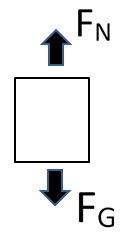
Which of the following is true about this free-body diagram?
the forces are are balanced
the object is free-falling
the object is moving upward
the forces are unbalanced
Which of the following is the same as INERTIA? (pick two)
object at rest
object moving at a constant velocity
momentum
force



