
 Worksheets
Seeds Roots Stems
Total questions: 25
Worksheet time: 14mins
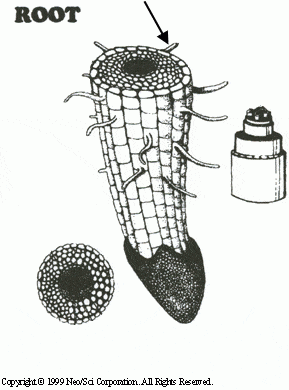
Which structure of the plant is responsible for transport?
Flower
Leaf
Stem
Root

Structures of the root that protect the root from injuries as it grows deeper into the soil are called __________________.
root feathers
root caps
root hairs
root fingers
In roots, where are phloem and xylem located?
In the center
Arranged in rings
In the root cap
Immediately under the surface cells
What is the function of the cortex of the root?
Filtering of minerals
Create an outer covering
Protect plants from disease
Storage, support, and movement of minerals and water
Which of the following best describes the movement of water through a plant root?
Cortex --> Root hair --> Endodermis --> Epidermis -->Vascular cylinder
Endodermis --> Vascular cylinder --> Cortex --> Root hair --> Epidermis
Root hair --> Epidermis --> Endodermis --> Vascular cylinder --> Cortex
Root hair --> Epidermis --> Cortex --> Endodermis --> Vascular Cylinder
Which statement best describes the role of osmosis in water movement in the root of a plant?
Water follows ions and flows into the root due to the accumulation of minerals beyond the impermeable m membrane due to active transport.
Active transport pumps the water from the roots to the stems.
Water is absorbed through the leaves and carried to the roots.
Water moves into the root and is stored in the root hairs.
Why is a one-way passage of material important within the endodermis of the root?
It ensures that no harmful materials get into the plant, such as bacteria and fungi.
It pumps water up the plant.
It keeps all nutrients and water stored in the root of the plant.
It ensures that the water and dissolved nutrients do not leak back out of the plant.
What is the function of the Casparian strip?
Cause one way flow of water and minerals into the vascular cylinder.
Protect the meristem as the root grows
Create an outer covering
Protect plants from disease
Which of the following is NOT one of the three main functions of stems?
Holds leaves up to the sun
Transports substances through the plant
Create a waterproof membrane
Create flowers, branches, and leaves
Stems become thicker because the vascular cambium produces new layers of ________ tissue each year.
vascular
dermal
ground
meristem
Primary growth of stems is the result of elongation of cells produced in the _________.
dermal tissue
apical meristem
vascular cambium
cork cambium
Dicots can grow to great heights because the increase in height is supported by an increase in __________.
width
mass
water
roots
Vascular cambium forms _________ the xylem and phloem of the vascular bundles.
outside
inside
between
around
The _________ of a stem is produced by the cork cambium.
inner layer
middle layer
outer layer
Which of the following is a primary difference between monocot and dicot stems?
vascular bundle location
epidermis
mesophyll
![[Practice Test] Skeletal & Muscular Systems](https://cf.quizizz.com/image/image-loader.svg)
