
 Worksheets
Cation Anion Lewis Dot Structure Covalent and Ionic Compounds
Total questions: 24
Worksheet time: 26mins
Name
Class
Date
1.
According to the octet rule most elements need _______ valence electrons.
a)
2
b)
8
c)
6
d)
18
2.
Metals and nonmetals form which kind of bond?
a)
Polar covalent
b)
Ionic
c)
Non-polar covalent
d)
Metallic
3.

What is the correct formula for this molecule?
a)
NH
b)
N3H
c)
NH3
d)
NH4
4.
How many valence electrons do elements in Group 2A have?
a)
12
b)
4
c)
1
d)
2
5.
How many electrons does each line indicate are shared?
a)
1
b)
2
c)
3
d)
4
6.
How many electrons do atoms need to be stable?
a)
1
b)
2
c)
6
d)
8
7.
Covalent compounds
a)
Share electrons
b)
transfer electrons
c)
contain a sea of electrons
d)
conduct electricity
8.
What is a double bond?
a)
a bond between two atoms
b)
one pair of electrons shared between two atoms
c)
two pairs of electrons shared between two atoms
d)
James Bond's brother
9.
Choose all of the covalent molecules below.
a)
H2O
b)
C
c)
Br2
d)
CCl4
10.
Atoms are MORE STABLE when they are combined.
a)
True
b)
False
11.
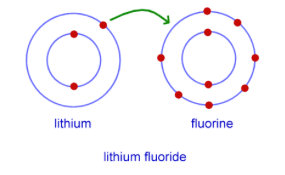
What type of bond is this?
a)
ionic
b)
covalent
12.
A charged particle that has gained or lost electrons is called a _____.
a)
molecule
b)
ion
c)
isotope
d)
element
13.
What is a valence electron?
a)
The sum of neutrons and protons.
b)
The # of electrons in the last shell.
c)
A type of bond.
d)
A popular compound.
14.
How are covalent bonds formed?
a)
Sharing of electrons
b)
Transfer of electrons
15.
How are ionic bonds formed?
a)
Transfer of electrons
b)
Sharing of electrons
16.
Why don't noble gases form bonds?
a)
They all have a full octet
b)
Noble gases do form bonds
c)
They only bond when with eachother
d)
none of these answers are correct
17.
The attraction between oppositely charged ions is called a(n) _______________.
a)
ionic bond
b)
polyatomic ion
18.
A(n) _____________ is an atom or group of atoms that has an electric charge.
a)
ion
b)
electron
19.
Ionic bonds form between two ions that have...
a)
ionic compounds
b)
negative charges
c)
positive charges
d)
opposite charges
20.
A anion will be a ____ ion.
a)
negative
b)
positive
c)
neutral
d)
ficticious
21.
A cation is a ____ ion.
a)
negative
b)
positive
c)
neutral
d)
ficticious
22.
What is Atomic Mass Number ?
a)
Number of Protons
b)
Number of Neutrons
c)
Number of Protons and Neutrons
d)
Number of Protons and Electrons
23.
What charge do protons have?
a)
Positive
b)
Negative
c)
Neutral
24.
What is the charge of an electron
a)
Positive
b)
Negative
c)
Neutral
d)
Neutron
100 %

