
 Worksheets
Photosynthesis + ATP
Total questions: 21
Worksheet time: 13mins
Name
Class
Date
1.
What are the reactants (what's needed) for photosynthesis?
a)
glucose and oxygen
b)
light, water, and carbon dioxide
2.

Most plants appear green because chlorophyll
a)
absorbs green light.
b)
absorbs violet light.
c)
reflects green light.
d)
does not absorb violet light.
3.

Which of the following is the correct equation for PHOTOSYNTHESIS?
a)
6CO2 + 6H2O --> 6O2 + C6H12O6
b)
6CO2 + C6H12O6 + 6H2O --> O2
c)
6O2 + 6H2O --> 6CO2 + C6H12O6
d)
C6H12O6 + 6O2 ---> 6H2O + 6CO2
4.

What is the function of NADPH and ATP?
a)
They absorb light
b)
They power the light-dependent reactions
c)
They are light-reflecting pigments
d)
They are short term energy carriers
5.

Which of the following is NOT a product of the light-dependent reactions?
a)
ATP
b)
NADPH
c)
Oxygen
d)
Glucose
6.

What is the primary function of the light-dependent reactions of photosynthesis?
a)
To produce glucose
b)
To produce NADPH and ATP
c)
To use ATP
d)
To produce RuBP
7.

Use the diagram to answer the question. Between which parts of the molecule must the bonds be broken to form an ADP molecule?
a)
A and B
b)
A and C
c)
B and C
d)
C and D
8.

Is ADP or ATP more like a fully charged battery, and why?
a)
ADP, because it has three phosphate groups; breaking and reforming the bonds among them releases energy.
b)
ATP, because it has three phosphate groups; breaking and reforming the bonds among them releases energy.
c)
ADP, because it has two phosphate groups; breaking and reforming the bonds among them releases energy.
d)
ATP, because it has two phosphate groups; breaking and reforming the bonds among them releases energy.
9.
Which gas is removed from the atmosphere during photosynthesis?
a)
hydrogen
b)
oxygen
c)
nitrogen
d)
carbon dioxide
10.
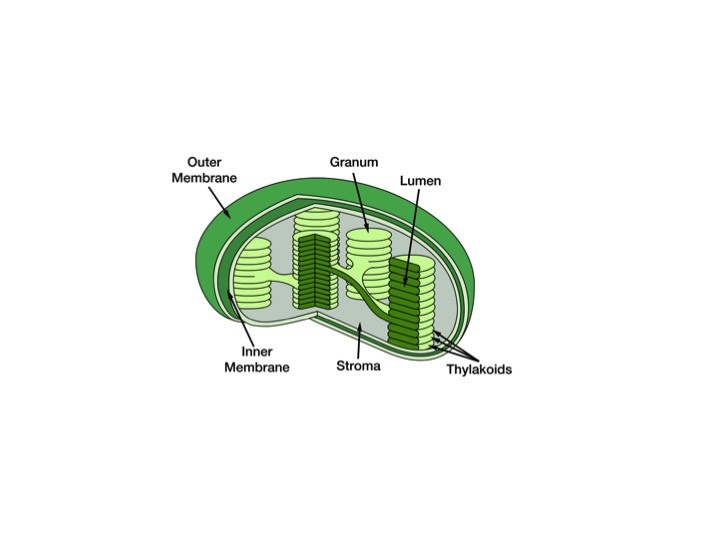
Chloroplasts are...
a)
Structures of animal cells to produce ATP
b)
Organelles where lipids are elaborated
c)
Specialized structures of plants where food is made
d)
Waste organelle of plants
11.
Where is ATP synthesized?
a)
light reaction
b)
light independent reaction
c)
chlorophyll
d)
Calvin cycle
12.
The Calvin cycle takes place in?
a)
stroma
b)
thylakoids
c)
photosystems
d)
chlorophyll molecules
13.
The light dependent reactions take place where?
a)
in the thylakoid membranes
b)
stroma
c)
outside the chloroplast
d)
mitochondria
14.
Which is NOT a part of ATP?
a)
chorophyll
b)
adenine
c)
ribose
d)
phosphates
15.
NADPH is what?
a)
carrier enzymes needed to make high energy sugars?
b)
pigment
c)
light absorbing molecules
d)
sugar
16.

In which organelle (part of the cell) does photosynthesis take place?
a)
mitochondria
b)
chloroplast
c)
nucleus
d)
cell membrane
17.
The two main stages of photosynthesis are the
a)
light reactions and respiration
b)
dark reactions and the Calvin cycle
c)
light reactions and the Calvin cycle
d)
dark reactions and fermentation
18.

What is the product of the Calvin Cycle?
a)
Rubisco
b)
Glyceraldehyde 3-Phosphate (G3P)
c)
Oxygen
d)
Starch
19.
Gel-like material that fills the space of the chloroplast is the
a)
stroma
b)
thylakoids
c)
cytoplasm
d)
mitochondria
20.
Where do NADP+ and ADP produced in the Calvin cycle go?
a)
Back to the light reactions
b)
out of the chloroplast
21.
a biochemical pathway of photosynthesis in which carbon dioxide is converted into glucose using ATP
a)
light reaction
b)
electron transport chain
c)
Calvin cycle
d)
carbon fixation
100 %

