
 Worksheets
Science Tier 2 Words
Total questions: 15
Worksheet time: 12mins
Name
Class
Date
1.
The heat from a lamp allows a lizard to remain warm. This is an example of which type of heat transfer?
a)
radiation
b)
conduction
c)
convection
d)
insulation
2.
Jordan places a hot spoon into a container of ice cream. How does this help him scoop out the ice cream?
a)
The coolness from the ice cream is conducted to the spoon making it easier to scoop out.
b)
The coolness from the ice cream is radiated to the spoon making it easier to scoop out.
c)
The warmth of the spoon is conducted to the ice cream making it easier to scoop out.
d)
The warmth of the spoon is radiated to the ice cream making it easier to scoop out.
3.
Which describes what can happen as a result of radiation?
a)
A piece of wood burns in a fire.
b)
A shirt is hot after having been ironed.
c)
A can of soup is heated in a pot on a stove.
d)
A car’s inside temperature rises to over 100 degrees on a sunny day.
4.
John put a heat pack on his cold feet. What will most likely be the result?
a)
The cold from John’s feet will be radiated into the heat pack.
b)
The warmth of the heat pack will be radiated onto John’s feet.
c)
The cold from John’s feet will be conducted into the heat pack.
d)
The warmth of the heat pack will be conducted onto John’s feet.
5.
Which best describes the process of convection?
a)
Convection is the primary way heat travels through rays.
b)
Convection is the primary way heat travels through metals.
c)
Convection is the primary way heat travels through appliances.
d)
Convection is the primary way heat travels through liquids and gasses.
6.
Which is an example of heat being transferred by conduction?
a)
a furnace heating the air in a school
b)
an ice cube melting in a person’s hand
c)
a pot of water on a stove boiling
d)
the sun heating water in a swimming pool
7.
What is the definition of CONVECTION
a)
When heat transfers through waves.
b)
When heat transfers from objects that are touching.
c)
a hot liquid or air that expands, becomes less dense, and rises or becomes more dense, and sinks.
d)
Heat traveling from the sun
8.
Which of the following is an example of convection?
a)
A hair dryer is drying up your hair.
b)
When the AC or heater changes the temperature.
c)
When a car engine turns hot after being turned on.
d)
When you are making soup and the water is rising and lowering.
9.
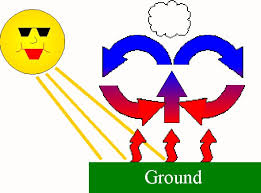
Warm air rises and the cool air sinks demonstrates this type of heat transfer.
a)
conduction
b)
convection
c)
radiation
d)
Insolation
10.
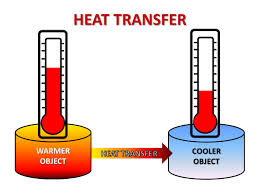
Heat transfers from an area of ____temperature to an area of ___ temperature.
a)
high to low
b)
low to high
c)
high to high
d)
It can travel high to low and low to high.
11.

What method of heat transfer is occurring in the beaker?
a)
Conduction
b)
Convection
c)
Radiation
12.
A hot rock is dropped into a pail of cool water. Heat energy transferred from the rock to the water by
a)
Boiling
b)
Evaporation
c)
Conduction
d)
Radiation
13.
A crayon placed on a dark driveway in bright sunlight melted into a colorful puddle. What caused the crayon to melt?
a)
Solar radiation heated the driveway and then heat transferred to the crayon by conduction.
b)
Solar radiation heated the driveway and then heat transferred to the crayon by radiation.
c)
Solar convection heated the driveway and then heat transferred to the crayon by radiation.
d)
Solar convection heated the driveway and then heat transferred to the crayon by conduction.
14.
You are in the top bunk of a bunk bed and you want to turn down the air conditioner because you are HOT! Your friend on the bottom bunk thinks the room temperature is fine. What is causing the top bunk to feel warmer than the bottom bunk?
a)
Conduction
b)
Radiation
c)
Convection
15.
When you pull your Totino's Pizza rolls out of the oven and the pan is so hot it burns your hand because you forgot your protective mit. The energy move to your hand from the pan to your hand through ...
a)
Conduction
b)
Radiation
c)
Convection
100 %

