
 Worksheets
Epicenter and Earthquakes
Total questions: 15
Worksheet time: 8mins
Name
Class
Date
1.
Which statement best explains the difference between longitudinal and transverse waves?
a)
Longitudinal waves have troughs, while transverse waves have crests.
b)
Longitudinal waves produce energy, while transverse waves consume energy.
c)
Particles in longitudinal waves travel towards a force, while particles in transverse wave travel away from a force.
d)
Particles in longitudinal waves travel in the direction of the wave, while particles in transverse waves travel perpendicular to the wave.
2.

Which diagram best represents the motion of a particle in a transverse wave?
a)
A
b)
B
c)
C
d)
D
3.
The most destructive type of wave is a
a)
P-wave
b)
S-wave
c)
Surface wave
d)
transverse wave
4.
An instrument that detects and measures earthquakes is a
a)
seismogram
b)
focus seismic map
c)
focus
d)
seismograph
5.
The point on Earth's surface directly above an earthquake's starting point or focus.
a)
Hot spot
b)
Focus
c)
Moho point
d)
Epicenter
6.
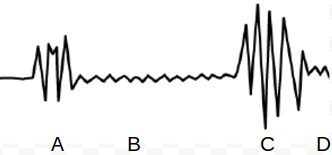
Where are the P-waves located on this seismogram?
a)
A
b)
B
c)
C
d)
D
7.

Where are the S-waves located on this seismogram?
a)
A
b)
B
c)
C
d)
D
8.
What happens to lag time the further you are from the epicenter?
a)
Increases
b)
Decreases
c)
Stays the same
d)
What is lag time?
9.
Which type of seismic waves are the slowest?
a)
S-waves
b)
P-waves
c)
Surface waves
d)
Primary waves
10.
Earthquakes are caused by the release of stored energy along a fault.
a)
True
b)
False
11.
What is the name of the waves given off by an earthquake?
a)
Seismic waves
b)
Radiation waves
c)
Sound waves
d)
Compaction waves
12.
Which of the statements best describes the relationship between lag time and distance from epicenter?
a)
The longer the lag time, the closer the distance.
b)
The longer the lag time, the farther the distance.
c)
The shorter the lag time, the farther the distance.
d)
There is no relationship.
13.
Which of these places is likely to have an earthquake?
a)
California because of the San Andreas fault
b)
Iowa because of the corn fault
c)
New York because of the Empire Fault
d)
No places are more likely to have earthquakes than others
14.

Where is the epicenter for this earthquake located based on triangulation?
a)
A
b)
B
c)
C
d)
D
15.
Which is the first seismic wave to arrive at a seismograph station (where they are measured and detected)?
a)
L wave
b)
R wave
c)
P wave
d)
S wave
100 %

