wayground logo

Free Printable Worksheets

Font size

S
M
L
XL
Worksheets

Lenses Images

Total questions: 22

Worksheet time: 48mins

Name
Class
Date
1.
What does the word "converging" mean?
a)
to separate
b)
to come together
c)
parallel 
d)
perpendicular
2.
A converging lens is also known as a ____ lens.
a)
convex
b)
concave
c)
double
d)
refracted
3.
When an object is placed on the focal point in front of a convex lens, the image produced is ___.
a)
real, reduced, and inverted
b)
real, enlarged, and inverted
c)
real, true, and inverted
d)
There is no image
4.
When an object is placed between the focal point and the convex lens, the image produced is ___.
a)
real, reduced, and inverted
b)
real, enlarged, and inverted
c)
virtual, enlarged, and upright
d)
virtual, reduced, and upright
5.
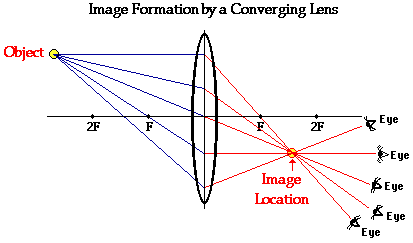
The point where the rays meet is known as....
a)
Fire
b)
the focal point
c)
refraction
d)
Plane of the lens
6.
This image is.....
a)
inverted and smaller
b)
inverted and larger
c)
not inverted and smaller
d)
not inverted and larger
7.
This image is...
a)
Inverted and smaller
b)
inverted and bigger
c)
not inverted and smaller
d)
not inverted and bigger
8.
a real image...
a)
is produced by virtual rays and can be projected on a screen
b)
is produced by real rays and cannot be projected on a screen
c)
is produced by virtual images and cannot be projected on a screen
d)
is produced by real rays and can be projected on a screen
9.
Which describes a convex lens?
a)
triangular in shape
b)
more transparent in the middle
c)
thicker on the edges than in the middle
d)
thicker in the middle than on the edges
10.
Is a convex lens thicker or thinner in the middle?
a)
Thicker 
b)
Thinner 
11.
What type of lens do humans have in their eyes? 
a)
Concave Lens 
b)
Convex Lens 
12.
What type of image is formed when rays of light actually intersect?
a)
real
b)
virtual
c)
projected
d)
curved
13.
If an object's distance from a convex lens were increased, the image would become which of the following?
a)
Larger and virtual
b)
Larger, only
c)
Smaller, only
d)
Smaller and virtual
14.

Where can you place an object in front of a convex lens but not create an image?

a)

At 2F

b)

At F

c)

Beyond 2F

d)

Before F

15.

If an object is placed at the F point in front of a converging lens, which of the following will describe the image correctly.

a)

Upright

b)

Virtual

c)

Smaller

d)

Located beyond 2F

e)

An image will not be created

16.

If an object is placed at the 2F point in front of a converging lens, which of the following will describe the image correctly.

a)

Real

b)

Inverted

c)

Same Size

d)

Beyond 2F

17.

If an object is placed between F & 2F points in front of a converging lens, which of the following will describe the image correctly. Select all that apply.

a)

Real

b)

Inverted

c)

Larger

d)

Located beyond 2F

18.

Where can you place an object in order to get a virtual image? Select all that apply.

a)

beyond 2F

b)

at 2F

c)

between F & 2F

d)

at F

e)

between F and the lens

19.

Where can you place an object in order to get a real image? Select all that apply.

a)

beyond 2F

b)

at 2F

c)

between F & 2F

d)

at F

e)

between F and the lens

20.

Where can you place an object in order to get a larger image than the object? Select all that apply.

a)

beyond 2F

b)

at 2F

c)

between F & 2F

d)

at F

e)

between F and the lens

21.

Where can you place an object in order to get a smaller image than the object? Select all that apply.

a)

beyond 2F

b)

at 2F

c)

between F & 2F

d)

at F

e)

between F and the lens

22.

Where can you place an object in order to get an image the same size as the object? Select all that apply.

a)

beyond 2F

b)

at 2F

c)

between F & 2F

d)

at F

e)

between F and the lens