
 Worksheets
Reporting Category 3 Biology STAAR
Total questions: 21
Worksheet time: 32mins
Homologous structures are defined as anatomical structures originating from the same structure in ancestral form. For instance, the bones in a human's hand and the wing bones of a bat are examples of homologous structures. Which of the following does the presence of homologous structures in vertebrates suggest?
All vertebrates developed at the same rate.
All vertebrates developed internally.
All vertebrates evolved from different animals.
All vertebrates have a common ancestor.

Imagine you are studying a chart of the animal kingdom for a biology project. In this chart, one section is specifically labeled to represent marine mammals. The section adjacent to it, labeled as section B, is most likely to represent which of the following categories?
fish
mammals
invertebrates
primates
Scientists compared the DNA of a population of Galapagos finches from 5,000 years ago to their descendants living today. They observed that the finches exhibited very little evolutionary change over this period. Which statement best explains this observation?
The Galapagos Islands did not undergo significant environmental changes, and finches that developed new traits managed to survive alongside their natural predators.
The Galapagos Islands experienced significant environmental changes, but the finches had no natural predators for a long period.
The Galapagos Islands did not undergo significant environmental changes, and finches that developed new traits did not survive.
The Galapagos Islands experienced significant environmental changes, and finches without advantageous traits did not survive.

Scientists can determine relatedness among organisms by comparing partial amino acid sequences. The table shows four partial amino acid sequences from four different species of birds. Which bird species is the LEAST related to the other three species?
Species A
Species B
Species C
Species D

A marine biologist observed four different organisms under a microscope during a research expedition in the Pacific Ocean. All these organisms were propelled by hundreds of tiny cilia and belonged to the phylum Ciliophora. Despite their similar mode of movement and belonging to the same phylum, these organisms are classified into different —
families
species
kingdoms
orders

Which list correctly identifies characteristics that protists share with animals?
F
G
H
J

In a forest, there are rabbits with white and brown fur. Considering the snowy environment, which outcome is most likely for the rabbit population due to predators over time?
The number of white-furred rabbits in the population will increase.
There will be more brown-furred rabbits than white-furred rabbits.
The number of white-furred rabbits will decrease.
The brown-furred rabbits will move to a different habitat.

The image shows part of the humerus bone in different genera of primates. Which statement is best supported by the observable structures of the different humerus bones?
The primates lived in similar environments
The primates shared a common ancestor.
The primates interbreed with similar organisms in a population.
The primates had diets that consisted of similar types of foods.

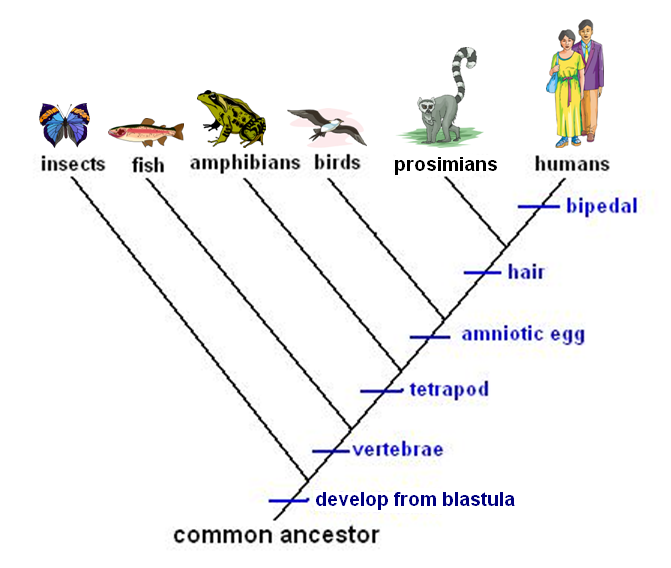
All the animals to the right of the hagfish would have the common characteristic of -
In the scientific community, the name given to a panda would be based on its:
class and family name
genus and species name
domain and kingdom name
kingdom and phylum name
Imagine you are organizing a library of life on Earth, from the broadest categories to the most specific ones. Which of the following is the correct order of classification levels?
Domain, Genus, Family, Order, Class, Phylum, Kingdom, Species
Domain, Species, Kingdom, Genus, Phylum, Family, Class, Order
Domain, Kingdom, Phylum, Class, Order, Family, Genus, Species
Order, Kingdom, Species, Domain, Phylum, Family, Class, Genus
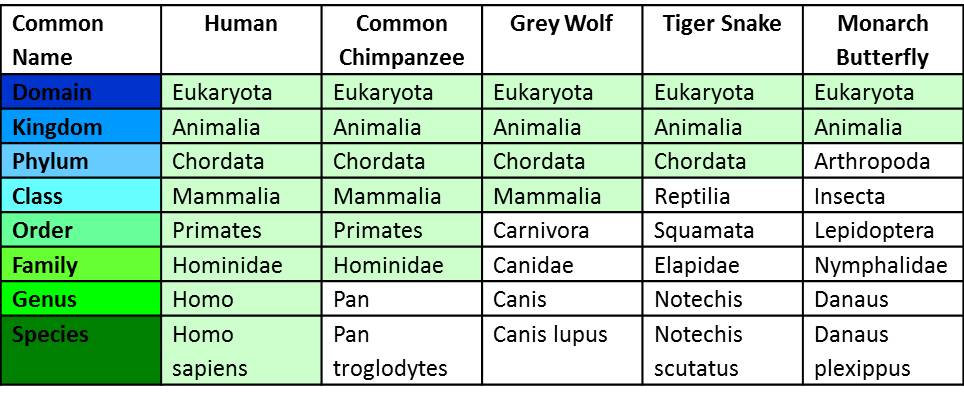

In a biology class, students are asked to identify the smallest taxonomic group where organisms share many characteristics. Which group is it?
domain
kingdom
species
class
Imagine you are exploring a dense forest and come across a living organism that is multicellular, heterotroph, and has a cell wall made of chitin. In which kingdom would you classify this organism?
fungi
plantae
animalia
eubacteria
In a population of finches on a remote island, mutations are important because they bring about
death of the organism in which they develop
genetic variation needed for the population to evolve
benefits for the individual, not for the population
Hardey-Weinberg equilibrium within a population

In the context of evolutionary biology, ostrich wings are best described as
homologous structures
vestigial structures
adaptations
traits

