
 Worksheets
Light Ray
Total questions: 20
Worksheet time: 25mins
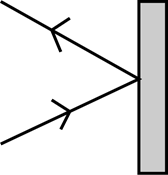
In the illustration, the light ray striking the object is-


If light is traveling from air to water with an angle of INCIDENCE of 40 degrees, what is the angle of refraction? (n=1 air, n=1.33 water)
...How do you solve: (1)(sin40) = (1.33)(sinƟ)
48 degrees
2.07 degrees
11.9 degrees
28.9 degrees
flint glass n=1.70
barium glass n=1.60
crown glass n=1.523
water n=1.33
diamond n=2.45


flint glass n=1.70
barium glass n=1.60
crown glass n=1.523
water n=1.33
diamond n=2.45
Angle between normal and the ray reaching the boundary is
angle of refraction.
angle of reflection
angle of incident
angle of incidence

What does part #2 in the system represent?
Light signals are what carries information in fiber optics
Digital signals are sent through fiber optic cables
Total internal reflection keeps the light inside of the cable
Lasers are the source of light that we send in fiber optics
Glass or plastic fiber optic cables carry information as light

If the light is travelling from glass with a wavelength of 600nm to diamond, then what is the wavelength in the diamond? (n of glass = 1.5 and n of diamond = 2.4)
236nm
256nm
610nm
375nm

Which one is true for the formation of a mirage?
The light first goes through TIR and then passes through the colder layers of air to hotter layers. (TIR is total internal reflection)
The light first goes through TIR after passing through the colder layers of air to hotter layers.
The light first goes through TIR and then passes through the hotter layers of air to colder layers.

Chose the TWO conditions are NOT correct for total internal reflection to take place
The incident angle should be less than the critical angle
The incident angle should be greater than the critical angle
Light should travel from a denser to a lighter medium
Light should travel from a lighter to a denser medium

Glasses are a use of:
Reflection
Refraction

