
NEW
Font size
S
M
L
XL
 Worksheets
Density NGSS
Total questions: 22
Worksheet time: 21mins
Name
Class
Date
1.
True or False: The density of a specific type of material never changes.
a)
True
b)
False
2.

I have two objects with the same volume but different masses. Which object will be more dense?
a)
The object with less weight.
b)
The object with more weight.
c)
The object with more mass.
d)
The object with less mass.
3.
What is the formula for density?
a)
density = mass x volume
b)
density = mass / volume
c)
density = mass + volume
d)
density = mass - volume
4.
The tool used to measure the mass of a substance or object is a ______________.
a)
balance
b)
graduated cylinder
c)
ruler
d)
thermometer
5.
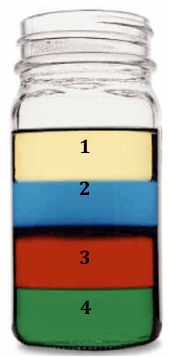
Put the liquids in order from most dense to least dense?
a)
4, 3, 2, 1
b)
1, 2, 3, 4
c)
3, 4, 2, 1,
d)
4, 3, 1, 2
6.
As a flame heats air in a hot air balloon it starts to rise. Which of the following statements correctly explains the chemistry behind why this happens.
a)
The air molecules become more dense & more bouyant than the cooler air in the surrounding atmosphere.
b)
The volume of the gas increases because the molecules in the gas are spaced further apart.
c)
The mass of the of the gas increases causing density to increase & buoyancy to decrease.
7.
A can of Coke will sink in a bowl of water. A can of Diet Coke will float in a bowl of water. What does this tell you about the density of the Diet Coke?
a)
it is bigger than 1
b)
it is smaller than 1
c)
it is equal to 1
d)
it is equal to -1
8.
Why do ice cubes float in a glass of water?
a)
the ice cubes are more dense than the water
b)
the water is more dense than the ice cubes
c)
the water is more dense than the glass
d)
the ice is more dense than the glass
9.
Will an object with a density of 1.01 g/cm3 float or sink when in pure water?
a)
float
b)
sink
10.
A brick sinks in water while a wooden block of the same size floats. This is because the brick has a
a)
lower volume than the wooden block
b)
lower density than the wooden block
c)
higher volume than the wooden block
d)
higher density than the wooden block
11.
Why do some substances float on water?
a)
they are warmer than water
b)
they are cooler than water
c)
they are more dense than water
d)
they are less dense than water
12.
Helium balloons rise on earth because
a)
helium is less dense than air
b)
helium is more dense than air
c)
helium is cooler than air
d)
helium is warmer than air
13.
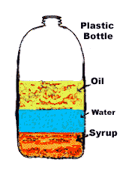
Which liquid is the least dense?
a)
oil
b)
water
c)
syrup
d)
plastic bottle
14.

Which box has a higher density?
a)
Box A
b)
Box B
c)
cannot be determined
d)
they are the same
15.

Why do the liquids form different layers?
a)
They have different densities.
b)
They have different masses.
c)
They have different volumes.
d)
They are different temperatures.
16.
In general what is the most dense form of matter?
a)
solid
b)
liquid
c)
gas
d)
plasmas
17.
What is the density of water?
a)
0 g/ml
b)
1 g/ml
c)
10 g/ml
d)
100 g/ml
18.
A student knows the mass of an object. What other variable does the student need to know to calculate the object's density?
a)
Color
b)
Weight
c)
Volume
d)
Length
19.
Why do objects sink or float in H2O?
a)
Because their densities are higher or lower than compared to water
b)
Because their densities are using gravity to pull down
c)
Because their densities are heavier or lighter
d)
Because their mass and volumes are equal
20.
Define the term "mass".
a)
Mass/Volume
b)
Anything that has mass and takes up space
c)
The amount of space an object occupies.
d)
The amount of matter in an object.
21.
Volume is ...
a)
Mass/Volume
b)
The amount of matter in an object.
c)
The amount of space an object occupies.
d)
Anything that has mass and occupies space.
22.
Density is...
a)
the amount of mass in an object
b)
the amount of space an object takes up
c)
the amount of mass in a given space
d)
the weight of an object
Reset

