
 Worksheets
Relative Dating and Index Fossils
Total questions: 13
Worksheet time: 24mins
Name
Class
Date
1.
An organism that no longer exists on Earth is called
a)
Decayed
b)
Evolved
c)
Extinct
d)
Preserved
2.
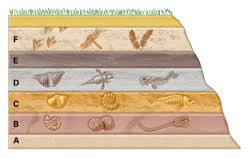
Which rock layer contains the newest fossils?
a)
F
b)
E
c)
B
d)
C
3.
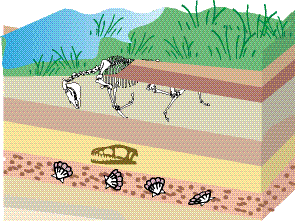
According to the law of superposition, the oldest fossils are found
a)
At the top of the rock layers
b)
Near the bottom of the rock layers
c)
In the middle of the rock layers
d)
Somewhat near the surface
4.
The best index fossils have which two traits?
a)
widespread geographically, long lifespan
b)
widespread geographically, short lifespan
c)
specific place, long lifespan
d)
specific place, short lifespan
5.
Index fossils help determine relative age through correlating rock layers.
a)
True
b)
False
6.
One of the oldest organisms discovered is called a(n) _________.
a)
dinosaur
b)
micro-organism
c)
trilobite
d)
cast and mold fossil
7.
The Law of Superposition helps scientists to determine what?
a)
The absolute age of rock layers
b)
The age of fossils
c)
The relative age of rock layers
d)
the super powers of rocks
8.

According to the law of superposition, which layer is the youngest?
a)
A
b)
B
c)
C
9.

Which rock layer in the diagram seems to be the oldest?
a)
F
b)
E
c)
B
d)
A
10.

Which rock layer most likely contains fossils of the most recently evolved organisms?
a)
1
b)
2
c)
3
d)
4
11.
How old do Paleontologists believe the Earth is?
a)
2015 years old
b)
3.6 billion years old
c)
4.6 billion years old
d)
4.6 million years old
12.

Which of the following organisms formed last on Earth?
a)
Jellyfish
b)
Shark
c)
Lizards
d)
Horses
13.

To be considered an index fossil, it had to have lived for a relatively short period of time.
a)
True
b)
False
100 %

