
NEW
Font size
 Worksheets
How Sound Waves Travel Through Matter
Total questions: 26
Worksheet time: 40mins
What form of energy is produced by vibrations?
Sound
Heat
Light

It is describes as a quick movement of back and forth.
Waves
Vibration
Matter

Sound travels through matter and empty space by means of _____________?
Seismic waves
Transverse waves
Sound Waves

Sound wave is a best example of what kind of wave?
Electromagnetic wave
Longitudinal Wave
Transverse waves

Property of longitudinal wave where particles are close together is called ___________?
Wavelength
Rarefaction
Compression

The place in a longitudinal wave where particles are far from each other is called_______________?
Compression
Rarefaction
Amplitude
Madeline is playing the guitar. When she moves her fingers across the strings, the strings vibrate. Then sound waves travel through the air to Madeline’s ear, and she can hear the guitar
The vibrating strings send tiny pieces of sound to Madeline’s ears.
The vibrating strings make the air around them move
The vibrating strings turn the air around them into sound. d

Sound travels faster in solid than in gas and liquid because___________________.
Solid particles are closed to each other allowing particles to move quickly in response to vibration.
Solid particles are far from each other allowing quick response to vibration.
Solid are particles are very far from each other allowing quick movement of particles in response to vibration.

When sound hits a hard, flat solid the sound tends to ____________ resulting to an echo.
Pass through
Bounce back
be absorbed

Sound cannot travel without a medium to pass through.
True
False
None of the above
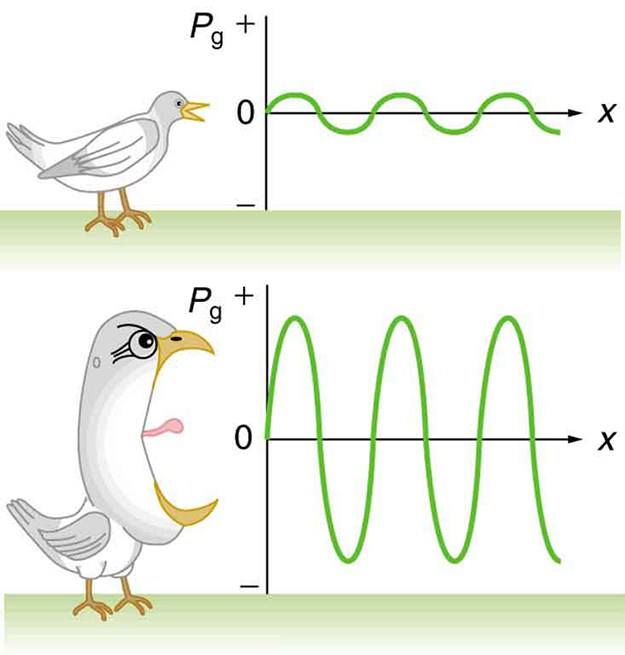

Sound waves help us:
see
hear
smell
Sound waves are:
visible
invisible

A special kind of sound wave is an ECHO because:
you can't hear it.
the sound bounces off a hard surface and you can hear something more than once.

Sound waves CAN travel in outer space.
false
true
The sound that we actually hear is the vibration of molecules.
True
False
If there is a loud noise in your house, the sound travels through
the air
the air and the wall
the air, the wall, the floor
the air and most everything in the house
If there is a loud noise in space, the sound travels through
the space particles
small atoms in space
space is a vacuum, so nothing
What is the source of a sound wave?
Electricity
Vibration
Light waves
Tiny nuclear explosions

