
Font size
 Worksheets
AP Biology Enzyme and Energy
Total questions: 35
Worksheet time: 22mins
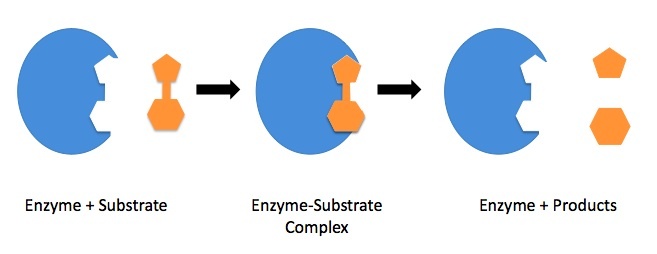
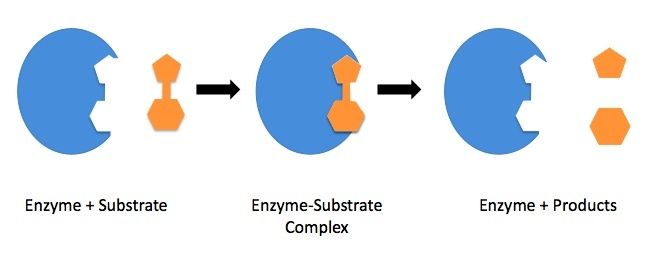
Where do substrates bind on an enzyme?
allosteric site
surface receptor
calcium channel
active site
Enzymes are capable of increasing the rate of a chemical reaction through which of the following means?
changing ΔG
reducing the activation energy
changing the equilibrium point of the reaction
increasing kinetic energy
How are enzymes different from a catalyst like a match?
they are reusable
they add more heat than matches
they are living things
they provide activation energy

Based on the graph, what temperature is optimum for this enzyme?
15 C
40 C
30 C


When an enzyme is denatured:
The secondary & tertiary structures unfold
The primary structure of the enzyme breaks down
Allosteric sites are bound to inhibitors
The enzyme is working at its maximum rate
Exergonic reactions (choose all correct answers)
Release Energy
Store Energy
Do not require energy to proceed
Produce products with more energy than the reactants


The graph shows the relative rates of action of four enzymes, A, B, C, and D. Which enzyme works under the most restricted pH range?
enzyme A
enzyme B
enzyme C
enzyme D

C represents
free energy absorbed
free energy released
activation energy
The graph shows the relative rates of action of four enzymes, A, B, C, and D. In what pH do both enzymes A and B both show some activity?
between 0 and 9
6
there is no pH where they both work
4

If a mutation occurs in a DNA sequence that codes for an enzyme, what is the most likely result?
There will likely be no change in the shape and function of the enzyme.
The enzyme will most likely fold in a way that makes its shape incompatible with the substrate and the enzyme will not function correctly.
The enzyme will not be produced at all.
The enzyme will have an enhanced ability to bind with the substrate.
If an enzyme solution is working at its maximum speed, the enzyme is said to be:
denatured
activated
saturated
coupled
The delta G of an enzyme-catalyzed reaction is 30 kJ/mol. If you double the amount of enzymes, what would be the delta G of the catalyzed reaction?
0 kJ/mol
15 kJ/mol
30 kJ/mol
60 kJ/mol

The decreased production of enzyme Trp-T would have which of the following responses?
Decrease in Tryptophan concentration
Increase in I3PA concentration
Increase in IAA concentration
Decrease in I3PA & IAA concentration
A + B --> C
Anabolic
Catabolic
A --> B + C
Anabolic
Catabolic
Energy coupling is where:
Energy from an exergonic reaction is transferred to an endergonic reaction
Energy from an endergonic reaction is transferred to an exergonic reaction
The product of one reaction becomes the reactant for another
Two reactions occur at the same time and share energy sources

