
 Worksheets
Fisika Nuklir
Total questions: 19
Worksheet time: 27mins
Nuclear particles and nuclear radiation may cause ionisation as they pass through matter. Which of the following is the most ionising?
α particles
β particles
γ rays
neutrons
An unstable nucleus recoils as it emits an alpha particle. This is due to the conservation of
charge.
kinetic energy.
momentum.
total energy.

The table below gives the range and number of ion pairs per centimetre produced by β particles, compared to α particles of the same energy. Select the row from the table which shows the correct comparison.
Range of β particles: greater, Number of ion pairs per centimetre: greater
Range of β particles: smaller, Number of ion pairs per centimetre: greater
Range of β particles: greater, Number of ion pairs per centimetre: smaller
Range of β particles: smaller, Number of ion pairs per centimetre: smaller
Radioactive decay is said to be a spontaneous process. This means that:
we cannot know when a nucleus will decay.
we cannot know which nucleus will decay next.
we cannot know how many nuclei will decay.
we cannot influence when a nucleus will decay.
In an experiment to measure the activity of a radioactive source the measured activity should always be corrected by:
adding the background count.
adding the background count rate.
subtracting the background count.
subtracting the background count rate.
When measuring the count rate from a radioactive source it is usual to also measure the background count rate. The background count rate must be:
as large as possible for an accurate experiment.
measured when the source is in place.
recorded for the same time as the count rate.
subtracted from the count rate measured from the source.
Before carrying out an experiment to measure the activity from a radioactive source, it is usual to measure the background count. The background count obtained is not affected by the
location of the experiment.
temperature of the surroundings.
time interval used for the count.
type of detector being used.
Health and safety guidelines state that radioactive sources suitable for school experiments should only be handled using long tongs, and only for restricted periods of time. Select the row in the table that gives the type of radiation that is most dangerous to the human body, in these circumstances, with the correct reason.
α-radiation because it is the most ionising.
α-radiation because it is the most massive.
β-radiation because it can penetrate up to a metre of air.
β-radiation because it can penetrate the skin and enter the body.
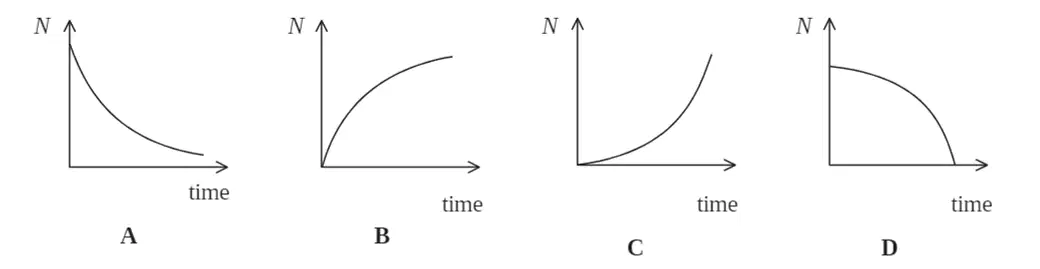
Some rocks contain lead as a result of radioactive decay. In one such decay a fixed amount of polonium decays to a stable isotope of lead. Which graph correctly shows the variation with time of the number of lead atoms, N, produced from the decay of polonium in the rock?
A
B
C
D
Which one of the following does not contribute to background radiation?
Dead matter
Living matter
Mobile phones
Rocks
A radioactive source is placed 2 cm from a detector. The count rate decreases slightly if a sheet of paper is placed between the source and the detector. It is reduced to background radiation level when the paper is replaced with a 1 cm thickness of aluminium. The correct conclusion is that the source emits
alpha radiation only.
alpha and beta radiation.
beta and gamma radiation.
gamma radiation only.
Protactinium has a half-life of 70 s. A sample of protactinium is prepared and monitored over a period of time. Which of the following statements is correct?
The activity of the protactinium will be zero after 140 s.
The activity of the protactinium will be 25% of its initial value after 140 s.
The activity of the protactinium will be 12.5% of its initial value after 280 s.
The activity of the protactinium will never become zero.
The ionising properties of radiations determine their penetrating power. Which of the following statements is correct?
α-particles are not very ionising so they are stopped by thin paper.
α-particles are very ionising so can only travel a few centimetres in air.
γ-radiation is very penetrating because it is very ionising.
γ-radiation is not very penetrating because it is very ionising.
Radioactive decay is sometimes described as being spontaneous. In this context spontaneous means
nothing can influence the decay.
the decay is random.
the decay can be predicted.
the decay is exponential.
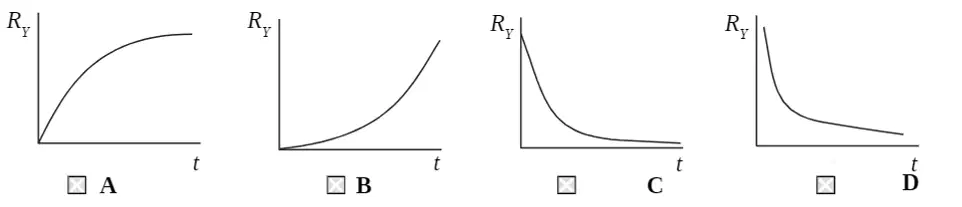
A sample of radioactive element X decays into a stable element Y. Which graph shows the rate of formation of element Y, RY, with time, t?
A
B
C
D
In a famous thought experiment, Schrödinger imagined that a cat is locked in a box, along with a radioactive atom that is connected to a tube containing a deadly poison. If the atom decays, it causes the tube to smash and the cat to die. The random nature of radioactive decay means that the radioactive atom will
decay after one half-life.
probably decay after one half-life.
have a fixed probability of decaying in a given time interval.
have a number of possible decay paths.
A radioactive source is placed a few cm away from a detector. There is no change in the count rate when a thin aluminium foil is placed between the source and the detector, but the count rate is reduced to the background rate when a 0.5 cm aluminium plate is introduced. These observations show that the source must be emitting
alpha and beta radiation.
beta and gamma radiation.
beta radiation only.
gamma radiation only.
Which of the following statements about nuclear fission is correct?
A uranium-235 nucleus can only undergo fission after absorbing a proton.
Kinetic energy is conserved during fission.
Linear momentum is not conserved during fission.
The fission fragments have a total mass less than that of the nucleus just before fission.
Fission & fusion are both nuclear process. Which statement is correct for both processes?
Neutrons are released
No harmful radiation is produced
The binding energy per nucleon increases
T

