
 Worksheets
Stoichiometry Chemistry
Total questions: 25
Worksheet time: 1hrs 20mins
Name
Class
Date
1.
Mole ratios are obtained from the
a)
balanced chemical equation
b)
periodic table
c)
molar mass
2.
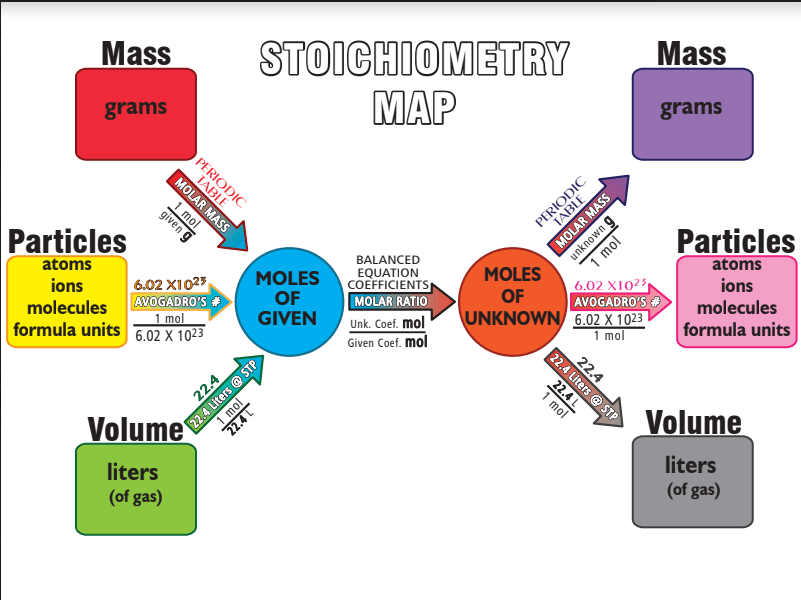
How many step will it take for me to go from moles given to moles unknown?
a)
1
b)
2
c)
3
d)
4
3.
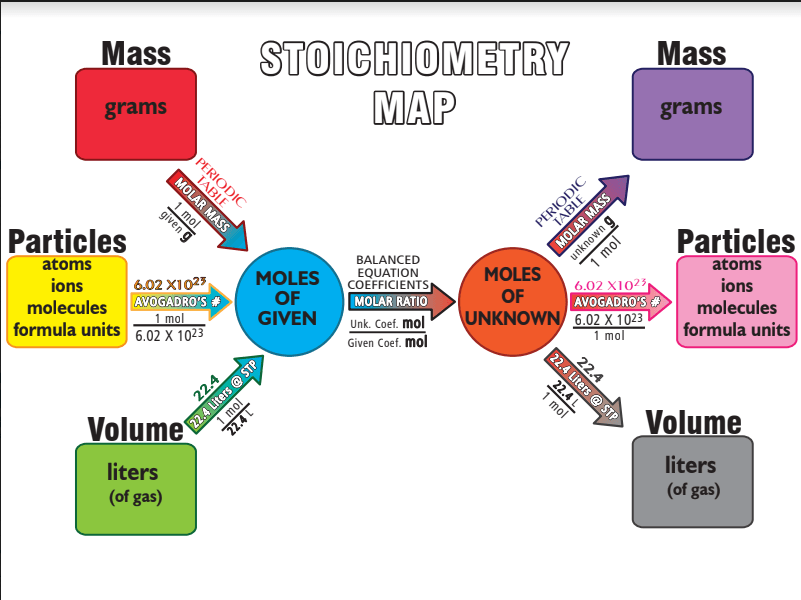
How many steps will it take me to go from grams to grams?
a)
4
b)
3
c)
2
d)
1
4.
How many step will it take for me to go from grams to moles unknown
a)
1
b)
2
c)
3
d)
4
5.
I use molar mass when the problem gives me grams?
a)
False
b)
True
6.
I use 6.02 x 10²³ when the problem gives me molecules?
a)
True
b)
False
7.
I use mole ratio (coefficients) from balanced chemical equation?
a)
True
b)
False
8.
Balance the following reaction :
CaC₂(s) + H₂O(l) --> C₂H₂(g) + Ca(OH)₂(aq)
CaC₂(s) + H₂O(l) --> C₂H₂(g) + Ca(OH)₂(aq)
a)
1,2,2,2
b)
1,2,1,1
c)
2,1,1,1
d)
2,1,2,1
9.
Cl2 + 2KBr → Br2 + 2KCl
How many grams of potassium chloride (KCl) can be produced from 356 g of potassium bromide (KBr)?
How many grams of potassium chloride (KCl) can be produced from 356 g of potassium bromide (KBr)?
a)
749 g
b)
223 g
c)
479 g
d)
814 g
10.
N2 + 3H2 −-> 2NH3
How many moles of hydrogen are needed to react with 2 moles of nitrogen?
How many moles of hydrogen are needed to react with 2 moles of nitrogen?
a)
6
b)
2
c)
3
d)
1
11.
2 KClO3 → 2 KCl + 3 O2
How many moles of oxygen are produced when 6.7 moles of KClO3 decompose completely?
How many moles of oxygen are produced when 6.7 moles of KClO3 decompose completely?
a)
6.7 mol
b)
1.0 mol
c)
10.1 mol
d)
4.5 mol
12.
2H2 + O2 → 2H2O
How many moles of water can be produced if 8 moles H2 are used?
How many moles of water can be produced if 8 moles H2 are used?
a)
4 moles
b)
8 moles
c)
16 moles
d)
2 moles
13.
What is a Limiting Reagent?
a)
speeds up a reaction
b)
what you run out of first
c)
what you have left over
d)
slows down a reaction
14.
What is a Excess Reagent?
a)
amount you end with
b)
what you run out of first
c)
what you have left over
d)
what you start with
15.
When does a chemical reaction stop?
a)
When the lab is finished
b)
When the excess reactant is used up
c)
When the limiting reactant is used up
d)
Chemical reactions never stop
16.
Mole ratios are obtained from the
a)
balanced chemical equation
b)
periodic table
c)
molar mass
17.
How many particles are in 13.5 grams of Beryllium?
a)
1.5 particles
b)
9 particles
c)
4x10²³ particles
d)
9x10²³ particles
18.
CH4 + 2 O2 → CO2 + 2 H2O
How many moles of carbon dioxide are produced from the combustion of 110 g of CH4?
How many moles of carbon dioxide are produced from the combustion of 110 g of CH4?
a)
13.7 mol
b)
2.75 mol
c)
6.11 mol
d)
6.85 mol
19.
B2H6 + 3O2 -->2 HBO2 + 2 H2O
What mass of O2 will be needed to burn 36.1 g of B2H6?
What mass of O2 will be needed to burn 36.1 g of B2H6?
a)
13.8 g O2
b)
3.86 mol of O2
c)
124 g O2
20.
P4 + 3O2 --> P4O6
What is the limiting reactant is 12 moles of P4 react with 15 moles of O2?
What is the limiting reactant is 12 moles of P4 react with 15 moles of O2?
a)
P4
b)
O2
c)
P4O6
d)
none of the above
21.
Theoretical yield = 73g
Actual yield = 62g
Calculate the percent yield.
Actual yield = 62g
Calculate the percent yield.
a)
1.16%
b)
116%
c)
85%
d)
76%
22.
What is the measured amount of a product obtained from a chemical reaction?
a)
mole ratio
b)
theoretical yield
c)
percentage yield
d)
actual yield
23.
The limiting reactant
a)
slows the reaction down
b)
is used up first
c)
is the reactant that is left over
d)
controls the speed of the reaction
24.
What is a limiting reactant?
a)
the reactant that determines how much product can be made
b)
the reactant that is in excess
c)
the product that you can make the most of
d)
the amount of reactants that react with each other
25.
If the percentage yield for a chemical reaction is 80.0%, the
a)
actual yield is 80.0g for every theoretical yield of 100g.
b)
actual yield is 80 times as much as the theoretical yield.
c)
theoretical yield is 80 times as much as the actual yield.
d)
theoretical yield is 80.0 g for every actual yield of 100g.
100 %

