Wayground logo

Free Printable Worksheets

Font size

S
M
L
XL
Worksheets

Cells and Systems

Total questions: 61

Worksheet time: 36mins

Name
Class
Date
1.
Which of the following is the smallest unit of life that can carry out all life functions?
a)
the mitochondria
b)
the vacuoles
c)
the nucleus
d)
the cell
2.
Which structures are found in every living cell?
a)
cell membrane and cytoplasm
b)
chloroplasts and mitochondria
c)
a cell wall and nucleus
d)
chloroplasts and cell wall
3.
Which cell structure is found in plant and animals cells and controls what can come into or leave a cell?
a)
cell membrane
b)
cytoplasm
c)
nucleus
d)
vacuole
4.
What is the function of the cell nucleus found in both plant and animal cells?
a)
to produce energy
b)
to control cell activity
c)
to remove waste products
d)
to allow molecules to enter the cell
5.
What is one basic function of the vacuoles?
a)
circulating oxygen
b)
producing food
c)
controlling cell processes
d)
storing water
6.
Chloroplasts in plant cells allow the plant to perform a function that animal cells cannot do.  What is the main function of the chloroplasts found in plant cells?
a)
to absorb light energy and manufacture food
b)
to remove waste materials by active transport
c)
to manufacture chemical energy from food
d)
to control the shape of the cell
7.
All cells need energy to function.  Which cell organelle is responsible for producing energy in the cell?
a)
chloroplasts
b)
mitochondria
c)
nucleus
d)
vacuoles
8.
What is the function of a cell wall?
a)
to protect and support the cell
b)
to perform different functions in each cell
c)
to prevent water from passing through it
d)
to prevent oxygen from entering the cell
9.
In what part of the plant cell does the process of photosynthesis take place?
a)
nucleus
b)
mitochondria
c)
chloroplasts
d)
vacuoles
10.
 Starch and water molecules in potato cells are stored in what organelle?
a)
mitochondria
b)
nucleus
c)
cell wall
d)
vacuole
11.
Who was the first  person to see cells under the microscope and give them their name?
a)
Mattias Schleiden
b)
Robert Hooke
c)
Theordor Schwann
d)
Anton van Leeuwenhoek
12.
The basic unit of structure and function in a living things.
a)
chloroplast
b)
nucleus
c)
cell
d)
cell membrane
13.
Every living organism is made up of one or more cells
a)
True
b)
False
14.
Which of the following are NOT found in animal cells
a)
chloroplasts and cytoplasm
b)
chloroplasts and cell wall
c)
cell wall and cell membrane
d)
mitochondria and nucleus
15.
The nucleus is like the ____________ of the cell.
a)
foot
b)
hand
c)
stomach
d)
brain
16.

Many celled organisms are called

a)

unicellular

b)

multicellular

c)

bicellular

d)

tricellular

17.

Single celled organisms are called

a)

unicellular

b)

multicellular

c)

bicellular

d)

tricellular

18.

According to the information in the given chart, what type of cell is cell X?

a)

bacteria cell

b)

plant cell

c)

animal cell

d)

prokaryotic cell

19.

Ian is looking at a cell using a microscope. He sees a nucleus and a large vacuole in the center of a cell. What type of cell is he most likely looking at?

a)

animal cell

b)

plant cell

c)

blood cell

d)

human cell

20.

"Small organs" of the cell that carry out specific functions

a)

Organelles

b)

Organs

c)

Cell Wall

d)

Cell

21.
What is the total magnification of a microscope with two lenses when one lens has a magnification of 10x, and the other lens has a magnification of 30x?
a)
15x
b)
30x
c)
40x
d)
300x
22.
If the eyepiece of your scope has a power of 10, and the selected objective lens has a power of 20,what is the total magnification?
a)
20x
b)
30x
c)
200x
d)
2000x
23.
When you focus on a new specimen, always begin with
a)
low power and coarse adjustment.
b)
low power and fine adjustment
c)
high power and coarse adjustment
d)
high power and fine adjustment
24.
If your teacher asks you to move a microscope to table, how do you carry it?
a)
by the body tube and the eyepiece
b)
with one hand
c)
one hand on the arm and the other under the base
d)
with one hand on the base and the other on the eyepiece.
25.
Which part of the microscope controls the amount of light available?
a)
coarse adjustment knob
b)
diaphragm
c)
objective lens
d)
revolving nosepiece
26.
Which part lets you turn up the power of magnification, such increasing from 40x to 100x?
a)
coarse adjustment knob
b)
diaphragm
c)
field-of-view
d)
revolving nosepiece
27.
What is part 1?
a)
eye piece
b)
body tube
c)
arm
d)
coarse adjust
28.
What part is 3?
a)
eye piece
b)
base
c)
arm 
d)
coarse adjust
29.
What part is 5?
a)
coarse adjustment
b)
fine adjustment
c)
diaphragm
d)
stage
30.
What is part 11?
a)
coarse adjustment
b)
fine adjustment
c)
diaphragm
d)
stage
31.
What is part 6?
a)
arm 
b)
base
c)
body tube
d)
illuminator
32.

The primary optical lenses on a microscope are called ___

a)

condensors

b)

objective lenses

c)

stage clips

d)

ocular lenses

33.

The specimen slide is placed on the ___

a)

platform

b)

table

c)

stage

d)

base

34.

These are used to hold the slide in place:

a)

rotating nosepiece

b)

objective lenses

c)

stage clips

d)

adjustment knobs

35.

Typical objective lenses come in magnifications of ___

a)

6x, 15x, 60x

b)

60x, 150x, 600x

c)

4x, 10x, 40x

d)

40x, 100x, 400x

36.

Cells form tissues, tissues form organs, organs work together to form

a)

lungs

b)

organ systems

c)

skin

d)

heart

37.

What is a group of cells that are alike and work together?

a)

a cell team

b)

a tissue

c)

a cell family

38.

A group of tissues that work together is a(n) ______________________.

a)

cell

b)

organ

c)

organ system

39.

Organs that work together are part of a(n) ________________________.

a)

cells

b)

tissue

c)

organ system

40.
 What do tissues form?
a)
Blood 
b)
Organ Systems
c)
Organs
d)
Nails
41.

What is the term for a group of organs that break down food so that it can be used for energy, cell growth and repair?

a)

circulatory system

b)

digestive system

c)

excretory system

d)

muscular system

e)

nervous system

42.

What is the term for the control center for the entire body that sends signals from throughout the body to the brain?

a)

circulatory system

b)

respiratory system

c)

excretory system

d)

muscular system

e)

nervous system

43.

What is the term for the group of organs that remove excess water and filter waste from the body?

a)

circulatory system

b)

respiratory system

c)

excretory system

d)

muscular system

e)

digestive system

44.

What is the term for the organ system that provides oxygen to the blood and removes carbon dioxide from the blood?

a)

circulatory system

b)

respiratory system

c)

nervous system

d)

muscular system

e)

digestive system

45.

What is the term for the organ system that allows for the body’s movement, including voluntary and involuntary movement?

a)

excretory system

b)

respiratory system

c)

nervous system

d)

muscular system

e)

digestive system

46.

What is the term for the organ system that moves blood, gases, and nutrients throughout the body?

a)

circulatory system

b)

respiratory system

c)

nervous system

d)

excretory system

e)

digestive system

47.

What organ system are lungs part of?

a)

digestive system

b)

respiratory system

c)

muscular system

d)

nervous system

e)

excretory system

48.

What is the name of the system that supports the weight of the entire body?

a)

Skeletal system

b)

Nervous system

c)

Digestive system

d)

Circulatory system

49.

How do the particles move in diffusion?

a)

From a region of low concentration to a region of high concentration
b)

From a region of high concentration to a region of low concentration

c)

From a region of low concentration to a region of low concentration

d)

From a region of high concentration to a region of high concentration

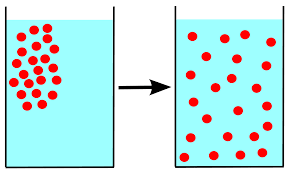
50.

The picture below is an example of _________________.

a)

osmosis

b)

isotonic

c)

diffusion

d)

active transport

51.

How long does diffusion last?

a)

Until the concentration of particles in the system is equal

b)

Until a region in the system has a smaller concentration of particles than the other

c)

Until a region in the system has a greater concentration of particles than the other

d)

Until the particles disappear from the system

52.
Osmosis is the movement of _____ across a membrane.
a)
food
b)
energy
c)
oxygen
d)
water
53.
During osmosis
a)
water moves from high to low concentration
b)
large or oddly shaped molecules move across a cell membrane
c)
water moves when energy is used
d)
proteins are built
54.

All organisms are made of

a)

organs

b)

tissues

c)

cells

55.
Photosythesis happens in a cell's 
a)
Mitochondria
b)
Chloroplast
c)
Nucleus
d)
Cell Wall
56.
Diffusion is the movement of molecules from an area of _____ concentration to an ______ concentration
a)
High, low
b)
Low, high
c)
Low, low,
d)
High, high
57.

What is DIFFUSION?

a)
b)
c)
d)
58.
An increase in temperature does what to diffusion?
a)
Speeds it up
b)
Slows it down
c)
Has no effect
d)
I wish i knew. Really I do.
59.
Where is there a low concentration of dye?
a)
at the bottom of cup
b)
in the color
c)
at the top of cup 
d)
no concenteraion gradient
60.
Where is there a low concentration of perfume?
a)
in the bottle
b)
on the hand
c)
in the room
d)
in the top
61.
What is the definition of  Selective Permeability?
a)
The movement of materials across the cell membrane that requires NO ENERGY from the cell.
b)
The movement of materials through (or across) the cell membrane
c)
The ability of the cell membrane to allow some things to pass through while preventing other things from passing through.
d)
The movement of molecules from an area of high concentration to a area of low concentration