
 Worksheets
Earthquakes Regents
Total questions: 35
Worksheet time: 44mins
Name
Class
Date
1.

The image shows the Mid Atlantic Ridge. Which type of boundary occurs at this ridge where the ocean floor is spreading apart?
a)
convergent
b)
divergent
c)
transform fault
2.
The innermost layer of the Earth is thought to be made of solid iron. What is the name of this layer?
a)
mantle
b)
asthenosphere
c)
inner core
d)
outer core
3.
What causes tectonic plates to move?
a)
ocean currents
b)
convection currents in the mantle
c)
volcanoes
d)
the Coriolis Effect
4.
The tectonic plates rest on this layer and it is responsible for the movement of those plates. What is the name of this layer?
a)
crust
b)
asthenosphere
c)
outer core
d)
inner core
5.
What instrument is used to detect the magnitude of earthquakes?
a)
barometer
b)
electrograph
c)
seismograph
d)
pictograph
6.
The movement of Earth's crust along plate boundaries produces
a)
earthquakes
b)
volcanoes
c)
moutains
d)
All of these options.
7.
What is the main cause of most earthquakes?
a)
human activity
b)
hurricanes
c)
changes in temperature in Earth's mantle
d)
pressure deep within the Earth that is being released
8.
If the focus of an earthquake occurs beneath the sea floor, as the seismic waves travel through the ocean, they create a massive and destructive
a)
epicenter
b)
tsunami
c)
focus
d)
mountain
9.

In the image, which type of boundary is shown? Hint: its located in the state of California.
a)
divergent
b)
convergent
c)
transform fault
10.

Look at the image. The South American and Nasca plate are moving together. Which type of boundary is this?
a)
divergent
b)
convergent
c)
transform fault
11.

What is represented by the picture?
a)
Sea-floor spreading
b)
Pangea
c)
How the continents are arranged today
d)
Volcanoes
12.
Earth's solid, rocky surface is the
a)
crust
b)
mantle
c)
core
d)
fault
13.
___________ is the point beneath Earth’s surface at which rock under stress breaks and triggers an earthquake.
a)
Focus
b)
Epicenter
c)
Surface waves
d)
Seismograph
14.
__________ is the point on the surface directly above the point at which an earthquake occurs.
a)
Focus
b)
Epicenter
c)
Surface waves
d)
Seismograph
15.
What is the minimum number of seismograph stations needed to locate an earthquake epicenter?
a)
1
b)
2
c)
3
d)
1 billion
16.
One seismograph station, by itself, can determine the
a)
direction of the epicenter
b)
location of the epicenter
c)
distance to the epicenter from the seismograph station
d)
location of the nearest Papa Johns
17.
Primary waves are also called ______________ waves.
a)
violent
b)
compression
c)
shear
d)
transverse
18.
Which wave can only go through solids?
a)
P - Primary
b)
S - Secondary
c)
Surface
19.
You use a travel-time graph (difference in P and S Wave arrival times) to find:
a)
Distance to epicenter
b)
Distance to fault
c)
Distance to core
20.
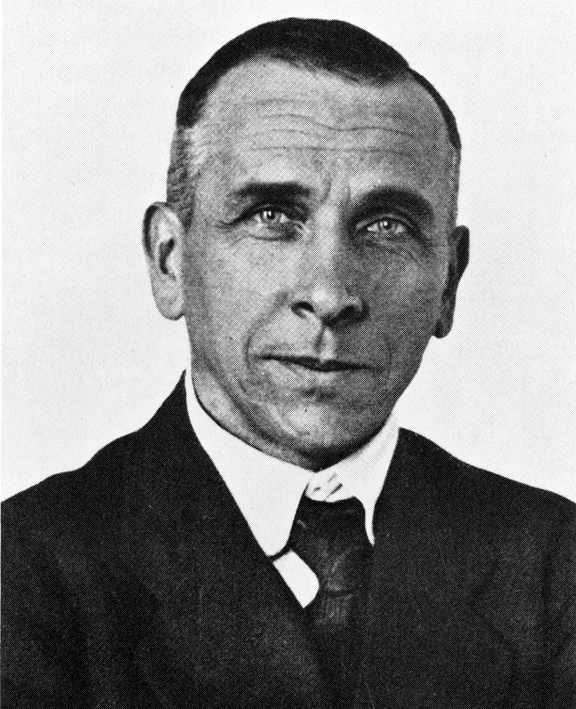
Who is the person credited with developing the theory of continental drift?
a)
Harry Hess
b)
Galileo
c)
Alfred Wegener
d)
Newton
21.
What evidence did Wegener use in his theory?
a)
Continents and fossils fitting together/matching-up like puzzle pieces
b)
glacier scars and evidence from temperature
c)
mountain ranges and coal deposits line up across continents
d)
all of the above
22.
Compared to the continental crust, the oceanic crust is
a)
more dense and more mafic
b)
more dense and more felsic
c)
less dense and less mafic
d)
less dense and less felsic
23.
Which two tectonic plates are separated by a mid-ocean ridge?
a)
Indian-Australian and Eurasian
b)
Indian Australian and Pacific
c)
North American and South American
d)
North American and Eurasian
24.

What is the approximate temperature range at point X?
a)
from 0°C to 10°C
b)
from 700°C to 1200°C
c)
from 2400°C to 2800°C
d)
from 5000°C to 6300°C
25.

Between which two tectonic plates does this plate boundary exist?
a)
Nazca Plate and South American Plate
b)
Eurasian Plate and Indian-Australian Plate
c)
North American Plate and Eurasian Plate
d)
North American Plate and Pacific Plate
26.
Which statement best supports the theory of continental drift?
a)
Basaltic rock is found to be progressively younger at increasing distances from the mid-ocean ridge.
b)
Marine fossils are often found in deep-well drill cores.
c)
The present continents appear to fit together as pieces of a larger landmass.
d)
Areas of shallow-water seas tend to accumulate sediment, which gradual sinks.
27.
A P-wave arrives at a seismic station 11 minutes and 40 seconds after the earthquake. How long after the first P-wave arrives will the first S-wave arrive?
a)
5 minutes
b)
8 minutes 40 seconds
c)
9 minutes 40 seconds
d)
21 minutes 20 seconds
28.

Where is the epicenter for this earthquake located based on triangulation?
a)
A
b)
B
c)
C
d)
D
29.
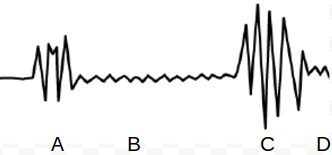
Where are the P-waves located on this seismogram?
a)
A
b)
B
c)
C
d)
D
30.

Which force pulls on the crust and stretches rock?
a)
Shearing
b)
Tension
c)
Liquefaction
d)
Compression
31.
A break in the crust where slabs slip past each other is a (an) ________________.
a)
Fault
b)
Epicenter
c)
Hanging Wall
d)
Footwall
32.

The point beneath Earth’s surface where the crust breaks and triggers an earthquake is called the
a)
Epicenter
b)
Fault
c)
Focus
d)
Igneous Cross Section
33.

Which type of seismic wave arrives first at a seismograph?
a)
Surface Waves
b)
Tsunamis
c)
P Waves
d)
All of the Above
34.
How do fold mountain form?
a)
Land on one side of a fault is raised, while the other side drops downward.
b)
When magma rises toward the surface but doesn't break through the crust.
c)
From a fiery explosion.
d)
When plates collide, causing the crust to fold and crumple.
35.
Which of the following is not a type of fault?
a)
Reverse Fault
b)
Strike-slip Fault
c)
Abnormal Fault
d)
Normal Fault
100 %

