
NEW
Font size
S
M
L
XL
 Worksheets
Air Mass and Front
Total questions: 20
Worksheet time: 30mins
Name
Class
Date
1.
A wet, cold air mass would be -
a)
maritime tropical
b)
maritime polar
c)
continental tropical
d)
continental polar
2.
A dry and cold air mass would be...
a)
Maritime polar
b)
Continental polar
c)
Maritime tropical
d)
Continental tropical
3.
How do we characterize an air mass that forms over land?
a)
Dry
b)
Wet
c)
Cold
d)
Warm
4.
How do we characterize an air mass that forms over the ocean?
a)
Dry
b)
Wet
c)
Cold
d)
Warm
5.
cT air mass is
a)
tropical maritime
b)
polar maritime
c)
tropical continental
d)
polar continental
6.
a cP air mass is a
a)
Arctic Continental
b)
Polar Maritime
c)
Polar Continental
d)
Tropical Continental
7.
All of these are air masses that affect the US EXCEPT
a)
cP
b)
cT
c)
mT
d)
mA
8.
Which of these locations did a tropical maritime (mT) air mass originate?
a)
over Antarctica
b)
over a Southern region of the Atlantic Ocean
c)
Over Canada
d)
Over Mexico
9.
If an air mass formed over land, and is mostly dry, which descriptor will likely be part of its name?
a)
Tropical
b)
Arctic
c)
Maritime
d)
Continental
10.
When a cold front is approaching, what happens?
a)
warm air is pushing under cold air causing humid weather and lower temperatures
b)
warm air is pushing under cold air causing humid weather and higher temperatures
c)
warm air rises, cools, and causes rain and thunderstorms
d)
cold air is pushed over warm air causing rain and thunderstorms
11.
In a high pressure area, the weather will likely be
a)
cooler and clear skies
b)
warm but cloudy
c)
cold and rainy
d)
snowy and clear
12.

What type of storm front is this?
a)
warm front
b)
cold front
c)
stationary front
d)
occluded front
13.
What is a boundary area where air masses meet but do not mix?
a)
low pressure system
b)
super cell
c)
front
d)
high pressure system
14.

What type of storm front is this?
a)
warm front
b)
cold front
c)
stationary front
d)
occluded front
15.
What characteristics are used to classify air masses?
a)
temperature and humidity
b)
pressure and temperature
c)
latitude and longitude
d)
wind speed and location
16.
What type of weather would you expect to see after a cold front has passed through an area?
a)
cool and clear skies
b)
warm and humid
c)
thunderstorms
d)
foggy
17.
What type of weather would you expect to see after a warm front has passed through an area?
a)
cool and clear skies
b)
warm and humid
c)
thunderstorms
d)
foggy
18.
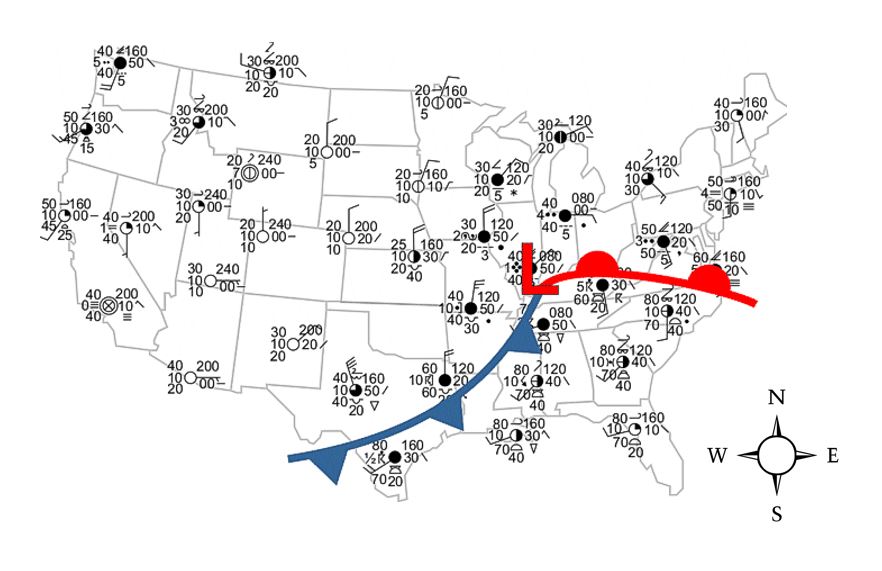
What direction is the cold front moving on the map?
a)
Southwest
b)
Northwest
c)
Southeast
d)
Northeast
19.
What direction is the warm front moving on the map?
a)
North
b)
South
c)
East
d)
West
20.
What type of front occurs when a warm air mass and a cold air mass do not have enough energy to move the other one out of the way?
a)
Warm front
b)
Cold front
c)
Stationary front
d)
Occluded front
Reset

