
 Worksheets
Staar Science Category Two
Total questions: 24
Worksheet time: 3hrs 44mins
Name
Class
Date
1.
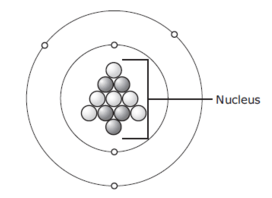
(8.5B) An atom of which element is represented by this model?
a)
Boron (B)
b)
Carbon (C)
c)
Neon (Ne)
d)
Sodium (Na)
2.

(8.5C) A student is studying the ways different elements are similar to one another. Diagrams of atoms from four different elements are shown below.
Which two atoms are of elements in the same group in the periodic table?
Which two atoms are of elements in the same group in the periodic table?
a)
Atom 1 and Atom 2
b)
Atom 1 and Atom 4
c)
Atom 2 and Atom 3
d)
Atom 3 and Atom 4
3.
(8.5E) The scientist spilled a few drops of dilute hydrochloric acid (HCl) on a lab table. For safety purposes, the scientist sprinkled some baking soda (NaCO3) onto the spill. Which observation would provide the best evidence that a chemical reaction occurred?
a)
The baking soda and hydrochloric acid combined, and bubbles formed.
b)
The baking soda absorbed the hydrochloric acid.
c)
Some of the baking soda dissolved in the hydrochloric acid.
d)
The hydrochloric acid evaporated, leaving only the baking soda.
4.
(7.6B) Many processes occur in the digestive system. Which process is best classified as a physical change?
a)
Saliva converting starch molecules in crackers to simple sugars
b)
Digestive enzymes breaking down proteins into smaller fragments
c)
Bacteria converting lactose into simple sugars in the intestines
d)
Teeth grinding an almond into smaller pieces in the mouth
5.
(8.5A) Which of the following best describes an electron?
a)
It has no charge and about the same mass as a proton
b)
It has a negative charge and much less mass than a proton
c)
It has a positive charge and much more mass than a neutron
d)
It has a negative charge and about the same mass as a neutron
6.
___________ is the SI(Standard) unit for force.
a)
Force
b)
Newton
c)
Kilogram
d)
Joule
7.
_________ is an objects tendency to resist changes in motion (ex. speeding up, slowing down, stopping)
a)
Force
b)
Inertia
c)
Friction
d)
Newton
8.
Which of Newton's laws states that the net force on an object is equal to the objects mass multiplied by its acceleration and it takes more force to move more mass?
a)
Law of Inertia
b)
Law of Force and Acceleration
c)
Law of Action-Reaction
d)
Law of Movement
9.

Which of the following statements best describes the movement based on the graph.
a)
A runner that is accelerating by speeding up.
b)
A car that is parked
c)
A car slowing down at a stop sign
d)
A runner running at a constant speed.
10.
What is the speed of a car if it travels 53 meters in 4 seconds?
a)
49 m/s
b)
212 m/s
c)
13.25 m/s
d)
53.4 m/s
11.

(8.7A) The diagram below shows four positions in Earth's orbit around the sun.
The Northern Hemisphere experiences the beginning of spring when Earth is in-
The Northern Hemisphere experiences the beginning of spring when Earth is in-
a)
Position 1
b)
Position 2
c)
Position 3
d)
Position 4
12.

(8.7A) Which of these locations on Earth experiences the least change in the number of daylight hours throughout the year?
a)
Equator
b)
North Pole
c)
Tropic of Cancer
d)
Tropic of Capricorn
13.

(8.8A) A Hertzsprung-Russell diagram is shown below.
Based on this diagram, which type of stars would belong to spectral class M and have the highest luminosity?
Based on this diagram, which type of stars would belong to spectral class M and have the highest luminosity?
a)
Main-sequence stars
b)
Giants
c)
White dwarfs
d)
Supergiants
14.

(8.9B) The diagram below shows a model of the movement of two tectonic plates. When the plates collide, one plate often moves below the other plate.
The rising magma that can result from this type of plate movement may produce-
The rising magma that can result from this type of plate movement may produce-
a)
fossil layers
b)
volcanic islands
c)
deep-sea sediment
d)
seafloor spreading
15.

(8.9C) The points labeled W and Y on the topographic map below show the campsites of two families. Each family hiked to the elevation on the map marked X. The arrows show the paths taken by both families.
What was the change in elevation, to the nearest ten meters, for the family that took the steepest path to Point X?
What was the change in elevation, to the nearest ten meters, for the family that took the steepest path to Point X?
a)
10
b)
20
c)
60
d)
120
16.

What phase comes AFTER this one?
a)
Waning Crescent
b)
Waning Gibbous
c)
Waxing Crescent
d)
Third Quarter
17.

What happens when the area in which you live tilts away from the sun?
a)
It is summer.
b)
It is spring.
c)
It is winter.
d)
It is fall.
18.
Organisms that eat other organisms (heterotroph).
a)
Producer
b)
Parasite
c)
Consumer
d)
Scavenger
19.
Organisms that digest dead producers and consumers such as mold, fungus, bacteria and worms.
a)
Producer
b)
Parasite
c)
Decomposer
d)
Consumer
20.
Gradual and orderly process of change in an ecosystem until a stable community is established.
a)
Ecological Succession
b)
Biodiversity
c)
Adaptation
d)
Competition
21.
Process by which organisms that are suited to a particular environment are better able to survive and reproduce than other organisms that are not.
a)
Ecological Succession
b)
Biodiversity
c)
Natural Selection
d)
Producer
22.

Why might an organism have more than one arrow coming from them in a food web?
a)
More than one organism may eat them.
b)
They may eat more than one other organism.
c)
This organism gets its energy from multiple sources.
d)
They have no resources available to them.
23.

A dichotomous key for insects is given. To what order does an insect with two pairs of scaly wings belong?
a)
Coleoptera
b)
Heteroptera
c)
Diptera
d)
Lepidoptera
24.

a body system that controls growth and homeostasis by secreting hormones from glands.
a)
skeletal system
b)
nervous system
c)
endocrine sytem
d)
integumentary system
100 %

