wayground logo

Free Printable Worksheets

NEW

Font size

S
M
L
XL
Worksheets

The Age of Earth's Rocks

Total questions: 19

Worksheet time: 41mins

Name
Class
Date
1.

Geologists use this way to determine whether a rock is older or younger by comparing it to ages other rocks.

a)

Superposition

b)

Relative Dating

c)

Fossil

d)

Unconformity

2.
Traces or remains of organisms that lived long ago
a)
Fossil
b)
Unconformity
c)
Superposition
d)
Column
3.
What is the law of superposition?
a)
The age of sedimentary rock not found in the original layers.
b)
Metamorphic rock is younger than the nearby igneous rock.
c)
Sedimentary rock in it's original position is older than layers above it.
d)
Metamorphic rock is older because it was deposited to nearby sedimentary rock.
4.

When determining the relative age of rocks, how do geologists explain the age of a fault?

a)

The fault is younger than the rocks above it.

b)

The fault is younger than the rocks it cuts through.

c)

The fault is older than the rocks above it.

d)

The fault is older than the rocks it cuts through.

5.
Analyze the seashell found in the white layer.  Which statement is true of the rock layer that contains this fossil?
a)
It could also contain a fossil from the bottom layer.
b)
It is older than the layers below it.
c)
It is younger than the layers above it.
d)
It is older than the layers above it.
6.

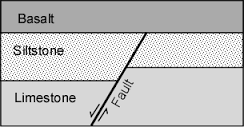
What are the relative ages of the features in order from oldest to youngest?

a)

Limestone, Basalt, Fault, Siltstone

b)

Siltstone, Fault, Basalt, Limestone

c)

Limestone, Fault, Basalt, Siltstone

d)

Limestone, Siltstone, Fault, Basalt

7.
Relative dating of rock layers tells us that the deeper we dig, _______.
a)
the younger the rocks get
b)
the smellier the rocks get
c)
the harder the rocks get
d)
the older the rocks get
8.
The Law of Superposition helps scientists to determine what?
a)
The absolute age of rock layers
b)
The age of fossils
c)
The relative age of rock layers
d)
the super powers of rocks
9.
The Geologic Time Scale is a record of what?
a)
old geologists
b)
sweet geology music
c)
the known history of rocks and fossils
d)
a list of every living thing ever
10.
According to the law of superposition, the oldest fossils are found 
a)
At the top of the rock layers
b)
Near the bottom of the rock layers
c)
In the middle of the rock layers
d)
Somewhat near the surface
11.
Which rock layer in the diagram seems to be the oldest?
a)
F
b)
E
c)
B
d)
A
12.
According to the law of superposition, which layer is the youngest?
a)
A
b)
B
c)
C
13.
Gaps in rock layers caused by erosion are called
a)
law of superposition
b)
unconformities
c)
uniformitarianism
d)
relative dating
14.
Which of the following is the oldest?
a)
Layer L
b)
Intrusion D
c)
Intrusion H
d)
Layer E
15.
Which of the following correctly lists the layers in order from oldest to youngest?
a)
A, B, C, D, E
b)
E, B, C, D, A
c)
E, D, C, B, A
d)
C, B, A, D, E
16.

Which property of fossils allows scientists to determine the relative ages of rock layers?

a)

Fossils form from the remains of living things

b)

Fossils can be analyzed to determine their exact ages

c)

Index fossils are widely distributed and existed for a short period of time.

d)

Fossils are usually found in sedimentary rock

17.
How do scientists use fossils to determine the relative ages of rock layers?
a)
by comparing all the fossils in one rock layer
b)
by comparing fossils in many different rock layers
c)
by determining the positions of fossils in many different rock layers
d)
by locating other areas of the world where the same fossils are found
18.

How does sedimentary rock usually form?

a)

Vertically

b)

Diagonally

c)

Folding

d)

Horizontally

19.

What is the process that geologists use to identify the number of years that have passed since the rock has formed?

a)

A. Relative age

b)

B. Absolute age

c)

C. Radioactive dating

d)

D. Law of Superposition