wayground logo

Free Printable Worksheets

NEW

Font size

S
M
L
XL
Worksheets

Fossils and Rock Strata

Total questions: 21

Worksheet time: 21mins

Name
Class
Date
1.
Which layer formed first?
a)
Rock Layer W
b)
Rock Layer X
c)
Rock Layer Y
d)
Rock Layer Z
2.
Fossils give us evidence about which of the following?
a)
plants and animals that lived long ago
b)
how weathering and erosion break down rocks
c)
the other planets in our solar system
d)
the transfer of energy from one form  to another
3.
Finding the fossils of trees in an area that is currently a desert without much life might tell us that the area, millions of years ago - 
a)
was heavily eroded by strong winds
b)
received enough rain to support a forest
c)
suffered very powerful earthquakes
d)
was destroyed by the impact of meteorites
4.
The breakdown of rock into smaller particles from the effects of wind, water and ice
a)
erosion
b)
cementation 
c)
pressure
d)

deposition

5.
Sediment that is left behind in rivers lakes and oceans
a)
weathering
b)
erosion
c)
cementation
d)
deposition
6.
Preserved parts or traces of animals and plants that lived in the past
a)
natural gas
b)

footprints

c)
photos
d)
fossils
7.

Which rock layer most likely contains fossils of the most recently evolved organisms?

a)

1

b)

2

c)

3

d)

4

8.
Finding fossils of coral reefs in the Nevada desert provides evidence that:
a)
Nevada used to be much colder than it is today
b)
an ocean once covered what is now Nevada
c)
there was a mistake because no coral reefs exist in deserts
d)
ancient corals used to live on land
9.
The diagram shows fossils in different rock layers. Which of these statements about the age of these fossils is most likely correct?
a)
Fossil A and C are the same age
b)
Fossil B is older than fossil C
c)
Fossils A is older than fossil B
d)
Fossil D is older than fossil C
10.
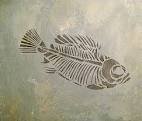
If scientists found this fossil, what could they infer?
a)
what fish are like today
b)
that this fish lacked oxygen
c)
what kind of animal ate this fish
d)
that water once covered the area
11.
Which layer is oldest?
a)
A
b)
W
c)
G
d)
Z
12.
Which layer formed first?
a)
Rock Layer W
b)
Rock Layer X
c)
Rock Layer Y
d)
Rock Layer Z
13.
What is the correct order of the rock layers from oldest to youngest?
a)
F, E, C, B, A, D
b)
A, B, C, D, E, F
c)
F, E, D, C, B, A
d)
D, F, E, C, B, A
14.

Which of these lists the fossils from oldest to youngest?

a)

A

b)

B

c)

C

d)

D

15.
Which area would a shark tooth most likely be found? 
a)
Area A
b)
Area B
c)
Area C
d)
Area D
16.

This area was most likely found

a)

At the top of a mountain

b)

Near an active fault zone

c)

Near an ocean or coastline

d)

By an active volcano

17.

This fern fossil is from the Grand Canyon and was found in the desert outside of Yuma. How did it get there?

a)

Weathering and erosion of the Colorado River carried it to Yuma.

b)

A rockclimber from Colorado dropped it in Yuma.

c)

Forest rangers spread fossils evenly around the United States for tourists to find.

d)

When Pangaea separated, the fossils were uplifted and deposited in the Yuma desert.

18.

Layers of rock found one on top of the other are called

a)

straight lines

b)

stratigraphy

c)

strata

19.

What could have caused the formation of layer D?

a)

Sea floor colliding

b)

An underwater trench

c)

A volcanic eruption

d)

Formation of a rift valley

20.

Studying the strata of the Earth can tell us

a)

how old animals are

b)

how old rock layers are

c)

how the Earth formed

21.

Does this diagram show evidence of earthquake activity in this area?

a)

Yes because the strata are all straight

b)

Yes because more than one layer is seen

c)

No because the strata are all straight

d)

No because more than one layer is seen