wayground logo

Free Printable Worksheets

NEW

Font size

S
M
L
XL
Worksheets

Oscillations

Total questions: 37

Worksheet time: 29mins

Name
Class
Date
1.
A mass attached to a spring vibrates back and forth. At the equilibrium position, the
a)
acceleration reaches a maximum.
b)
velocity reaches a maximum.
c)
net force reaches a maximum.
d)
velocity reaches zero.
2.
For a system in simple harmonic motion, which of the following is the number of cycles or vibrations in one second?
a)
amplitude
b)
period
c)
frequency
d)
revolution
3.
For a system in simple harmonic motion, which of the following is the time required to complete a cycle of motion?
a)
amplitude
b)
period
c)
frequency
d)
revolution
4.
Which position shows the spring with maximum kinetic energy?
a)
A
b)
B
c)
C
d)
D
5.
A mass is hung from a spring and set into vertical oscillation.
Which row in the table correctly shows the kinetic energy Ek of the mass at maximum displacement and the potential energy Ep of the mass at the equilibrium position?
a)
A
b)
B
c)
C
d)
D
6.
Which position shows the spring with maximum elastic potential energy?
a)
A
b)
B
c)
C
d)
D
7.

Which would have the longest period?

Pendulum A: A 200-g mass attached to a 1.0-m length string

Pendulum B: A 400-g mass attached to a 0.5-m length string

a)

A

b)

B

c)

Same

8.

In any system in simple harmonic motion, the restoring force acting on

the mass in the system is proportional to

a)

displacement.

b)

the length of a pendulum

c)

the mass

d)

frequency.

9.

In an oscillating mass-spring system, the velocity of the mass is greatest when the mass is

a)

at the point of maximum displacement

b)

halfway between the equilibrium point and maximum displacement

c)

at the point where acceleration is greatest.

d)

at the equilibrium point

10.

The period of a pendulum may be decreased by

a)

shortening its length.

b)

increasing the mass of the bob

c)

moving its equilibrium point

d)

decreasing the mass of the bob

11.

As the swinging bob of a pendulum moves farther from its equilibrium

position, the pendulum’s _______________ increases

a)

frequency

b)

mass

c)

restoring force

d)

length

12.

The gravitational potential energy of the bob of a swinging pendulum is

at its maximum when the bob is at

a)

maximum displacement

b)

the equilibrium point

c)

the center of its swing

d)

minimum displacement

13.

Stretching a spring increases its ______________ energy

a)

mechanical kinetic

b)

gravitational potential

c)

vibrational kinetic

d)

elastic potential

14.
If the length of a simple pendulum is doubled, its period will: 
a)
halve 
b)
increase by a factor of sqrt(2) 
c)
decrease by a factor of sqrt(2)
d)
double 
15.
The angle between the string of a pendulum at its equilibrium position and at its maximum displacement is the pendulum’s
a)
period.
b)
frequency.
c)
vibration.
d)
amplitude.
16.

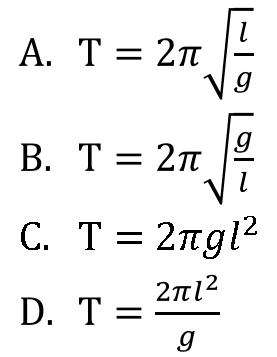
Based on your findings, which equation could best describe the pendulum’s period?

a)

A

b)

B

c)

C

d)

D

17.
Which of the following is not an example of SHM?
a)
A simple pendulum
b)
A vibrating spring
c)
A marble on a concave surface
d)
Bouncing on a trampoline
18.

Which of the following is/ are characteristics of simple harmonic motion?

I. The acceleration is constant .

II. The restoring force is proportional to the displacement.

III. The frequency is independent of the amplitude.

a)

II only

b)

I and II only

c)

I and III only

d)

II and III only

e)

I, II, and III

19.
What is the definition of the period of a pendulum?
a)
one oscillation
b)
the time taken for one oscillation
c)
the time for one swing back and forth
d)
swing from A to B to A
20.
What is the only thing that increases the period of a pendulum?
a)
increase the length of the pendulum
b)
decrease the length of the pendulum
c)
increase the weight of the pendulum bulb
d)
decrease the weight of the pendulum bulb
21.
A mass-spring system is set into simple harmonic motion. Which graph shows the variation of the acceleration, a, of the mass with its displacement, x? 
a)
A
b)
B
c)
C
d)
D
22.
How are frequency and period related in simple harmonic motion?
a)
They are directly related.
b)
They are inversely related.
c)
Their sum is constant.
d)
Both measure the number of cycles per unit of time.
23.

Define amplitude.

a)

maximum displacement from equlibrium position

b)

total displacement

c)

maximum distance from where the object is released

24.

what is the gradient of the acceleration-displacement graph represent?

a)

frequency

b)

angular displacement

c)

angular velocity

d)

square of angular frequency

25.
An object is attached to a vertical spring and bobs up and down between points A and B.  Where is the object located when its kinetic energy is a minimum?
a)
at either A or B
b)
midway between A and B
c)
one-third of the way between A and B
d)
one-fourth of the way between A and B
26.
An object is attached to a vertical spring and bobs up and down between points A and B.  Where is the object located when its kinetic energy is a maximum?
a)
at either A or B
b)
midway between A and B
c)
one-third of the way between A and B
d)
one-fourth of the way between A and B
27.
The diagram shows a velocity-time graph for a mass moving up and down on the end of a spring. Which point represents the velocity of the mass when at the lowest point of its motion? 
a)
A
b)
B
c)
C
d)
D
28.
A mass M hangs in equilibrium on a spring. M is made to oscillate about the equilibrium position by pulling it down 10 cm and releasing it. The time for M to travel back to the equilibrium position for the first time is 0.50 s. Which row, A to D, in the table is correct for these oscillations? 
a)
A
b)
B
c)
C
d)
D
29.
An object oscillating in simple harmonic motion has a time period T. The first graph shows how its displacement varies with time. Which of the subsequent graphs, A to D, show how the kinetic energy, Ek, of the object varies with time? 
a)
A
b)
B
c)
C
d)
D
30.
Which graph, A to D, shows the variation of the kinetic energy, Ek, with displacement x for a particle performing simple harmonic motion? 
a)
A
b)
B
c)
C
d)
D
31.
The time period of oscillation of a simple pendulum of length l is the same as the time period of oscillation of a mass M attached to a vertical spring. The length and mass are then changed.
Which row, A to D, in the table would give a simple pendulum with a time period twice that of the spring oscillations? 
a)
A
b)
B
c)
C
d)
D
32.
A mass is hung from a spring and set into vertical oscillation.
Which row in the table correctly shows the kinetic energy Ek of the mass at maximum displacement and the potential energy Ep of the mass at the equilibrium position?
a)
A
b)
B
c)
C
d)
D
33.

What is the effect of damping on resonance?

a)

decrease slightly the value of proper frequency.

b)

reduce the maximum amplitude of an oscillator.

c)

The shape of the curve of resonance becomes broad.

d)

All

34.

The curve of high damping is

a)

1

b)

2

c)

3

d)

no one

35.

An oscillator is said to be driven if a device allows, at regular intervals of time, to communicate energy to the oscillator to compensate losses due to friction.

a)

False

b)

true

36.

The curve that represents the free undamped oscillations is

a)
b)
c)
37.

In free damped mechanical oscillations:

a)

The object oscillates with a decreasing amplitude.

b)

The object oscillates with a period called the pseudo-period T.

c)

The pseudo-period T is slightly greater than the proper period T0 .

d)

All