
NEW
Font size
 Worksheets
Pneumatic Circuits - Practice Test
Total questions: 42
Worksheet time: 1hrs 24mins
What is a pressure of 2000 N/m² equal to in units of kiloPascals?
2 kPa
20 kPa
200 kPa
2000 kPa

If the lever of the directional control valve shown is shifted to the right (as indicated by the large arrow), in what direction will air flow in this pneumatic circuit?
Port P to Port B
Port EB to Port A
Port B to Port EA
Port B to Port EB
What method of lubricating pneumatic components mixes the lubricant with the compressed air?
Oil injection
Forced draft
Aerosol
Oil cup
What method is most commonly used to determine the flow rate of lubricant being dispensed by an air mist lubricator?
External flow control setting
Lubricant level in bowl
Pressure gauge reading
Drip rate shown in sight dome
In a compressed air system, what carries lubricant from an air lubricator to the points of use?
Water droplets
Dust particles
Air flow
Oil lines
When should lubricant be added to a pneumatic lubricator?
The sight feed dome of the lubricator is under 50% level.
The lubricator drip rate slows.
The oil level in the lubricator bowl is below the end of the suction tube.
The oil level in the lubricator bowl is below the minimum level line.
What is Delta P?
Pressure difference between absolute and gauge pressure
Pressure difference between the cylinder and the rod
Pressure difference between two points in a pneumatic system
Pressure difference between three points in a pneumatic system
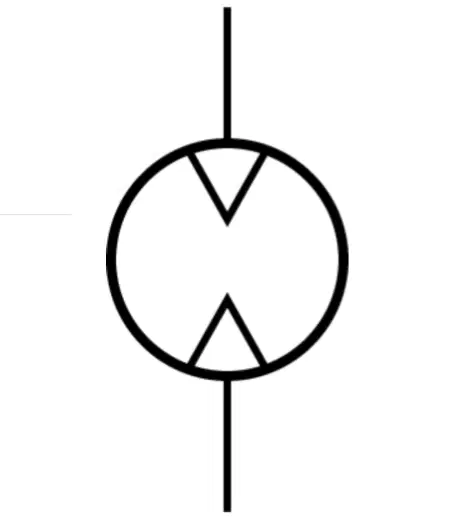
Which schematic symbol is shown?
Conditioning device
Air motor
Restriction
Junction
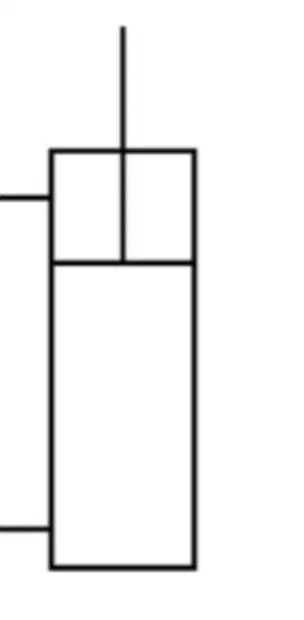
Where is the cap located?
At the top
At the bottom
Why should you avoid blocking a pressurized air line with your fingers or hands?
The air can penetrate the skin.
You could damage the line.
The line would not be properly secured.
Your finger can contaminate the air supply.
How many connection ports does the body of a single-acting, spring-return cylinder have?
None
One
Two
Four
How many connection ports does the body of a double-acting cylinder has?
None
One
Two
Four
What is the impact of air friction resistance in a pneumatic system?
Actuator speed increases.
Air pressure increases as air flows through the system.
Air pressure drops as air flows through the system.
Actuator load decreases.
How does a meter-out flow control circuit control the speed of an actuator?
Exhausts excess air.
Restricts the air that flows into the actuator.
Applies back pressure to the actuator.
Reduces the supply pressure.
What is the function of a needle valve in a pneumatic circuit?
Regulate pressure.
Block flow in one direction.
Measure flow rate.
Control flow rate.
What happens if the air temperature in a pneumatic system drops below the dew point?
Air friction increases.
Condensation forms.
Pipes will freeze.
Decrease in compressor performance.
What device is most often used to automatically turn off a reciprocating air compressor when the system demand for air stops?
Pressure switch
Flow switch
PLC output
Pushbutton switch

What type of flow control circuit is shown?
Meter-in retract
Meter-out retract
Meter-in extend
Meter-out extend
What is placed between the valve and ports on a subplate to prevent leakage when installing the subplate?
Machined plugs
Teflon rings
Teflon tape
O-rings
Which of these parts is contained in a pneumatic flow control valve?
Check valve
Regulator
Spool
Solenoid
When does industry typically use quick-connect fittings?
Whenever possible.
When low cost is desired.
When the equipment is used at high altitudes.
When there is a frequent need to connect and disconnect a hose.
In an air compressor system, what is done with condensed water?
Used to rinse particles from the air filters.
Recycled to add moisture to the air.
Drained from the system.
Used in the aftercooler to cool the air.
What function is built into many pneumatic directional control valves to operate the valve if the controller fails, or to test actuators during machine setup?
Manual override
Remote piloting
Spooling
Pneumatic centering
What device is most commonly used to automatically turn off a reciprocating air compressor when the system demand for air stops?
Pressure switch
Flow switch
PLC output
Pushbutton switch
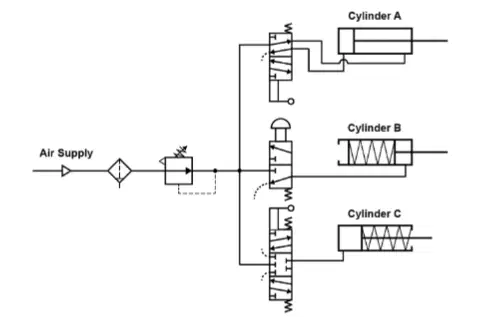
Which cylinder does not require air pressure to extend?
Cylinder A
Cylinder B
Cylinder C
None
What setting on a compressor pressure switch must be adjusted to keep the compressor from constantly cycling?
Deadband
Maximum pressure
Minimum pressure
Flow rate
What is the volumetric flow rate in units of m³/hr if 1.0 cubic meter of air passes a measurement point in 30 seconds?
30 m³/hr
15 m³/hr
120 m³/hr
60 m³/hr
What type of pneumatic conductor connects the compressed air source to the control devices?
Actuator line
Supply line
Exhaust line
Control line
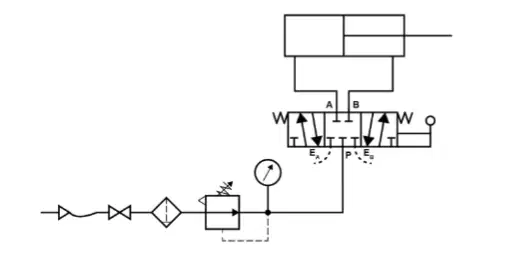
What type of directional control valve is shown in the schematic?
2-way, 3-position
3-way, 2-position
4-way, 3-position
5-way, 3-position
What method do most small air compressors use to compress air?
Impeller rotation
Inlet and discharge valve movement
Screw rotation
Piston movement
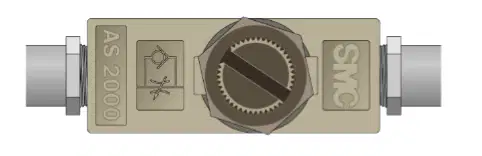
In the flow control valve shown, which direction allows free flow?
Right to left
Left to right
Both directions
Neither direction
Why should any device or hose containing compressed air be properly secured?
To avoid losing the item.
To prevent the item from whipping.
To avoid contamination.
So you can quickly turn up the pressure.
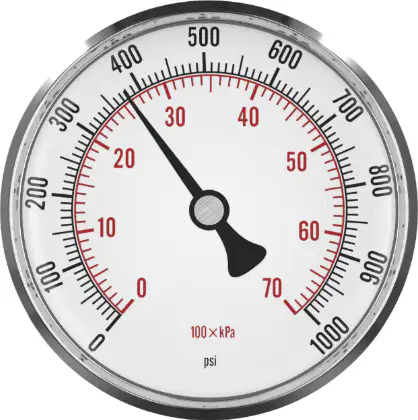
What is the reading on this pressure gauge?
26 psi
380 psi
26 kPa
260 kPa
What is a common type of SI unit used for the graduations of a pressure gauge?
Kilo Pascals
Kilo per cm
Newtons per mm
Pascals per Square meter
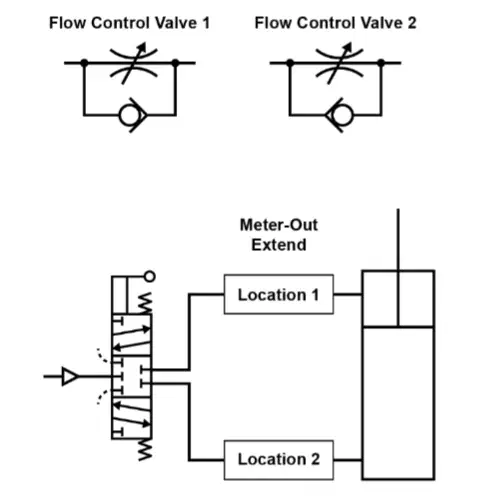
To create a meter-out flow control circuit when the cylinder extends, which valve would you use and where would you place it?
Valve 1 in location 1
Valve 2 in location 1
Valve 1 in location 2
Valve 2 in location 2
What are the main factor(s) that affect pneumatic cylinder speed?
Load only
Load and piston size
Load, piston size and stroke length
Load, piston size and piston delta P
What are the power output devices in a pneumatic system called?
Compressors
Conductors
Valves
Actuators
When a double-acting cylinder is extending or retracting, the cylinder load includes the load to be moved, internal mechanical friction of the cylinder, and which of these other effects?
Back pressure
Front pressure
Pressure loss
Spring compression
If a pressure gauge in a pneumatic circuit reads a gauge pressure of 480 kPa (69.62 psig), what is the absolute pressure in the circuit assuming the circuit is at sea level?
379 kPa (54.97 psig)
480 kPa (69.62 psig)
581 kPa (84.27 psig)
682 kPa (98.92 psig)
What does a dashed line in a pneumatic schematic represent?
Main line
Exhaust line
Enclosure
Pilot line
What do MOST industrial pneumatic systems use to transmit energy?
Water
Petroleum
Air
Pure Nitrogen
When should an air filter be drained?
When any amount of fluid is trapped in the filter element.
When the filter element is clogged with dirt.
After the fluid in the bowl reaches the top of the baffle.
Before the fluid level in the bowl reaches the bottom of the baffle.

