
 Worksheets
Population Ecology
Total questions: 25
Worksheet time: 25mins

The common brushtail possum is a marsupial native to Australia. This possum was introduced to New Zealand where it had no natural predators and had an abundant food supply. Which of these likely occurred a few years after the introduction of this possum to New Zealand?
The possums became extinct.
The possums developed shorter life spans.
The possum population grew to a larger size.
The possum population evolved into a different species.
Processes that remove individuals from a population.
death and emigration
birth and immigration

What type of growth is represented in this graph?
exponential
logistic
survivorship curve
predator-prey

What is the carrying capacity of the following graph?
1000
8000
800
600
Which of the following populations is most likely to go extinct?
a very small population in an unstable environment
a moderate-sized population of r strategists
a large population with lots of genetic variability
all would be equally likely to go extinct
How many types of survivorship curves are there?
1
2
3
4
A good way to estimate the population size.
mark-recapture
count everyone of them
satellites
cameras

Refer to the diagram of the survivorship curve.
Which curve best describes an organism that invests a lot of energy in parenting?
A
B
C
this is not a survivorship curve
Which best describes the graph of logistic growth?
S-shaped
J-shaped
W-shaped
U-shaped
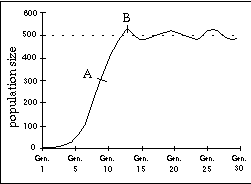
What is the carrying capacity of the graph?
around 500
more than 800
less than 300
around 700

What is the largest number of individuals that an environment can support long term?
carrying capacity
emigration
immigration
survivorship

Describes organisms with a high death rate (or low survivorship rate) immediately following birth. Examples include bacteria, fishes, and invertebrates.
Type I
Type II
Type III
Type IV
The average number of individuals per unit of area or volume is called ______.
Population size
Population systematics
Population density
Population distribution
If birth rate plus immigration exceeds death rate plus emigration, a population _______.
grows
declines
stays the same
none of the above
The lion is the natural predator of the zebra. If the zebra population drops, what will likely happen to the lion population?
drop
thrive
be unaffected
decrease, then increase exponentially
Under ideal conditions with unlimited resources, a population will have ________.
linguistic growth
experimental growth
exponential growth
logistic growth
These organisms occupy stable environments, are larger in size and have longer life expectancies. They produce, during their life spans, fewer offspring, but place a greater investment in each.
k-strategist
r-strategist
m-strategist
s-strategist
These organisms typically live in unstable, unpredictable environments & are able to reproduce rapidly (exponentially). They do not take care of their young & are subject to predation.
k-strategist
r-strategist
m-strategist
s-strategist
Which of the following are density independent factor(s)?
competition for resources
predator-prey relationships
parasitism and disease
weather, natural disaster and man made disturbances

What term is used to define anything that regulates the size of a population?
density
a limiting factor
carrying capacity
biodiversity

Which of the following would INCREASE the carrying capacity of an ecosystem?
increase in predators
disease
increase in available food
drought
Which of the following is a density-dependent factor affecting population size?
A) Natural disasters
B) Disease
C) Climate change
D) Habitat destruction
What is the carrying capacity of an environment?
A) The maximum number of individuals an environment can support
B) The minimum number of individuals needed for a population to survive
C) The average number of offspring produced by an individual
D) The rate at which a population increases
In a mark-recapture study, 100 fish are captured, marked, and released. Later, 100 fish are captured again, and 10 of them are marked. What is the estimated population size?
A) 1000
B) 500
C) 100
D) 200
Which of the following best describes a population experiencing exponential growth?
A) The population size increases at a constant rate
B) The population size increases rapidly and then stabilizes
C) The population size doubles at regular intervals
D) The population size decreases over time

